pudgy heads of state

The standard of “beauty” for men is clearly different.  Not that anyone is calling these men beautiful, but I highly doubt that Hillary Clinton or Sarah Palin would have risen to the top of the political arena if they were “fat.”  Too bad Sarah Palin’s not fat…

Hail to the Chef: 4 American Presidents Who Loved to Eat

Feeding an appetite for power rarely fills a guy’s belly. These four pudgy heads of state were as happy raiding the pantry as they were creating policy.

Grover Cleveland: The Glass is Always Half Empty

Large, jovial Grover Cleveland – also known as “Uncle Jumbo” – enjoyed his beer. In 1870 (15 years before he became president), Grover ran for district attorney of Erie County, New York, against Lyman K. Bass. It was a friendly contest. In fact, it was so friendly that Cleveland and his opponent drank and chatted together daily. In the interest of moderation, they agreed to have no more than four glasses of beer per day. But soon they exceeded that and started “borrowing” glasses from the next day and the next day until they’d exhausted their ration for the whole campaign – with the election still weeks away. The solution: Each brought his own giant tankard to the tavern, called it a “glass,” and went back to the four-a-day ration.

An Extra-Cuddly Teddy

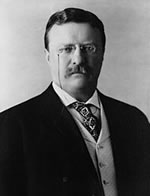
The standard scoop on Teddy Roosevelt was that he was a scrawny, sickly weakling from New York City who built himself up into a rough, tough cowboy type through vigorous outdoor pursuits. What’s seldom mentioned is that Roosevelt went from skinny boy to robust young man to plump (though vigorous) president to obese (though still active) ex-president. While running on the Bull Moose Party ticket in a 1912 attempt to regain the White House, Roosevelt was described as “an eager and valiant trencherman” (it meant he ate a lot). If the main course was roast chicken, TR would consume an entire bird himself, in addition to the rest of the meal. Not to mention the four glasses of whole milk the portly prez routinely threw back with dinner. Photos and films show an aging Roosevelt carrying a decidedly wide load.

W.H. Taft and His Presidential Privileges

William Howard Taft often dieted because his doctor and his wife told the 290-pound president that he must. But without supervision, Will “the Thrill” didn’t just give in to temptation, he sought it. Once while traveling he asked a railroad conductor for a late-night snack. When the conductor said there was no dining car, Taft angrily called for his secretary, Charles D. Norton, who had probably – under instruction from Mrs. Taft – arranged for the diner to be unhooked. Norton reminded the president that his doctor discouraged between-meal eating. Taft would have none of it. He ordered a stocked dining car attached at the next stop and specified that it have filet mignon. “What’s the use of being president,” he said to Norton, “if you can’t have a train with a diner on it?”

Bill Clinton: With an Assist from Helmut Kohl

President Bill Clinton, who famously frequented McDonald’s, was known for eating whatever was put in front of him. He showed a more discriminating, if just as hungry, side in the company of Germany’s chancellor Helmut Kohl, though. Kohl was called “Colossus,” at least in part because he carried 350 pounds on his 6-foot-4 frame. But, in Kohl, Clinton found a gourmand soul mate. In 1994, Clinton hosted the chancellor at Filomena Ristorante of Georgetown for a lunch at which both consumed mass quantities of ravioli, calamari, and red wine, as well as plenty of antipasto, buttered breadsticks, Tuscan white bean soup, salad, and sweet zabaglione with berries. Each ended the meal by ordering a large piece of chocolate cake to go. Clinton once remarked that he and his German counterpart, though the largest of world leaders, were still too slim to be sumo wrestlers.

the world’s prime aesthetic object

I think this article is brilliant and I think that everyone should read it.  So, here you go, everyone!

Women and body image: a man’s perspective

Ever wondered why a man can look at an advert featuring a six-pack and laugh, while a woman might look at a photograph of female perfection and fall to pieces? William Leith thinks he might have uncovered the answer

By William Leith

Plenty of guys have told me this story. The guy in question is preparing to go to a party with his girlfriend. She is trying on shoes and dresses. He is telling her how good she looks. She tries on more shoes, more dresses. And then: the sudden, inexplicable meltdown. She crumples on the bed. Something is horribly wrong. Now the party is out of the question.

At this point the other guys will say, ‘Yeah – she looks great.’ And: ‘She looks fine.’ And: ‘I saw her the other day, wearing those shorts.’ And: ‘She is hot.’ Then the first guy will say, ‘That’s what I kept telling her. And that’s when she got really upset. She said, “You just don’t understand.”‘

It’s true – men, by and large, do not understand. In her book The Beauty Myth, Naomi Wolf made this point very powerfully. When a woman has a crisis of confidence about the way she looks there is nothing a man can do to console her.

‘Whatever he says hurts her more,’ says Wolf. ‘If he comforts her by calling the issue trivial, he doesn’t understand. It isn’t trivial at all. If he agrees with her that it’s serious, even worse: he can’t possibly love her, he thinks she’s fat and ugly.’

But it doesn’t stop there, says Wolf. What if the man were to say he loves the woman just as she is – that he loves her for her? An absolute no-no, of course, because then ‘he doesn’t think she’s beautiful’. Worse still, though, if he says he loves her because he thinks she’s beautiful.

There’s no way out. It seems to be, in Wolf’s words, ‘an uninhabitable territory between the sexes’. So why don’t men understand? And, given a bit of education, can the situation be improved?

Well, I’m a man, so let’s see. The first thing to say is that, when it comes to their bodies, men have a completely different attitude. I’m not saying they don’t think about their bodies, or worry about them, because they do. But men relate to their bodies in a simple way.

A man’s body is either fine, or it’s not fine. For a man, the body is a practical object. It’s a machine. Sometimes it works well; sometimes it needs fixing. Some guys know how to fix it, by taking up a sport, maybe, or cutting down on the carbs. Some don’t, and go to seed.

Men see their bodies as machines because, for most of their time on this earth, they have defined themselves as hunters and protectors. They equate being attractive with being strong and fast and muscled. That’s a simple concept, isn’t it? And that simplicity is hard-wired into the male brain.

When his girlfriend has a meltdown, and says she hates her body, that is not a simple concept. Unlike men, women do not have a simple relationship with their bodies. They have a complex relationship with their bodies. This is what men often don’t understand. When it comes to their bodies, women are extremely vulnerable – and, what’s more, lots of people take advantage of that vulnerability. This makes the situation worse.

Men don’t have to contend with this – the hair people, and the make-up people, and the fashion people, and the shoe people, and the bra people, and the nail people, and the eyelash people, and the Botox people, and the cosmetic surgery people, and the perfume people, and the hair-removal people. Oh, and the diet people.

Men are not at the mercy of corporate manipulation on remotely this scale. Sure, there are six-packs creeping into our field of vision every so often. And, sure, this is making us feel insecure. I know – I was fat, and it’s no fun being fat, especially with all those pictures of Brad Pitt nagging away.

And then there are the adverts for Lynx, and the Reebok advert in which a man is chased around town by a big fat hairy belly. But for men the message is very direct. Buy some running shoes. Go to the gym. Cut down on the carbs. For men there is no mystery behind the veil of the adverts. You either tackle the situation, or become a fat slob. End of story.

For men the holy grail is within reach – you just need to get fit, and then you’ll be fine; then you can think about something else. But the messages aimed at women are much more complex and confusing. As the American social commentator Warren Farrell has pointed out, women’s magazines often contain articles about being Superwoman, which are next to adverts about being Cinderella.

In other words, the words tell women how to be independent and in control. But the adverts, where the money is, tell them they have to be beautiful.

Farrell said this more than two decades ago – and, shockingly, nothing has changed. There’s a solid pulse running through everything our culture aims at women – be beautiful, be beautiful, be beautiful.

But being beautiful, it turns out, is a near-impossible task. It keeps getting harder and harder. Everybody knows that it entails being slim – and every year the ideal gets slimmer and slimmer. In 1960 the average model weighed 10 per cent less than the average woman. Now she weighs 25 per cent less. Soon she will weigh 30 per cent less. But she doesn’t have the breasts of a skinny woman – nor, as Susie Orbach has recently pointed out, the bottom. To achieve the ideal is vanishingly impossible.

And it’s getting worse. Orbach believes that we are exposed, on a weekly basis, to several thousand images that have been digitally manipulated. And this, in turn, makes more women opt for cosmetic surgery – which, of course, moves the goalposts even farther away.

When lots of people have surgery to make themselves look more beautiful this has the effect of making everybody else feel less beautiful. And this is happening on a global scale – in 2007 people spent £9 billion on cosmetic surgery; the vast majority of them, of course, were women.

So: men are told they should aspire to fitness and strength, and women are told they should aspire to something more nebulous. But that still does not explain, in terms a man could understand, why the female message is so much more powerful and disturbing.

It doesn’t explain why a tenth of women are anorexic, why a growing number are bulimic, why almost half of women, at any given time, are on a diet. It doesn’t quite explain the meltdowns. And it doesn’t explain why women want to be so skinny. Why they think they are fat, when they are not. It doesn’t explain why, when a woman’s body is perfectly attractive, she often thinks it isn’t, and can’t be persuaded otherwise.

In short, it does not explain why a man can look at an advert featuring a six-pack and laugh at it, whereas a woman might look at a picture of Gisele Bündchen and feel a sense of unease that hangs around for days.

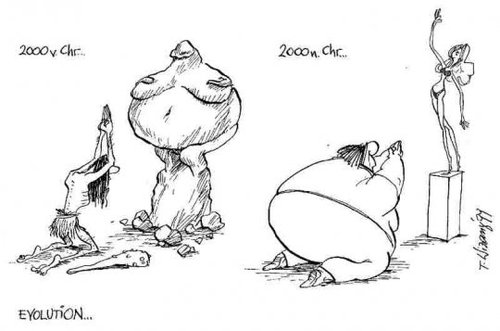
John Updike once said that the female body is the world’s prime aesthetic object – we look at it more than we look at anything else, including landscapes, gadgets, cars. In fact, cars and gadgets are often designed to resemble the female body, and landscapes can be painted to remind us of it. When we talk about ‘the nude’ in art we are almost certainly referring to the female nude. As far as nudes are concerned, the male nude is a distant runner-up.

I once wrote the introduction to a book of male nudes by the photographer Rankin; it was a sequel to his previous book of female nudes. One thing struck me above all – male nudes were a much, much harder thing to portray than female ones.

That’s because the female body carries with it a huge weight of iconic significance – thousands of years of being looked at. The female body has meaning. Pictures of the female body can be profound, serious and complex. For thousands of years they have been depicted with reverence. Now imagine having one of those bodies. It puts a bit of pressure on, doesn’t it?

Now I’m beginning to see why women might be so addicted to perfection. They have a lot to live up to – a couple of thousand years of art history, and a couple of thousand airbrushed boobs and bums to deal with every week.

But what started this off in the first place? Why aren’t there so many airbrushed pictures of men around? Of course, these pictures do exist, and their numbers are increasing. But why are women so much more vulnerable to pictures of perfect bodies than men?

In his book The Evolution of Desire, the American psychologist David Buss goes some way towards explaining why this should be so. Since the Stone Age, he explains, men and women have had different attitudes towards sex. Men can pass on their genes with very little risk – all they need is a fertile woman.

But it’s different for women, because pregnancy is incredibly risky. What women need is a man who looks like a good provider – better still, who looks like a proven provider.

So let’s think about our Stone Age man and woman. If he’s going to settle down, and stop playing the field, he wants one thing above all – a woman who looks fertile. More than that, he wants a woman who looks as if she’ll be fertile for many years to come. In other words, he might consider being a provider and protector, as long as his mate looks young, fertile and unblemished.

And now consider his mate. What does she want? Not just a man who is a good hunter and a good fighter, but a man who has a track record as a hunter and fighter. In other words, an older man. And this is not only true of Stone Age couples. In a survey conducted by David Buss, 10,000 people, in 37 cultures, were polled. ‘In all 37 cultures included in the international study on choosing a mate,’ writes Buss, ‘women prefer men who are older than they are.’

Now I’m getting close to understanding why women are so critical of their bodies. Since prehistoric times they have had a hard-wired link to how they look. For tens of thousands of years it was crucial; it could be the difference between having a protector and not having one – between life and death, even.

For men it’s not the same at all. The odd wrinkle or grey hair doesn’t matter. Hell, it might even be an advantage. As long as you’re good at throwing spears and building shelters, you’ll be fine.

Twenty thousand years on, what has changed? Well, as David Buss points out, it’s unlikely that a Stone Age man would have seen ‘hundreds or even dozens of attractive women in that environment’. But now, when he looks at a Playboycentrefold, he is seeing a woman who has competed with thousands of other women for the part – not only that, he’s seeing the best picture out of thousands.

And it’s not just centrefolds, is it? Just look at newsreaders – mostly, it’s a pretty girl and a grey-haired man. Message to men: relax. Message to women: panic! And then there are the girl groups, and the short-skirted girl onCountdown, and even the characters in the Harry Potter films, where the boys are allowed to look like geeks but the girl must look like a model.

As the art critic John Berger wrote: ‘Men look at women. Women watch themselves being looked at. This determines not only the relations of men to women, but the relation of women to themselves.’ It’s a tough one, isn’t it?

Surely guys can understand that, at least. If it happened to us, we’d have a meltdown, too.

SOURCE
decreasingly on the rise

This article raises more questions for me than it imparts information.  That may be it’s purpose.  I want to know why there is a decrease in the rate of increase of interracial marriages.  Ever since my “a-ha” moment surrounding my biracialness, I’ve been super-interested in the greater number of white women/black men couplings as opposed to black women/white men.  I realized on that day that having a black mom/white dad made me a “minority” within a “minority” within a “minority” (and a majority?).  What!?  I don’t even like the word minority.  Let’s use anomaly.  I perceive myself to be an anomaly within an anomaly.  That’s better.  Anyway, I would love to conduct a study on why exactly the trend in gender and race of black/white couples is as it is.  Lastly, what really stands out to me in the information below is that U.S. born Hispanics and U.S. born Asians are marrying (I assume) U.S. born whites.  What does this mean?  Americans are marrying Americans.  That should be the paradigm that we as a nation collectively shift toward.  Race doesn’t exist. Nationality does.

Interracial Marriage: Who is More Likely to Wed Outside Their Race?

by Lynnette Khalfani-Cox

Interracial marriages are on the rise in the U.S., although they’ve slowed somewhat over the past decade. The latest census figures show that interracial marriages in America now account for 8 percent of all marriages, up from 7 percent in 2000. During the decade from 1990 until 2000, there was a sharp increase in mixed-race marriages, with such couplings growing by 65 percent. Since the year 2000, however, mixed-raced marriages have grown by just 20 percent to about 4.5 million couples.

Looking at the data over the past three decades, which groups are more likely to marry outside their race? According to federal statistics, African Americans are three times more likely to marry whites than they were back in 1980. Some attribute this to an increase in African American educational attainment and more professional interaction among blacks and whites.

Other findings from the census data include:

*14.5 percent of black men and 6.5 percent of black women now marry whites

*38 percent of U.S.-born Hispanics marry whites, compared with 30 percent in 1980

*40 percent of U.S.-born Asians marry whites, a number unchanged since 1980

It would have been interesting to see other data that looked at interracial couples of all kinds, not just a look at which “minority” groups marry whites. In this sense, this data is skewed and rather limited when talking about the full scope of interracial marriages.

We all know that the world is fast becoming multicultural, global in nature and interdependent in numerous ways. From the adventurous traveler who meets and marries someone of a different race and culture in another country to the investor who buys stocks and bonds from companies all around the globe, the world is at once becoming smaller, yet bigger and with more possibilities.

The challenge going forward will be how do we deal with the social, economic and political realities of living in an increasingly multiethnic, interracial society? And will we ever get to a point where race will simply cease to matter — all matters personal, professional and otherwise?

SOURCE

yesterday’s history

When I started reading this article I thought, “This is about to be some ‘tragic mulatto’ b.s.”  Much to my surprise, it isn’t really.  I think Sarah played the part of the tragic mulatto very well, and got exactly what she wanted and deserved.  I wonder if the congregation’s response would have been different if “Pinky” hadn’t been quite so pink, but maybe “Brownie” instead.  Just a thought.  I also like this piece of our history because once upon a time, in a former life in which I considered myself black, I was a nanny and I worked in Brooklyn Heights and I walked by that church every day and was very drawn to it.  Part of me knew… And part of me was so clueless.

On This Day in History: June 1
Rev. Beecher’s Freedom Auction

by Vernon Parker

VIA

On June 1, 1856, Henry Ward Beecher, minister of Plymouth (Congregational) Church, and an ardent supporter of the antislavery cause, held a public “auction” of a young mulatto slave named Sarah to dramatize the evils of slavery.

The Brooklyn Daily Eagle reported that “she had been brought from a plantation near Staunton, Virginia.” When Sarah was called to the pulpit, she … “walked slowly, head bowed, and took a seat near the famous minister. She lifted her eyes, stared at the spellbound audience, and burst into sobs. Her plight tugged at the heart of the most stolid Congregationalist as Beecher’s inflamed rhetoric described her life. Daughter of a well-known white citizen, she had been put up for sale by her own father. The slave dealer involved contacted Beecher through a mutual friend and they struck a deal allowing Sarah to go north with the promise of either her return or the full manumission fee.”

The mock auction raised sufficient funds to purchase her freedom and buy her a modest home in Peekskill, New York.

The following is an excerpt from James H. Callender’s book Yesterdays on Brooklyn Heights: “As the anti-slavery agitation increased, Mr. Beecher thundered his invectives against the slave-owners of the South, and many of the leading men of his church were said to be directors of the famous ‘Underground Railroad’ by which fugitive slaves were passed along from the South across the border to Canada. It was at the close of one of his most powerful sermons that Mr. Beecher said he had a little matter he wished to present to the congregation. No one had any idea as to what he was going to say and the people waited in profound silence.

“He then suddenly burst forth, ‘Sarah, come up here!’ As the audience gazed, a little mulatto girl arose in the body of the church, ran up the pulpit steps and took Mr. Beecher’s hand. Turning to the assembled multitude, he said — ‘This little girl is a slave, and I have promised her owner $1,200, his price for her, or she will be returned to slavery. Pass the baskets.’ A scarcely stifled sob arose from the almost three thousand present. Bills of all denominations, jewelry, and watches and chains were flung in the overflowing baskets and when the total was counted, Mr. Beecher announced, amid thunders of applause, that Sarah was free, and enough remained to strike the shackles from the limbs of several others.”

A tintype of Sarah, also known as “Pinky,” the young mulatto slave whose freedom was “auctioned” by Rev. Henry Ward Beecher.

a fearless champion

I knew nothing of Evelyn Cunningham before her death.  Shame on me.  All I know now is that in the name of Evelyn, in the name of Lena, and in the name of the nameless:  I have got to do better.  I’m posting segments of the New York Times obituary of Ms. Cunningham and what I presume to be one of the last interviews with her that appeared in the NY Daily News in November of 2009.  For whatever reason, today I am particularly struck by what she said about her four husbands.  I feel a feminist kick coming on…

2009-12-14-cunningham.jpg

Evelyn Cunningham, a civil-rights-era journalist and later an aide to Gov. Nelson A. Rockefeller of New York, died on Wednesday (April 28th, 2010) in Manhattan. She was 94 and lived in Harlem most of her life.

At a time when few women worked at newspapers — never mind as reporters handling hard news — Ms. Cunningham covered many of the civil rights era’s biggest stories, including the battle over school desegregation in Birmingham, Ala., and the work of the Rev. Dr. Martin Luther King Jr. and Malcolm X.

Starting in 1940, she worked for more than 20 years as a reporter and editor for The Pittsburgh Courier, a black newsweekly with nationwide circulation. Much of that time she worked out of the paper’s New York office.

In the newsroom, she was nicknamed “Big East,” partly because of her height, 5-foot-11 in heels. She also became known as the “lynching editor,” a reference to her reporting on such killings in the segregated South.

…Ms. Cunningham entered another realm of public life in the late 1960s, when she took a job as special assistant to Governor Rockefeller, who had been impressed with her when she interviewed him as a candidate.

Governor Rockefeller named her to lead an office on women’s affairs, and she later served on many government panels dealing with women’s rights and community issues. She continued to advise him when he became President Gerald R. Ford’s vice president.

Evelyn Elizabeth Long was born on Jan. 25, 1916, in Elizabeth City, N.C., the daughter of a taxi driver and a dressmaker. She moved with her parents to New York as a child, and earned a bachelor’s degree from Long Island University. She had no children.

…Politically, Ms. Cunningham described herself as a “Rockefeller Republican,” Ms. Bell-Stevens said. “She said, ‘That means I’m a liberal Republican,’ and then she would add in more recent years that there hasn’t been a good one since.”

In a statement, Mayor Michael R Bloomberg, who appointed Ms. Cunningham to a commission on women’s issues in 2002, said, “With the passing of Evelyn Cunningham, all New Yorkers and all Americans who value our ideals of liberty and justice for all have lost a good friend and a fearless champion.”

…Ms. Cunningham married four times, taking the name of her third husband. Her fourth marriage was to Austin Brown, a Juilliard-trained pianist and watchmaker who died last year.

“Each one of my husbands tried to diminish my independence and my work,” Ms. Cunningham said in a profile in The New York Times in 1998. “They all loved me most while I was cooking — and I am not a good cook.”

Well-versed journalist Evelyn Cunningham writing piece on ‘unknown black history’

CLEM RICHARDSON

Monday, November 23rd 2009

VIA

She has interviewed and worked with some of the most historically significant people of the past 60 years; Nelson Rockefeller, Martin Luther King and Malcolm X, Sheriff Eugene (Bull) Connor, Supreme Court Justice Thurgood Marshall, and Presidents Richard Nixon and Gerald Ford.

Yet at 93 years old and after a journalism career that began in 1940 with the Pittsburgh Courier, it’s American women of all races who most impress Evelyn Cunningham.

“The women in my country, there does not seem to be anything they cannot be,” she said. “Presidents, heads of banks, millionaires. In the United States, women seem to gain or get practically everything they want.”

Seated on an overstuffed chair in the sunny study of her Riverside Drive apartment in Harlem, the television tuned to CNN, Cunningham said “I’m still a reporter, every inch of me.”

Though she doesn’t get out as much as she used to, Cunningham said she’s busy.

With the help of a group of local college students who do her leg work (“They think I’m this talky old lady,” she said.), she is writing and rewriting a piece on black history.

“I call it unknown black history, and there is a lot of it out there,” she said. “So much of black history is unknown, but even I am shocked to find out how much of it there is.

“Black people don’t even know what’s missing,” said Cunningham, who declined to give examples pending publication of her work. “That intrigues me to no end. Here I am part of a people who do not know much of their history.”

Cunningham honed her reporting skills covering lynchings in the South before and during the civil rights movement.

She was one of the first reporters to identify the Rev. Martin Luther King Jr. as a rising leader in the movement, and once asked Connor, who became infamous for using police dogs and fire hoses on peaceful demonstrators, for an interview.

He walked away.

Cunningham and several members of the Pittsburgh Courier staff of her era were awarded a George Polk Award in 1998 for the paper’s civil rights reporting.

After the civil rights era, Cunningham went on to hold a variety of civic and government positions, including special assistant to New York Gov. Rockefeller and on President Nixon’s Task Force on Women’s Rights and Responsibilities.

Having lived and worked in the segregated South – she was born in Elizabeth, N.C.- Cunningham said Barack Obama’s election “is hard to believe, hard to believe.

“No, I did not see it happening,” she said. “I never saw it, imagined it, or believed it, and here we got a black President.

“I met him right here in this apartment,” she said. “He came up to see me when he first visited the city. I adored him. He was a natural born leader.

“He is the greatest thing to hit our country.”

But if Cunningham could cover one story today it would not be local.

“I would go to Africa,” she said. “There is so much … I can only put it this way, dirty work going on there that even Africans don’t want people to know.

“That bothers me. It’s terrible and sad.”

re: previous posts

I’ve been meaning to post these things that have some correlation to a few of the week’s previous posts.  So now I’m doing it.

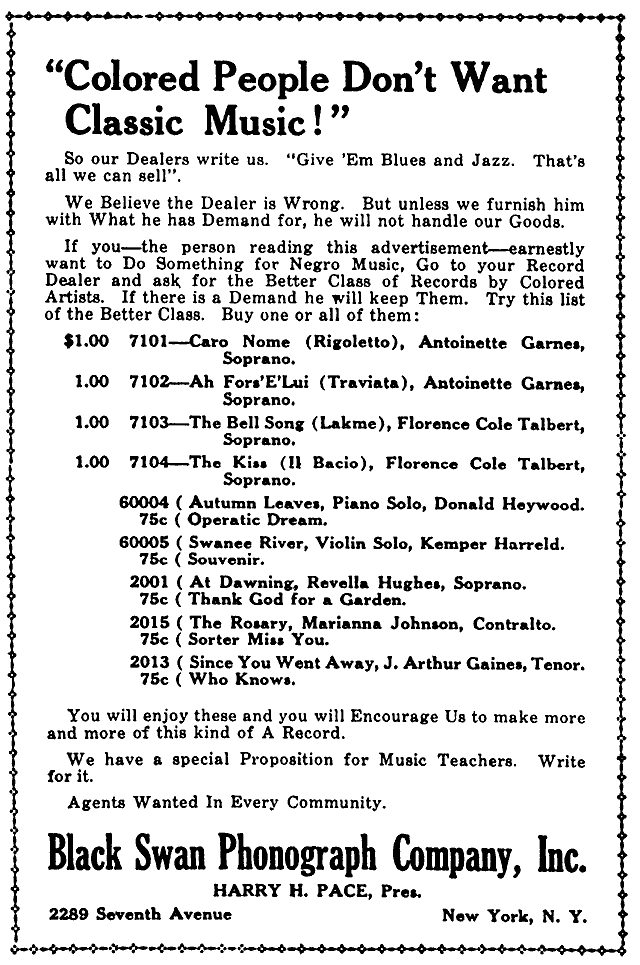
  • I think Philippa Schuyler and George Bridgetower help to disprove the theory that they were trying to disprove in this ad:

  • When I read about Stacey Bush,the white girl who (along with her biracial sister) was adopted by a black woman and is now on a multicultural scholarship, I thought of the mistake that Crayola made when naming this pack of crayons.  Maybe Stacey could explain to Crayola the difference between race and culture.  Throw in ethnicity and nationality too because a lot of people don’t seem to understand that those words are not synonyms:

  • This one goes along with the whole darn blog and it made me smile, so:

the worst kind of acceptance

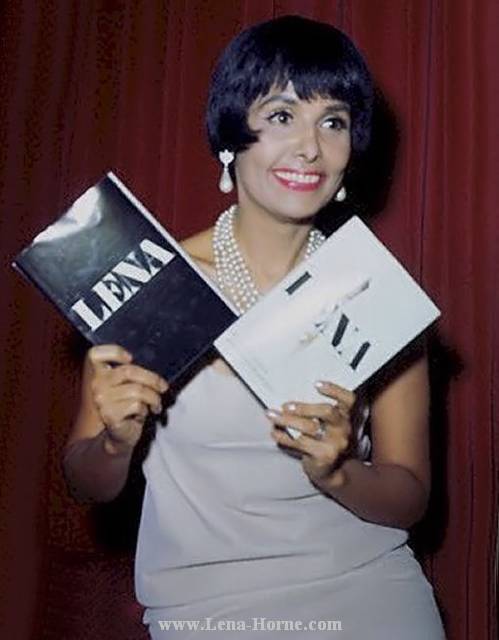
I’m going to try to get all of this Lena stuff out of my system today.  It’ll actually never be out of my system, but as far as blogging goes… you know what I mean.  I really enjoyed the following NPR blog post focusing on the racialization of Ms. Lena Horne.  I wonder how different things would have been for her if things would have been different.

Lena Horne: Of Race And Acceptance

by PATRICK JARENWATTANANON

In the reports of Lena Horne’s death that have emerged so far, much has been made of the fact that she was a black woman in an age of popular entertainment dominated by white faces. Her talent was obvious, but her skin hampered her attempts to become a major movie star, assigning her to bit parts that could be removed for Southern audiences.

Eventually, after the civil rights movement, Horne would be recognized as an entertainment icon. Her work as a jazz singer, theatre performer and television actress did much for that legacy, as well. But she also knew that the skin color that worked against her also worked for her. In the obituary that came over the AP wire, she is quoted as saying this:

“I was unique in that I was a kind of black that white people could accept,” she once said. “I was their daydream. I had the worst kind of acceptance, because it was never for how great I was or what I contributed. It was because of the way I looked.”

“A kind of black that white people could accept.” Think on that for a moment, and beyond the idea of being a light-skinned African-American. You could write the entire history of jazz through that lens.

Jazz’s early black stars (Louis Armstrong, Duke Ellington, Nat “King” Cole, Billie Holiday and others) worked overtime to be somehow disarming, or mythologized, or otherwise acceptable to white bourgeois audiences. Meanwhile, the music they and all their colleagues were making was popularized by white musicians — Paul Whiteman, Benny Goodman, the Original Dixieland Jazz Band, the Dorsey Brothers — sometimes well, sometimes drained of its swing energy. This continuing process is a big part of jazz’s transformation from scourge of society into America’s classical music.

Indeed, the entire cultural history of the U.S. in the 20th century could be viewed like that. Even today, where ethnic identity comes in many more shades, the middle-class white audience still plays arbiter and co-opter of what hits the mainstream. That’s admittedly a reductive viewpoint, ignoring the powerful experience of the art created, and perhaps it’s a bit cynical, too. But it would be true to Lena Horne’s experience, both marginalized and a trailblazer for who she, biologically, was.

So what’s to do about this? Can’t we just remember Horne as a great singer and actress, the woman who did “Stormy Weather,” and the person whose friendship with Billy Strayhorn brought out the best in both of them?

Sure, but I’d rather not do only that. For one, it negates how she stood up against demeaning portrayals in what roles she took, and how she spoke out strongly against discrimination throughout her career. By omitting all that from our narrative of her life, it allows even the most well-meaning of people to conveniently forget how racism profoundly shaped the creation, marketing and embrace of American art, and continues to do so today.

The New York Times‘ obituary has another illustrative quotation:

My identity is very clear to me now. I am a black woman. I’m free. I no longer have to be a ‘credit.’ I don’t have to be a symbol to anybody; I don’t have to be a first to anybody. I don’t have to be an imitation of a white woman that Hollywood sort of hoped I’d become. I’m me, and I’m like nobody else.

Lena Horne didn’t choose to be racialized based on her genetic assignment, but she was. Remarkably, she ran with it, using it as a source of strength and pride and artistic inspiration. That’s worth remembering, to0.


goodbye, lena

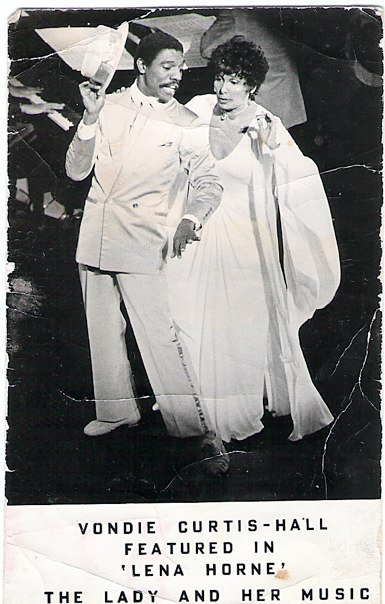
I am deeply saddened by the loss of the legendary Lena Horne.  I don’t think I have much  personal commentary at this moment.  I met Lena Horne once.  I was four or five.  My mom had a friend in Ms. Horne’s Broadway show.

She took me to see it.  We went backstage.  My mom says that with Lena and I it was love at first sight.  From what I can recall, I agree.  On my end anyway.  When I think back on that night the images that come up are all glowy and glittery with a hazy quality.  Almost like a dream.  Lena was truly magical.  She seemed to think I was as well.  Heck, when I was four or five I thought I was magical, too.  Or, should I say that I knew I was. That I hadn’t forgotten.  And nobody had tried to tell me otherwise yet.  I imagine now that Lena sprinkled some kind of fairy dust on me with a whisper never to forget who I am.  Not any part of it.  Especially not the magic.

I digress.

Needless to say I am extremely grateful to my mother and to Vondie and to Lena for that moment.  And also to Lena for breaking down barriers and speaking out against injustices and for paving the way for me to stand here today thinking these thoughts and trying to be a beacon for positive social change.

via The Huffington Post

Singer Dies At 92

VERENA DOBNIK

NEW YORK — Lena Horne, the enchanting jazz singer and actress known for her plaintive, signature song “Stormy Weather” and for her triumph over the bigotry that allowed her to entertain white audiences but not socialize with them, has died. She was 92.

Horne died Sunday at NewYork-Presbyterian Hospital, said hospital spokeswoman Gloria Chin, who would not release details.

Quincy Jones, a longtime friend and collaborator, was among those mourning her death Monday. He called her a “pioneering groundbreaker.”

“Our friendship dated back more than 50 years and continued up until the last moment, her inner and outer beauty immediately bonding us forever,” said Jones, who noted that they worked together on the film “The Wiz” and a Grammy-winning live album.

“Lena Horne was a pioneering groundbreaker, making inroads into a world that had never before been explored by African-American women, and she did it on her own terms,” he added. “Our nation and the world has lost one of the great artistic icons of the 20th century. There will never be another like Lena Horne and I will miss her deeply.”

“I knew her from the time I was born, and whenever I needed anything she was there. She was funny, sophisticated and truly one of a kind. We lost an original. Thank you Lena,” Liza Minnelli said Monday. Her father, director Vincente Minnelli, brought Horne to Hollywood to star in “Cabin in the Sky,” in 1943.

Horne, whose striking beauty often overshadowed her talent and artistry, was remarkably candid about the underlying reason for her success: “I was unique in that I was a kind of black that white people could accept,” she once said. “I was their daydream. I had the worst kind of acceptance because it was never for how great I was or what I contributed. It was because of the way I looked.”

In the 1940s, Horne was one of the first black performers hired to sing with a major white band, to play the Copacabana nightclub in New York City and when she signed with MGM, she was among a handful of black actors to have a contract with a major Hollywood studio.

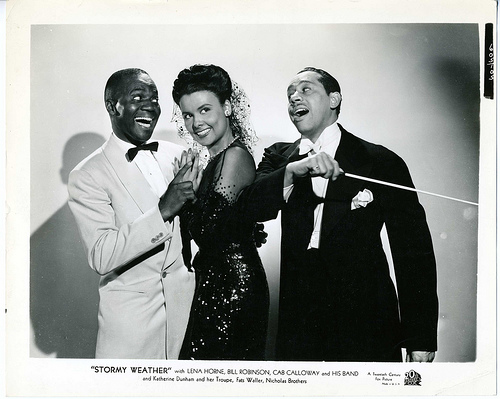
In 1943, MGM Studios loaned her to 20th Century-Fox to play the role of Selina Rogers in the all-black movie musical “Stormy Weather.” Her rendition of the title song became a major hit and her most famous tune.

Horne had an impressive musical range, from blues and jazz to the sophistication of Rodgers and Hart in such songs as “The Lady Is a Tramp” and “Bewitched, Bothered and Bewildered.” In 1942’s “Panama Hattie,” her first movie with MGM, she sang Cole Porter’s “Just One of Those Things,” winning critical acclaim.

In her first big Broadway success, as the star of “Jamaica” in 1957, reviewer Richard Watts Jr. called her “one of the incomparable performers of our time.” Songwriter Buddy de Sylva dubbed her “the best female singer of songs.”

“It’s just a great loss,” said Janet Jackson in an interview on Monday. “She brought much joy into everyone’s lives – even the younger generations, younger than myself. She was such a great talent. She opened up such doors for artists like myself.”

Horne was perpetually frustrated with racism.

“I was always battling the system to try to get to be with my people. Finally, I wouldn’t work for places that kept us out. … It was a damn fight everywhere I was, every place I worked, in New York, in Hollywood, all over the world,” she said in Brian Lanker’s book “I Dream a World: Portraits of Black Women Who Changed America.”

While at MGM, Horne starred in the all-black “Cabin in the Sky,” but in most movies, she appeared only in musical numbers that could be cut when shown in the South and she was denied major roles and speaking parts. Horne, who had appeared in the role of Julie in a “Show Boat” scene in a 1946 movie about Jerome Kern, seemed a logical choice for the 1951 movie, but the part went to a white actress, Ava Gardner, who did not sing.

“Metro’s cowardice deprived the musical (genre) of one of the great singing actresses,” film historian John Kobal wrote.

“She was a very angry woman,” said film critic-author-documentarian Richard Schickel, who worked with Horne on her 1965 autobiography.

“It’s something that shaped her life to a very high degree. She was a woman who had a very powerful desire to lead her own life, to not be cautious and to speak out. And she was a woman, also, who felt in her career that she had been held back by the issue of race. So she had a lot of anger and disappointment about that.”

Early in her career, Horne cultivated an aloof style out of self-preservation. Later, she embraced activism, breaking loose as a voice for civil rights and as an artist. In the last decades of her life, she rode a new wave of popularity as a revered icon of American popular music.

Her 1981 one-woman Broadway show, “Lena Horne: The Lady and Her Music,” won a special Tony Award, and the accompanying album, produced by Jones, earned her two Grammy Awards. (Horne won another Grammy, in 1995 for “An Evening With Lena Horne.”) In it, the 64-year-old singer used two renditions – one straight and the other gut-wrenching – of “Stormy Weather” to give audiences a glimpse of the spiritual odyssey of her five-decade career.

Lena Mary Calhoun Horne was born in Brooklyn on June 30, 1917, to a leading family in black society. Her daughter, Gail Lumet Buckley, wrote in her 1986 book “The Hornes: An American Family” that among their relatives was Frank Horne, an adviser to President Franklin D. Roosevelt.

She was largely raised by her grandparents as her mother, Edna Horne, who pursued a career in show business and father Teddy Horne separated. Lena dropped out of high school at age 16 and joined the chorus line at the Cotton Club, the fabled Harlem night spot where the entertainers were black and the clientele white. She left the club in 1935 to tour with Noble Sissle’s orchestra, billed as Helena Horne, the name she continued using when she joined Charlie Barnet’s white orchestra in 1940.

A movie offer from MGM came when she headlined a show at the Little Troc nightclub with the Katherine Dunham dancers in 1942.

Her success led some blacks to accuse Horne of trying to “pass” in a white world with her light complexion. Max Factor even developed an “Egyptian” makeup shade especially for her. But she refused to go along with the studio’s efforts to portray her as an exotic Latina.

“I don’t have to be an imitation of a white woman that Hollywood sort of hoped I’d become,” Horne once said. “I’m me, and I’m like nobody else.”

Horne was only 2 when her grandmother, a prominent member of the Urban League and the National Association for the Advancement of Colored People, enrolled her in the NAACP. But she avoided activism until 1945 when she was entertaining at an Army base and saw German prisoners of war sitting up front while black American soldiers were consigned to the rear.

That pivotal moment channeled her anger into something useful.

She got involved in various social and political organizations and, partly because of a friendship with singer-actor-activist Paul Robeson, was blacklisted during the red-hunting McCarthy era.

By the 1960s, Horne was one of the most visible celebrities in the civil rights movement, once throwing a lamp at a customer who made a racial slur in a Beverly Hills restaurant and, in 1963, joining 250,000 others in the March on Washington for Jobs and Freedom when Martin Luther King Jr. gave his “I Have a Dream” speech. Horne also spoke at a rally that year with another civil rights leader, Medgar Evers, just days before his assassination.

The next decade brought her first to a low point, then to a fresh burst of artistry. She appeared in her last movie in 1978, playing Glinda the Good in “The Wiz,” directed by her son-in-law, Sidney Lumet.

Horne had married MGM music director Lennie Hayton, a white man, in Paris in 1947 after her first overseas engagements in France and England. An earlier marriage to Louis J. Jones had ended in divorce in 1944 after producing daughter Gail and a son, Teddy.

“It was in Hollywood that Horne met her second husband, Lennie Hayton, who was also her musical mentor at MGM. He was also white. When the couple announced their marriage in 1950 — three years after it had actually occurred, they were confronted with angry rejection from the Hollywood community. Despite all the difficulties of a racially mixed marriage, their union flourished, lasting from 1947 until Hayton’s death in 1971.”

Her father, her son and Hayton all died in 1970 and 1971, and the grief-stricken singer secluded herself, refusing to perform or even see anyone but her closest friends. One of them, comedian Alan King, took months persuading her to return to the stage, with results that surprised her.

“I looked out and saw a family of brothers and sisters,” she said. “It was a long time, but when it came I truly began to live.”

And she discovered that time had mellowed her bitterness.

“I wouldn’t trade my life for anything,” she said, “because being black made me understand.”


speaking of golden…

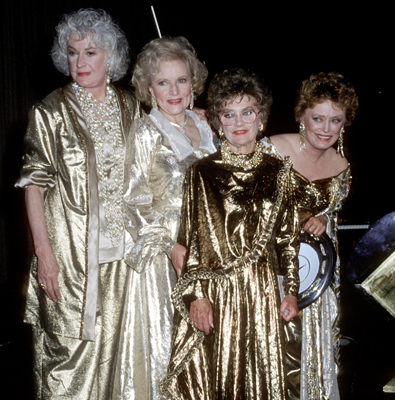
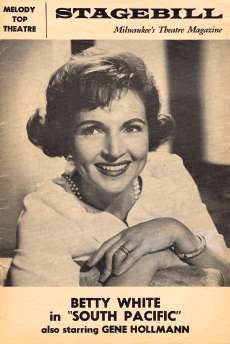
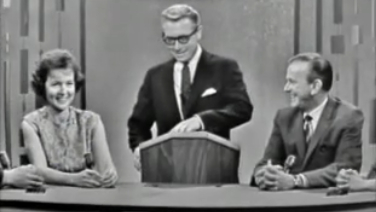
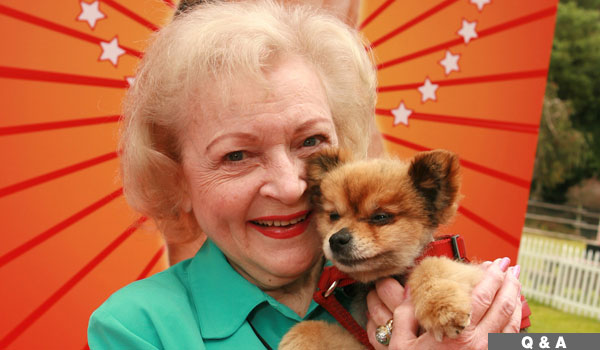
Tonight’s the night!!  Ms. Betty White is hosting SNL and I am so freaking excited!  I joined the facebook group ages ago, so of course I feel personally responsible for this magical night of entertainment.  Actually, long before it was cool to love Betty White, I loved Betty White.  It all started with Rose.  I have such a soft spot for Rose, although I’m pretty sure that the novelty of her naivete would quickly wear off if we ever met face to face.  I think what drew me in was the fact that Betty White reminded me of my Grandma, who didn’t take too kindly to that at first.  I think I probably said that Rose reminded me of her, which my grandmother took to mean that I thought she was kinda dumb.  She isn’t.  And it wasn’t Rose, it was Betty.  So pretty and so funny.  I was too young to know anything about Password, or The Mary Tyler Moore Show, or anything Betty that pre-dated Rose.  All I’m trying to say is that since I was nine years old, I have been a fan of Betty White.  She loves dogs!  She loves games!  She’s really good at the games!  She’s hilarious, and though she plays cute and innocent very well, she has a totally raunchy sense of humor.  About ten years ago I discovered Match Game reruns.  That’s when I was struck by the comedic genius of Betty White.  I could barely believe that that woman would one day morph into my beloved Rose.  Then there’s the animal loving.  It is still one of my greatest desires to not only meet Betty White, but to introduce her to my dog.  I always thought that would be Indy and that she would just melt when she saw him, but that ship has sailed.  Now I think she’d get a kick out of Oscar because he is super-cute and super-funny.  I’m still hanging on to that dream.  I should probably head over to Rockefeller Center with the dog and spend today waiting for Betty White.  I’m not going to though.

who knew!?

Dean Martin Celebrity Roast of Betty White

lucky dogs!!

Mrs. Weezmer aka “Witch Lady” on My Name is Earl

Thank you, Betty White!! xoxo!