1st photo

The picture above is reputed to be        the world’s first photograph.  It was taken in 1826 and was developed        by French photographer Joseph Nicéphore Niépce. He called this process        “heliography” or sun drawing and the entire process took eight hours.The next picture below is reputed        to be the world’s first color photograph.  Taken by by Louis Ducos du        Hauron in 1872, the photo is of a view of Angouleme in Southern France.source

The picture above is reputed to be the world’s first photograph.  It was taken in 1826 and was developed by French photographer Joseph Nicéphore Niépce. He called this process “heliography” or sun drawing and the entire process took eight hours.

The next picture below is reputed to be the world’s first color photograph.  Taken by by Louis Ducos du Hauron in 1872, the photo is of a view of Angouleme in Southern France.

source

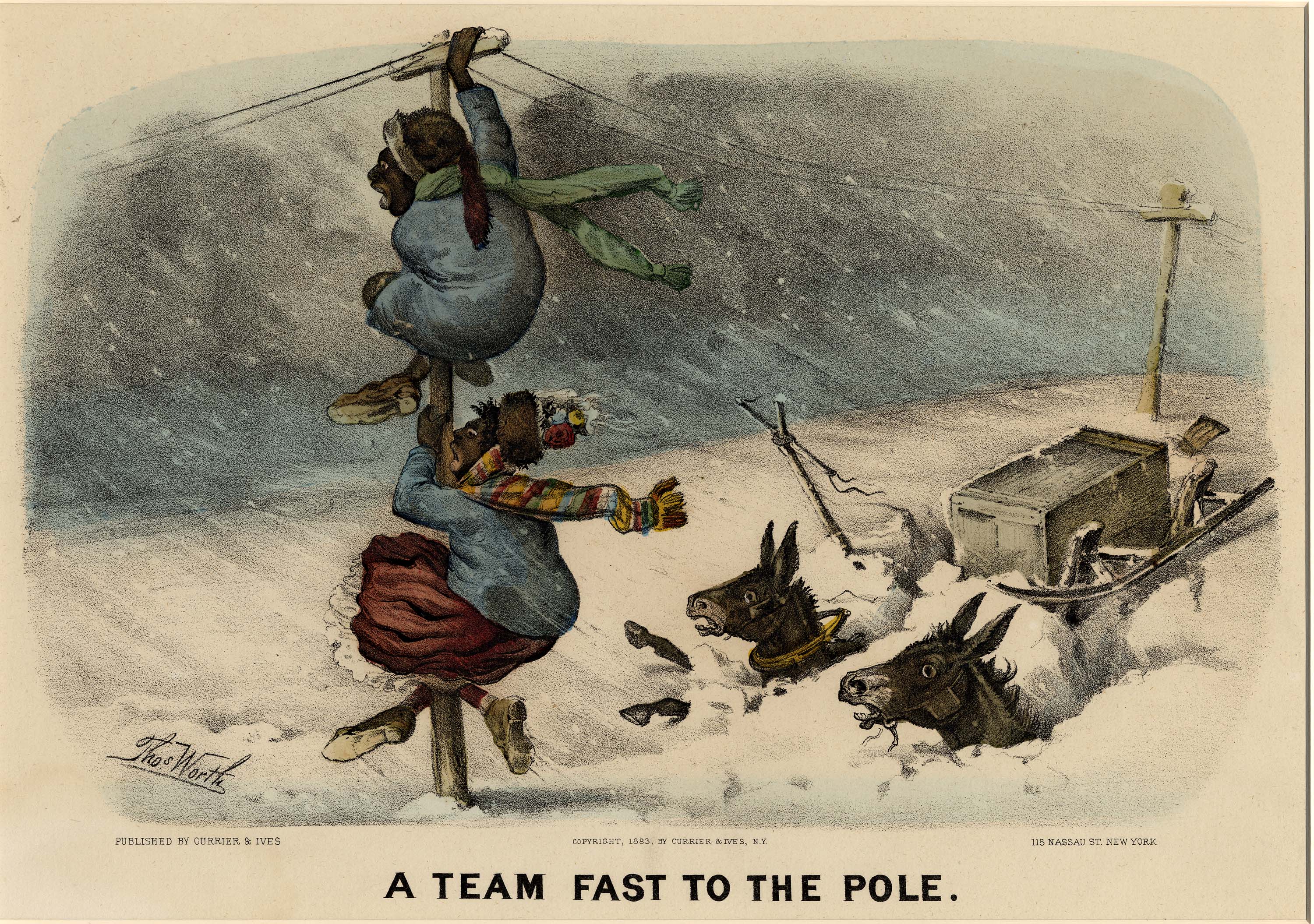
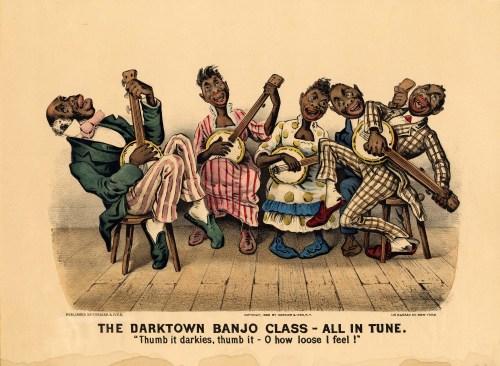
darktown

I’ll never be able to sing “Sleigh Ride” again!  Ever!  Not even with Amy Grant.  Currier & Ives!?  Puh-lease!  I’ll take Norman Rockwell any day.  ANY day.

In 1857, Nathaniel Currier, a Massachusetts lithographer, and James Merritt Ives, a self-trained artist and bookkeeper for the business of N. Currier, formed a partnership. The result was the firm of Currier & Ives, which produced three to four prints every week for fifty years – a total of over 7,500 titles. The lithographs produced by the company were published by Currier & Ives, none were actually drawn or lithographed by them. Upon their deaths in 1888 and 1895 respectively, their sons, Edward West Currier and Chauncy Ives, directed the firm until its close in 1907 (American Historical Print Collectors Society).

Previous to the Emancipation Proclamation, Currier & Ives generally depicted blacks as individuals content with their lives and position in society; they were often pictured in the background of idyllic plantation images. Initially after the Proclamation was issued, the firm continued to depict blacks in a positive light, focusing more on individuals, publishing portraits of John Brown, Frederick Douglas, and black Union soldiers fighting for their freedom (222). As time went on, however, and the freedmen began to move north into the cities, it became more apparent that not all Northerners were unanimous in their support of emancipation and the status of the freedman. The political images published by Currier & Ives during this time were vicious attacks against the character and intelligence of blacks, depicting them as unsupportive and disobliging of the political figures who sought to free them, such as Abraham Lincoln, Horace Greeley, and Senator Charles Sumner (226).

During and after Reconstruction, Currier & Ives, and America it seems, continued to appreciate these negative images of African Americans. Out of this, between the mid-1870s to the early 1890s, the Darktown Comics arose, mostly illustrated by Thomas Worth (1834-1917) and James Cameron (1828-1963). The company described the Comics as “pleasant and humorous designs, free from coarseness or vulgarity, being good natured hits at the popular amusements and excitements of the times”. It has been suggested that Darktown may have “served as satires on polite white behavior as well”, as could be supported by previously positive images of African Americans. Regardless of intent, the prints only reinforced negative racial stereotypes throughout the country.


The caricatures presented by the Darktown Comics consisted of “African Americans performing actions that were more or less normal for ‘ordinary’ folk, meaning whites…the implication being that the African Americans could not execute even the simplest tasks of everyday life without making themselves appear ridiculous”. The most common images depicted by Currier & Ives’ artists were of African Americans attempting to have horse, skull, and sulky races; ride in carriages and yachts; hunt; host lawn parties; play tennis; and fight fires–always with disastrous results. And the depiction of  African American lawyers, doctors and the clergymen as bumbling and dishonest were quite malicious. African American children were also featured in a poor light – as mischievous, out of control, disrespectful hoodlums. This is evident in prints by Thomas Worth such as “A Put Up Job” and “A Fall from Grace” (1883) and “Breaking In: A Black Imposition” and “Breaking Out: A Lively Scrimmage” (1881).


African American stereotypes that still exist today were begun here – the connection of African Americans to music, in Darktown specifically of banjo playing, and of their supposed eating habits, most notable in the Comics, that of eating watermelon. This can be seen in the prints that make up the set of the Darktown Banjo Class and in single prints like “O Dat Watermillion!”. As one can see, African American speech was attacked as well, through phonetic renderings steeped in the distortion of stereotypes and caricature.


The Darktown Comics did not develop or exist in a vacuum, however. In addition to theDarktown prints that came out of this time, Harper’s Weekly featured the Blackville prints; examples of which can be seen at HarpWeek’s exhibition, “Toward Racial Equality:Harper’s Weekly Reports on Black America, 1857-1874 or the Philadelphia Print Shop’sBlackville Prints.” These were similar in content to Darktownspoofs of African American attempts at high fashion, sports, etc. The most prevalent artists of this series were Sol Eytinge, Jr., William Ludwell Sheppard, S.C. McCutcheon and “Sphinx” (Philadelphia Print Shop, Ltd.). Other publications, such as Life, Puck and Judge, as well as Pulitzer’s New York World and Hearst’s New York Journal produced similar images but these were in the context of satire (Hays). Whether or not these images were taken as satire or at face value by the American populous is up for debate, however. Other news and editorial magazines, such as The Outlook and The Independent, also promoted these types of images through their illustrations and advertising—exemplifying the prevalence and acceptance of these racist stereotypes across the country (Hays).


The “high art” of this time, specifically that of southern artists, furthered these stereotypes as well, dehumanizing the African American through their depictions of coal black skin, thick red lips, oversized teeth, and patchwork clothing. It wasn’t until the impact of the Ashcan Society and the period of realism came into play that classical forms of art began to celebrate the figure of the African American as he really appeared. The art of Robert Henry, George Luks, and George Wesley Bellows are forefathers of this new view – a celebration of the African American.

SOURCE

speaking of norman rockwell

This post is completely reblogged.  I came across it HERE yesterday while looking for more of Jason Claiborne’s work.  I became curious about Norman Rockwell’s own views on race.  Angelo Lopez broke it down pretty well, as far as Rockwell’s work is concerned anyway, and I thought I’d share.

Norman Rockwell and the Civil Rights Paintings

By Angelo Lopez

Fifty years after he first started doing work for the magazine, Norman Rockwell was tired of doing the same sweet views of America for the Saturday Evening Post in the early 1960s. The great illustrator was increasingly influenced by his close friends and loved ones to look at some of the problems that was afflicting American society. Rockwell had formed close friendships with Erik Erickson and Robert Coles, psychiatrists specializing in the treatment of children and both were advocates of the civil rights movement.

His most profound influence was his third wife, Mary L. “Molly” Punderson, who was an ardent liberal and who urged him in new directions. On December 14, 1963, Rockwell did his last cover for the Saturday Evening Post and he began working for Look magazine. Look magazine finally gave Norman Rockwell the opportunity to express his social concerns.

Rockwell’s first painting was The Problem We All Live With, one of his greatest paintings. This painting depicts Ruby Bridges, the little girl who integrated the New Orleans school system in 1960, being escorted to her class by federal marshals in the face of hostile crowds. It’s a simple picture, the disembodied figures of 4 stiff suited men and the vulnerable yet defiant figure of a school age African American girl marching lockstep. To the right is a tomato staining a wall, obviously thrown at the girl but just missing. My eyes focus on the girl and her immaculate white, a contrast to the graffiti stained wall in the background. As a painting it’s a wonder, with it’s composition conveying Rockwell’s message in a few simple figures. To look at the picture, go here.

An even greater departure from Rockwell’s usual sweet America paintings is Southern Justice, painted in 1963. Rockwell did a finished painting, but the editors published Rockwell’s color study instead, and I think his color study conveys the terror of the scene more successfully. It depicts the deaths of 3 Civil Rights workers who were killed for their efforts to register African American voters. It is done in a monochrome sienna color, and it is a horrifying vision of racism. A look of it can be seenhere.

Rockwell’s most optimistic view of the civil rights movement wasNegro In The Suburbs, painted in 1967. It depicts an African American family moving into a white suburban neighborhood. The African American children look over by the kids in the neighborhood, with all the children sharing a love of baseball, America’s game. This painting can be found in this gallery.

a “half black” rockwell

I think this is so cool.  Just one thing though…. If his father was mixed-race himself, how is it possible for Mr. Claiborne to be half black? Don’t get me wrong, I am not questioning his personal identity.  I would love to have a conversation with him about it.  About how he came to that conclusion.  I used to think that if I could make “half black” kids.  Then one day I realized that… I can’t.

A Rockwell Illustrating a Street-Lit World

By COREY KILGANNON

Jason Claiborne

When Jason Claiborne was a third grader at Public School 187 in Washington Heights, the teacher scolded him for drawing a picture of a naked woman.

“Jason stood up and told the teacher, ‘I come from a family of artists and we have nude paintings on the wall,’ ” recalled his mother, Jane Jaffe, 65, whose father was Richard Rockwell, an artist and a nephew of the famous illustrator Norman Rockwell.

That would make Norman Rockwell — who was born 116 years ago on Feb. 3 — a great-great-uncle to Jason Claiborne, a 33-year-old artist living in Inwood, Manhattan.

If one were to have preconceptions about what a relative of Norman Rockwell would be like, Mr. Claiborne might not match them.

First of all, he is, as he calls it, “half black,” being the product of Ms. Jaffe’s second marriage, to a mixed-race man named Mario Claiborne. Jason Claiborne did not grow up in middle America, but rather in Washington Heights.

Like Rockwell, who died in 1978, Mr. Claiborne makes his living illustrating book and magazine covers. But Mr. Claiborne does not sit at a spindly easel painting sentimental portraits of white-bread middle Americana. He uses a computer to illustrate the covers publications that fall into the so-called street lit genre of publishing: urban tales of city dwellers who deal in guns, drugs, gangs and vice. The characters (and readers, largely) tend to be people of color.

“Norman documented middle America, and I’m documenting the ’hood,” said Mr. Claiborne, president and creative director for Augustus Publishing, which puts out books with titles such as “Ghetto Girls” and “Streets of New York.”

Authors include former prison inmates and gang members, and Mr. Claiborne provides the brash cover art that is more hustlers and hip-hop than the hobos and homespun scenes of “Saturday Evening Post” covers.

“A lot of Norman Rockwell illustrations can be seen as Polaroid images of the American dream,” Mr. Claiborne said. “I’m showing an American dream that’s not as pretty.”

…“Norman drew life as he experienced it, and like him, Jason draws from his personal life experience,” Ms. Jaffe said. “Norman would not be averse to the way Jason’s doing, because Norman was always ahead of his time as well.”

Richard Rockwell — whose father was Jarvis Rockwell, brother of Norman Rockwell — became a notable illustrator for comics and a courtroom illustrator, before dying in 2006. Richard’s daughter Jane Rockwell (later, Jane Jaffe) became a noted dancer and actor and Radio City Rockette, before becoming a lawyer and eventually taking her current position as an administrative law judge for New York State, in Brooklyn.

Mr. Claiborne has been painting on canvas since childhood. His mother raised him as a single parent, and he developed a close bond with Richard Rockwell and spent much time in Richard’s house surrounded by Norman Rockwell’s art and watching Richard Rockwell sketch. Richard Rockwell drew for many comic strips, including the Steve Canyon series for more than 30 years. He was also a prominent courtroom sketch artist, and several of his sketches hang on Mr. Claiborne’s walls.

Ms. Jaffe noted the significance of having an interracial descendant carrying on the Rockwell artistic mantle.

“When my father was on his deathbed, Jason whispered in his ear that he would keep the Rockwell creative juices flowing,” she said.

DESCRIPTION

Read more HERE

make your own definition

I enjoyed and appreciated this article about “us.”  I’ve been thinking lately about the choice we have to either “interact with the system the way it interacts with you,” or to come up with (and stick to and be ready to defend) our own definition of self.  In other words, you can let everyone else define you because it’s the path of least outward resistance, or you can follow the path of the least inward resistance.  I tried to go along with the system.  I think that was the primary source of my former discontent.  Now that I’m being true to myself, lots of things make a lot more sense and the possibilities seem greater.  Other things seem to make no sense at all and the obstacles loom large.  Yet I’m confident that I’m heading in the right direction.

For fast-growing group of Americans, race isn’t defined by one name

The question hit Tiffanie Grier like a hammer, and more than 15 years later, the impact lingers. She was just 9 years old, a third-grader at a school awards program, when she was asked by a friend’s mother about her ambiguous racial appearance.

What are you?

For Grier, now 26 and career placement director for the Boys & Girls Club of Greater Memphis, it was the first of many instances in which she confronted questions related to her heritage as the daughter of a white mother and an African-American father.

“I get asked a lot,” she said. “(People) feel the need to know.”

Far from being a rarity, however, Grier is part of what may be the fastest-growing demographic, both locally and nationally.

Between 2000 and 2008, the number of people of two or more races rose nearly 33 percent, from 3.9 million to nearly 5.2 million nationwide, according to census estimates.

In Shelby County, the growth rate was even faster. The number of multiracial residents increased some 43 percent, from 6,384 to 9,113 during the eight-year period in which the overall county population grew by only about 1 percent.

The 2010 Census, barely two months away, is expected to show even greater growth in the category, demographers say.

The reasons are twofold. First, the number of interracial marriages, and the children produced by them, has risen steadily since 1967, when the U.S. Supreme Court struck down state prohibitions on the unions.

Second, as a result of a growing acceptance of multiracial heritage, researchers say, people have become increasingly willing to check more than one category for race on the census forms. The election of a mixed-race president, Barack Obama, likely will reinforce that trend.

“It’s the wave of the future, for sure,” said William Frey, a demographer with the Brookings Institution in Washington. “I think symbolically … it might have an impact on how people view race.”

The upcoming census will be only the second in which respondents are able to identify themselves as multiracial.

The 2000 Census showed the emerging “two-or-more-races” group was poised for rapid growth. About 42 percent of them were under age 18, compared to only 25 percent of the general population that young, and 70 percent were younger than 35.

“What that’s telling you is that it’s a young population, and that it’s increasing,” said Nicholas Jones, chief of the Census Bureau’s racial statistics branch.

Among the most common combinations named by people in the two-or-more-races category in 2000 were white-Native American/ Alaskan (1.08 million), white-Asian (about 868,000) and white-black (nearly 785,000).

The significance of the emerging multirace demographic is anything but clear. Frey predicts it will diminish the importance of race — helping to propel society beyond a black-white divide — while others say the impact will be more on a personal level.

“I think it’s important to the people themselves — how they identify themselves,” said Darryl Tukufu, vice president for academic affairs and associate professor of sociology at Crichton College in Memphis.
Memphians (clockwise from top left) Felicia Scarpeti-Lomax, Tiffanie Grier, Cardell Orrin  and Desireé Robertson are members of what may be the fastest-growing demographic, both locally and nationally -- people who may identify themselves by two or more races.

(PHOTO BY MIKE BROWN: Memphians (clockwise from top left) Felicia Scarpeti-Lomax, Tiffanie Grier, Cardell Orrin and Desireé Robertson are members of what may be the fastest-growing demographic, both locally and nationally — people who may identify themselves by two or more races.)

Whatever other effects it might have, the relatively recent census acceptance of multiracial classification recalls the nation’s troubled and convoluted history regarding race.

Although many African-Americans have some white ancestry, the historic “one-drop rule” meant that anyone with so much as a drop of black blood was categorized as black and potentially subjected to disenfranchisement and other forms of discrimination.

That history, said Warner Dickerson, president of the Memphis Branch of the NAACP, blurs the significance of the new census categories.

“I happen to be a fair-skinned black man, and you and I both know why,” Dickerson said. “Most of us are mixed with black blood and white blood.”

Because society has labeled them as black, many people with one African-American and one white parent say they will continue to check only the black category on the census form.

“I will be addressed, especially here in the South, as an African-American,” said Cardell Orrin, 35, a Memphis business consultant and co-founder of a political action committee called New Path. “You decide to make your own definition or interact with the system the way it interacts with you.”

Tukufu said the labeling, and discrimination that accompanied it, tended to instill in many mixed-race people a pride in their black heritage. That’s why they’ve stuck with one racial category on census forms.

“But now you have more of the younger folks who identify with both,” he added.

Grier interviewed people of ambiguous racial appearance, including many of mixed heritage, for her master’s thesis at the University of Memphis. She found that the question of how mixed-race people identified themselves often depends on who raised them.

That was the case with Desireé Robertson, 37, of Millington, who was adopted by an African-American couple and didn’t discover until age 30 that her biological mother was white.

“That’s my primary identification,” Robertson said in explaining why she’ll stay with just African-American as her identity in the census.

But Felicia Scarpeti-Lomax, 39, who was raised by both her white Italian-American mother and her black father, plans to use both racial categories.

“For me to use one racial category, that would be eliminating one of my parents, and that’s not my heritage,” Scarpeti-Lomax said.

She formerly lived in New York City, where racial identity was never an issue, she said.

“I never faced this craziness until I moved to the South,” she said.

Scarpeti-Lomax, like many others of biracial heritage, said she’s glad the Census Bureau finally began offered the choice of multiple categories.

“This is 2010 …” she said, “and I just refuse to live my life identified by a color.”

remembering king

newfilosofee:think4yourself:julyshewillfly:      King said in an interview that this photograph was taken as he tried to explain to his daughter Yolanda why she could not go to Funtown, a whites-only amusement park in Atlanta. King claims to have been tongue-tied when speaking to her. “One of the most painful experiences I have ever faced was to see her tears when I told her Funtown was closed to colored children, for I realized the first dark cloud of inferiority had floated into her little mental sky.” (TIME)

King said in an interview that this photograph was taken as he tried to explain to his daughter Yolanda why she could not go to Funtown, a whites-only amusement park in Atlanta. King claims to have been tongue-tied when speaking to her. “One of the most painful experiences I have ever faced was to see her tears when I told her Funtown was closed to colored children, for I realized the first dark cloud of inferiority had floated into her little mental sky.” (TIME)

Back on the BusLife photographer Don Cravens documented Rosa Parks’ first ride on the integrated bus system. Of the strike, King wrote, “We came to see that, in the long run, it is more honorable to walk in dignity than ride in humiliation.” Time

Back on the Bus
Life photographer Don Cravens documented Rosa Parks’ first ride on the integrated bus system. Of the strike, King wrote, “We came to see that, in the long run, it is more honorable to walk in dignity than ride in humiliation.”
Time

fun website alert

www.onesentence.org

One Sentence - True stories, told in one sentence.

One Sentence is an experiment in brevity. Most of the best stories that we tell from our lives have one really, really good part that make the rest of the boring story worth it.

This is about that one line.

This is about telling the most interesting or poignant story possible in the least amount of words.

This is about small bite-sized pieces of extraordinary lives and ordinary lives alike… the happy, the sad, the funny, the depressing.


My 8-year-old sister proudly declared that she knows that “WTF” means “Wow, That’s Funny” and has been using it all over the internet.

I couldn’t help but smile as my third grader threw the ball through the hoop and yelled, ”Touchdown!”

Only after stepping on a lego in the middle of the night and ignoring the pain in order not to wake up the little princess I was carrying to bed did I realize that I was really a dad and not just a father.

A man was abusing his dog so I stole the dog, got arrested and fought a legal battle, and now every night when the dog jumps in bed with me I know it was worth it.

When I was 5 or so my mom would tell me to lie down before she tied my tie and I just now realized at the age of 19 that she did this because she’s a funeral director.

I knew God had a sense of humor when I hesitantly answered the ringing K-Mart payphone, only to hear my best friend, who had misdialed my home phone number, on the other end.

Today you shaved your hair into a mohawk to make my mom laugh over losing hers to chemo and today I realized that you are my hero.

When asked to name the one person absent from her life that she missed the most, she responded, “The person I hoped I’d be by this point in my life.”

I conduct job interviews for a living and nothing gives me a better sense of wielding karma than giving the job to the nervous kid instead of the better qualified arrogant prick.

As I woke up from my nap to find written on my feet “This is my momma and you can’t have her,” I realized that my child is very, very strange.

I know 18 digits of pi and can recite the quadratic equation, but I still need to make an L with my hand to find out where left is.

Supporting gay rights does not make me a lesbian any more than supporting the civil rights movement made my mother black, you idiot.

segregated orphans

A discarded term!?  I guess Bill Kemp has never visited this blog.  I’m grateful for this little piece of our history.

Booker T. Washington Home offered safe haven for black children

By Bill Kemp Archivist/librarian McLean County Museum of History | Posted: Saturday, December 12, 2009

For much of the 20th century, Bloomington-Normal residents thought it necessary to maintain segregated group homes for underprivileged children. One would be hard-pressed to find a better illustration of the embarrassing state of race relations over the decades than the fact that impoverished, neglected and unwanted children were separated by race until the 1960s.

From World War I until JFK and Camelot, African-American children lived at the McLean County Home for Colored Children, later renamed for Booker T. Washington, on Bloomington’s far west side.

This institution dates to 1918 when Alexander Barker and his wife Cedonia, with assistance from Margaret Wyche, took it upon themselves to care for six orphaned black children. Not long after, the Missionary Union, a group of four local churches stepped in to lend much-needed assistance. Though chartered by the state of Illinois in December 1920, the home was a rather primitive operation, with 25 children and 2 adults living in a six-room house with no plumbing or running water.

Improvements in the home, both in its physical plant and operation, soon followed. Located on the 1200 block of West Moulton Street, now MacArthur Avenue, the home’s mission was to “foster self respect, independence and good character.”

Overseen by a 15-member board of progressive-minded women, the home expanded to an adjacent residence. Also acquired in the early years were five nearby lots that were converted to truck gardens so the home could grow much of its own food. The boys generally worked the garden plots and the girls handled the laundry and canning, along with other duties.

The 1920 U.S. Census identified 15 of the 18 children at the home as mulatto, a since-discarded term for someone of mixed-race heritage. Back then, children with one black parent and one white were often outcasts, and into the 1940s, if not later, the home served as a safe haven for mixed-race children abandoned by their parents and local communities.

Money was always tight and the needs of the new arrivals great. “A special effort has been made to give each child his full quota of milk and butter fat, as many of the children were underweight,” read one report from 1921.

“There is absolutely no place of good repute open to such children in Illinois, except this one,” noted The Pantagraph two years later. “The question arises, shall a child be permitted to subsist on the contents of garbage cans … simply because of their race? Paraphrasing the Biblical interrogatory, ‘Who is thy brother’s keeper?’”