oh… but… jill…

I was pained by this headline, but upon reading the article wasn’t as offended as I’d prepared myself to be.  There’s a lot of history behind this pain, and I won’t ask anyone not to feel it or to ignore it.  That would be detrimental to our progress.  I’m glad Jill Scott has put this out there in this way.  I wonder, though, if her soul burns when she sees a not-so-successful black man with a white woman.  The history is the same and the choice sends the same message wealthy man or not, right?  Anyhow, I think we need to dialogue about this so that we’re clear on where these pains and hurts originate, so that eventually the love a person lives will speak to his soul’s credibility.  Not the color of the love a person lives.

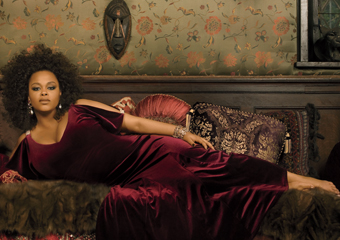
Jill Scott ‘pained by mixed-race couples’

By Marcell Minaya

Jill Scott has reportedly said that her “soul burns” every time she see a “successful black man with a white woman”.

In an interview with Essence magazine, the R&B-soul singer-songwriter said that she wished that a male, African-American friend was married to a black, rather than a Caucasian, woman.

Scott wrote: “My new friend is handsome, African-American, intelligent and seemingly wealthy. He is an athlete, loves his momma, and is happily married to a white woman. I admit when I saw his wedding ring, I privately hoped. But something in me just knew he didn’t marry a sister. Although my guess hit the mark, when my friend told me his wife was indeed Caucasian, I felt my spirit wince. I didn’t immediately understand it. My face read happy for you. My body showed no reaction to my inner pinch, but the sting was there, quiet like a mosquito under a summer dress.”

She continued: “Was I jealous? Did the reality of his relationship somehow diminish his soul’s credibility? The answer is not simple. One could easily dispel the wince as racist or separatist, but that’s not how I was brought up. I was reared in a Jehovah’s Witness household. I was taught that every man should be judged by his deeds and not his colour and I firmly stand where my grandmother left me. African people worldwide are known to be welcoming and open-minded. We share our culture sometimes to our own peril and most of us love the very notion of love. My position is that for women of colour, this very common “wince” has solely to do with the African story in America.”

Scott added: “Our minds do understand that people of all races find genuine love in many places. We dig that the world is full of amazing options. But underneath, there is a bite, no matter the ointment, that has yet to stop burning. Some may find these thoughts to be hurtful. That is not my intent. I’m just sayin’.”

SOURCE

speaking of isabella fowler…

So here’s what came from my search for more on Isabella Fowler.  In these paragraphs excerpted from Black Slaveowners: free Black slave masters in South Carolina, 1790-1860 by Larry Koger we see where the intraracial divide between mulattoes and “negroes”started.  I must admit that I am disappointed (to say the least) in the behavior of these privileged “biracials.”  I cannot defend the behavior.  Don’t want to.  On the other hand, it’s easy for me to sit in judgement in the year 2010 when my freedom and my opportunity for advancement are not on the line.  I would love to believe that back then, were I given the choice I would free my people.  That I would not see myself as separate from or better than, and that the only privilege I would take advantage of would be the one by which I could exercise my right to right some wrongs and provide an opportunity for others to be liberated and elevated alongside me.  I would love to believe that… but circumstances were different and I can’t possibly know how I would have behaved.  I do know that none of those attitudes/ideals have taken root in me, yet the accusations continue to be hurled and conclusions jumped to.  All of that being said, it’s 2010 and the time for ridding ourselves of these old paradigms of house slaves vs. field hands is long overdue. Maybe by 2012… according to Willie Lynch (perhaps a mythical “legend”) that’s when the stronghold of slave conditioning will lose it’s grip.

The mulatto children of slave masters, who were accepted as legitimate heirs, held a position in the household of their fathers which placed them in a superior status over the other slaves.  These children were accustomed to the master-slave relationship; however, they conceived of themselves not as slaves but slave masters.  In spite of the fact that they were of African descent, the white blood that ran through their veins separated them from their fellow black slaves on the estates of their fathers.  For example, the children of Michael Fowler, a white planter of Christ Church Parish, and his black companion named Sibb were raised in an environment which condoned slavery.  According to Calvin D. Wilson, in 1912, “there was a rich planter in Charleston named Fowler who took a woman of African descent and established her in his home…. There was a daughter born, who was called Isabella; the planter insisted that she should be known as Miss Fowler.”  Clearly Michael Fowler expected his slaves to serve and regard his mulatto children as thought they were white.  So the offspring of Fowler were treated as little masters and mistresses by the slaves of their father.

In fact, the process of cultural assimilation was so complete that the children of Michael Fowler, once reaching maturity and inheriting their father’s plantation and slaves, chose to align themselves with the values of white slaveowners rather than embracing the spirit of freedom and liberty espoused by the abolitionists.  In 1810, the estate of the deceased Michael Fowler was divided among his mulatto children….  When the descendants of Michael Fowler received their slaves, manumission was still the privilege of the slaveowners; however, none of the heirs chose to emancipate their slaves… Undoubtedly, the children of Michael Fowler considered slavery a viable labor system and chose to hold their slaves in bondage.

Mulatto children were not always acknowledged as the offspring of white slaveholders.  However, upon the death of their owners, they occasionally were manumitted and provided for once freed.  These children  probably were unaware of the bond of kinship to their owners.  Yet that bond allowed them to receive preferential treatment from their slave masters.  The unknowing mulatto offspring of white slaveowners often were trained as house servants or artisans.  Although they were not acknowledged as the children of slave masters, their encounter with the culture of their masters influenced them to become slaveowners.

In fact, the slaves of both mixed and unmixed racial heritage who served as house servants or artisans accepted certain aspects of the culture of white slaveowners.  Regrettably, the close interaction with the Southern culture influenced many slaves to identify with their owners.  For the house slaves, the contact with their masters and mistresses perpetuated the difference between themselves and the majority of the slaves who tilled the soil.  The house servants were taught to consider themselves superior to the common field hands.  Furthermore, the house slaves’ conception of superiority was reinforced by their dress, food, and housing, which was slightly better than that given to the field hands.  So it was that they separated themselves from the field slaves and occasionally accepted the values of their slaveowners and looked upon slavery as a justified institution.  As a consequence, they envied the life of splendor that their owners enjoyed and viewed slavery as a means of obtaining the luxuries possessed by their masters.

SOURCE

richard dereef

I wanted to know more about this “colored slave owner” after reading that small bit about him in the gullah tour article.  There is more information out there than I’d expected.  I wish I could see a photograph of his Caucasian and Indian (American) parents.  The New York Times article truly fascinates me.  First of all, I’d love to know who wrote it!  Secondly, it’s nice to hear (although there’s nothing nice about the sick and twisted system) that there were legitimate and acknowledged mulatto children.  But that nice feeling quickly disappeared when I searched for more information on Isabella.  I’ll include that in a separate post.

[Richard DeReef]

Richard Edward DeReef was one of the richest black men in Charleston. He had a Wharf at the end of Chapel Street, was in the “woodage business” (wood), and owned rental properties, most of which are located on the East side of Charleston. Because of his dark complexion he would have never been accepted into Charleston’s elite mulatto society but he claimed to be of Indian descent, and he had money.

IMAGE: ON RIGHT — Richard Edward Dereef (1798-1876), a free black wood factor and real estate investor, built this small two story frame single house sometime after he purchased the site in April, 1838. The site was part of a large lot, extending to Calhoun Street, on which Dereef erected several buildings, of which only this house remains. Dereef, a native Charlestonian, was one of the wealthiest men of the free black community. He and his son, Richard, Jr., had a wood factorage business on Dereef’s Wharf at the foot of Chapel Street, and lived nearby on Washington street. By 1867 Dereef had conveyed this property, apparently built for rental purposes, to Margaret Walker, a black woman.
(Stockton, unpub. MS.) SOURCE

COLORED SLAVE OWNERS.; One Family of Mixed Blood in Charleston Owned Forty Negro Servants.

May 26, 1907, Sunday

To the Editor of the New York Times:

Truth is stranger than fiction, and had not the information of the ownership of slaves by colored citizens of Charleston, and elsewhere, been sent forth by such an authority as The News and Courier, the statement would have been regarded as incredible. But The News and Courier has not stated nearly all the truth which is, according to your confession, surprising to you, and, according to your belief, surprising to many others in the North.

The prevalent views, State documents, Congressional debates, and lecture courses bearing upon the general subject render it difficult of belief that the proclamation of emancipation by Mr. Lincoln reduced many colored people of the South, and especially in the City of Charleston, from a state of affluence and competence to a condition of need, if not of poverty.

But such was the case.

Those slave owners were not called “negroes,” but “colored people,” as they were generally of mixed blood- sometimes of Caucasian and African; sometimes of Caucasian and Indian; (American.)  Many of the colored people of Charleston had no African blood whatever.  The question you ask, and The News and Courier failed to answer, is:  How did those people come into possession of their slaves- by inheritance, gift, or purchase?  The answer is, By all these ways.  They were generally the children of rich planters who, in the early days of the coast settlements, established themselves in lower South Carolina, with Charleston as the centre of operation.  These children were regarded as such, and not as illegitimate of slaves.  They bore the name of the father with recognition and as by right.  They were also educated.

Upon the death of the father these children would come, by inheritance, into possession of the estate, including beasts of burden, slaves, etc.  There was a very large number of free colored people in Charleston in the eighteenth century.

An interesting article on this subject may be found in the January issue of The Southern Workman.  Some of those who owned slaves in years before the war were by name De Reefs, McKinlays, Westons, Hollaways, Thornes, and Howards.  There are descendants of some of those people in  New York and Brooklyn to-day.  There is information enough at hand on this subject to fill a book, but let me relate you one story which may prove interesting.

There was a rich planter in Charleston of the name of Fowler.  He took a woman of African descent and established her in his home.  Whether there were a pledge of relationship or form of ceremony is not of record, but it was known that he had no other family.  There was a daughter born in that home to whom was given the name of Isabella.  But the planter insisted upon it that all persons should know her as Miss Fowler.  She grew to womanhood, and was married to Richard De Reef, a young man of Caucasian-Indian blood.  At the time of her marriage her father presented to her as a wedding gift a plantation and a sufficient number of slaves to work it.

The News and Courier says that two colored Charlestonians had each fourteen slaves, but the records of the family showed that at emanicpation Mrs. Isabella De Reef liverated forty instead of fourteen.

In another thing the News and Courier is wrong- that is, in saying those free persons of color had no political privileges.  The De Reef brothers- Richard and Joseph- born, respectively, in 1798 and in 1802, voted on reaching their majority, and ever after.  Some others may have enjoyed the same privilege, but there are colored men in Charleston to-day, and some now living elsewhere, who could claim the right to vote on the “grandfather clause”;  these were never enfranchised by an amendment to the Constitution of the United States.

A former Charlestonian.

New York, May 23, 1907.

click HERE for a link to a copy of the original NYTimes article

stono

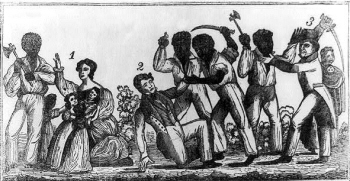
I wasn’t familiar with the Stono Rebellion before yesterday.  Nat Turner, yes.  Stono, no.  So I “looked” it up.  Here’s what BlackPast.org had to offer…

Stono Rebellion (1739)

On Sunday, September 9th, 1739 the British colony of South Carolina was shaken by a slave uprising that culminated with the death of sixty people. Led by an Angolan named Jemmy, a band of twenty slaves organized a rebellion on the banks of the Stono River. After breaking into Hutchinson’s store the band, now armed with guns, called for their liberty.  As they marched, overseers were killed and reluctant slaves were forced to join the company. The band reached the Edisto River where white colonists descended upon them, killing most of the rebels.  The survivors were sold off to the West Indies.


The immediate factors that sparked the uprising remain in doubt. A malaria epidemic in Charlestown, which caused general confusion throughout Carolina, may have influenced the timing of the Rebellion.  The recent (August 1739) passage of the Security Act by the South Carolina Colonial Assembly may also have played a role. The act required all white men to carry firearms to church on Sunday. Thus the enslaved leaders of the rebellion knew their best chance for success would be during the time of the church services when armed white males were away from the plantations.

After the Stono Rebellion South Carolina authorities moved to reduce provocations for rebellion.  Masters, for example, were penalized for imposing excessive work or brutal punishments of slaves and a school was started so that slaves could learn Christian doctrine.  In a colony that already had more blacks than whites, the Assembly also imposed a prohibitive duty on the importation of new slaves from Africa and the West Indies.  Authorities also tightened control over the enslaved.  The Assembly enacted a new law requiring a ratio of one white for every ten blacks on any plantation and passed the Negro Act of 1740 which prohibited enslaved people from growing their own food, assembling in groups, earning money they, rather than their owners, could retain or learning to read.

SOURCE

I read a few more accounts of the Rebellion.  While most of the websites relayed the story in identical fashion, I was slightly disturbed by this one that I found on teachingushistory.org.  I think this 4th grade textbook account is clearly biased in favor of the “white families.”  It’s almost subtle, but not really.  No other recounting mentioned drunk (on stolen goods) slaves, nor started the tale with “while the white families were in church.”   I can imagine my 4th grade self wanting to disappear during this lesson…


The Stono Rebellion occurred during the early morning hours of Sunday, September 9, 1739.  While white families were in church, a slave called Jemmy led a group of about 20 slaves who broke into a store, killed the store owner, and armed themselves with a supply of guns and ammunition.  From there the slaves moved southward from one plantation to another slaughtering whites and burning houses as they went.  Men, women, and children were killed.  Some were beheaded and their heads were left for display.  At one tavern, the insurgents spared the life of the innkeeper because he was known to be good to his slaves. At another, a slave hid his master and distracted the insurgents. (Smith 18)  As the slaves moved southward more slaves from the plantations joined the rebel force, which continued in military fashion displaying a flag and beating a drum.

Lt. Gov. William Bull, who was traveling on horseback with four companions, happened upon the rebels about eleven o’clock in the morning.  Bull and his companions quickly fled for their own safety.  They alerted the militia and local planters, who then organized men to pursue the insurgents. At about four o’clock in the afternoon they came upon the group of slaves about ten miles to the south.  Some slaves were resting.  Others were drunk on whiskey they had stolen in the raid.  The slaves fought hard, but the militia won the fight and ended the Stono Rebellion killing many of the slaves.  Slaves who escaped the scene were tracked down for months, and most were apprehended.   Those responsible for the revolt were executed.  One slave, July, who had saved the lives of his owner and the owner’s family was given his freedom.  Forty-four blacks and twenty-one whites lost their lives as a result of the Stono Rebellion.

SOURCE


blacks were ashamed, whites felt guilty

I would love to take this tour.  So many fascinating (albeit horrifying) pieces of our nation’s history are highlighted.  Underground railroad, black slave owners, paved over cemeteries, middle passage “reception,” color hierarchy.  I’m elated by the notion of forsaking shame and guilt in favor of honest discussion to ensure that this never happens again.  I’d like to think that “it” happening again is an impossibility, and that now our ultimate goal is to get rid of the vestiges of slavery.  Clearly we’re making progress.

Taking a Gullah tour of Charleston

BY SARAH STAPLES

The biggest hint that Charleston is a very different breed of Southern Belle — and that I’m on no ordinary city tour — comes as our air-conditioned mini-bus reaches the mainly African-American east side, a warren of economically deprived streets framing what was once an important stop on the Underground Railroad.

I look up to see a most unusual Star Spangled Banner flying bold African colors of red, black and green from a worn-looking flagpole. It’s an expression of indomitable Gullah pride, explains tour guide Alphonso Brown.

Like many living in the east side, Brown himself is Gullah: a descendant of slaves who endured the brutal “middle passage” from West Africa and the Caribbean during the 18th century, landing at Charleston’s bustling port before being sent to toil on plantations across the South.

Brown’s popular Gullah Tour, which marks its 25th anniversary this year, brims with atypical landmarks like this flag, as it excavates vestiges of an uglier time hidden amid the exquisite cobblestone streets and pastel-painted Georgian home fronts.

A multi-million-dollar waterfront estate, for example, looks impressive — until it is revealed to have been built by a rich slave ship proprietor who added slave quarters and a threatening-looking spiked gate to pen in human chattel. Later, we stop and stretch our legs in a parking lot owned by a Catholic church. It turns out to conceal the paved-over graves of freed slaves, for it was once their cemetery.

And the bus rolls on.

It’s potentially uncomfortable subject matter for his mixed-race audience, but Brown manages to keep the atmosphere light, sprinkling his commentary with anecdotes and jokes, and slipping in and out of the sing-songy Creole of his forefathers. “I-eh hab disshuh dreem,” he recites in Gullah. “We hol’ dees trut’ fuh be sef-ebbuhdent, dat all man duh mek equal.”

Plumped with West-African and Elizabethan English influences, Gullah was initially spoken in secret and spread wherever slaves were taken, along the coast and barrier islands as far as Georgia, and down to around Jacksonville, Fla.

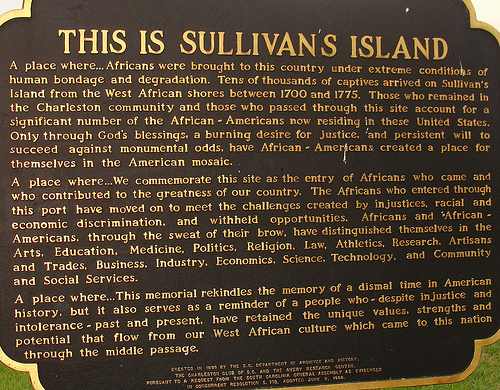
SULLIVAN’S ISLAND


Sullivan’s Island, opposite Charleston, became the macabre version of Ellis: a processing station where newly arrived slaves were kept in preventive isolation before their auction at The Old Slave Mart downtown, which today is a museum.

When the Civil War ended, emancipated blacks stayed on the barrier islands, renting rooms from former masters or squatting on abandoned plantations. In their isolation — bridges were few — they incubated the distinctive Gullah body of traditions for cooking, planting, fishing, praying and burying that are subtly evident throughout Charleston and the Lowcountry today.

Front porches in the city, we learn, often face southeast for shade, as per the African custom. Charlestonians were early, enthusiastic practitioners of root medicine and witchcraft. In literature, the tales of Brer Rabbit and Brer Fox derive from West African oral storytelling. And characteristic dishes, from spicy stone ground grits and shrimp to slippery-smooth okra gumbo, are Gullah to the core.

The inside of Brown’s mini-bus is ringed with pictures of inspiring Gullah throughout history and modern times. Among them is Clarence Thomas, second black appointee to the U.S. Supreme Court, and Philip Simmons, lauded by the Smithsonian Institution as a National Folk Treasure for his ornamental iron gates, which dress many of the city’s architectural landmarks.

CIVIC ACTIVISM

Politically, we learn, the Gullah have been determined organizers of abolitionist and Civil Rights movements. Dr. Martin Luther King, Jr. often retreated to St. Helena Island’s Penn Center — where one of America’s first schools for freed slaves was established — and may have begun drafting his 1963 I have a dream speech there.

More recently, in the run-up to the last presidential election, the Gullahs’ organized support for Barack Obama helped him clinch the crucial South Carolina primary.

Brown, who grew up in nearby Rantowles — not far from the site of the failed Stono River Rebellion of 1739, in which runaway slaves killed 20 whites before they were themselves slain — is justifiably proud of his ancestors’ achievements and defiant will.

He doesn’t deliver history in monochrome. Brown’s choice of material portrays a complex view of race relations in Charleston, which even during slavery was never officially segregated. We’re told, for example, that one of the richest freed black families was the DeReefs, whose patriarch, Richard Edward DeReef, owned multiple businesses — and at least 16 slaves.

Color was such a delineator of social status that freed “octoroons,” who had one-eighth black blood, judged themselves superior to “quadroons” with one-quarter slave ancestry. They, in turn, held themselves above mulattos, the children of white fathers who were often referred to, in delicate conversation, as “friends.” The divisions were physically embodied in the city’s many integrated churches, where slaves worshipped from the balconies while freed blacks sat behind whites in the lower pews.

A SENSE OF PRIDE

Two hours speed by on this tour. Brown makes it clear that Gullah traditions thriving in secrecy and isolation for centuries have more recently become a source of civic pride. Efforts to preserve and celebrate the culture are being stepped up, he says. And events, such as the Gullah Festival in Beaufort each May, or the Penn Center Heritage Days Celebration every second weekend in November, draw ever-growing crowds.

“Slavery was always a taboo subject: blacks were ashamed and whites felt guilty,” says Chuma Nwokike, owner of Gallery Chuma, which hosts works depicting traditional activities like crabbing and sweetgrass basket-sewing. The gallery doubles as rendezvous point for Brown’s tour.

“Now, the younger generation wants to acknowledge what went on, so we’re better able to come together and say, ‘how can we make sure it never happens again?’ ”

SOURCE

alice disrobed

More on the Rhinelander Trial.  I’d like to make a movie about this.

Leonard “Kip” Rhinelander Trial (1925)

The New Rochelle, New York annulment trial of Leonard “Kip” Rhinelander and his wife, Alice Jones Rhinelander, was a much-publicized issue in the 1920s which highlighted white America’s definitions of race, class, and marriage.

Alice Jones was the daughter of working-class English immigrants.  Her mother was known to be white, while her father’s ancestry was “mixed.”   Leonard “Kip” Rhinelander was descended from a wealthy, white New York family.

Rhinelander and Jones met in 1921, fell in love, and married in 1924.  Because of the Rhinelander family prestige, the union soon became public.  In the social atmosphere of the 1920s, it was scandalous that Rhinelander would marry a woman of lower socioeconomic class, or who possessed any “non-white” blood.  Rhinelander’s father pushed the annulment lawsuit brought by his son only weeks after the wedding, in which Rhinelander, Jr. charged Mrs. Rhinelander with deceiving him as to her race.  The prosecution argued that if Leonard had known she was “not white,” he would not have married Alice.  A leading issue in the trial thus became what Alice Rhinelander’s true race was, bringing into sharp focus the arbitrary nature of white America’s obsession with racial classification during that period.

Attorneys on each side attempted to answer this question using Alice Jones Rhinelander’s social network, her father’s ancestry, and even her language as evidence of her racial status.  The Rhinelander attorneys attempted to paint Leonard as a “dupe” victimized by a “vamp,” playing on sexualized stereotypes of African American women, while defense counsel resorted to desperate means to prove that Rhinelander must have known his bride was not “white” when they induced a stricken Alice to disrobe before the jury.

During the trial, the court required Alice to disrobe on the witness stand for examination of her skin. The court wanted the jury to inspect the color of her nipples.

The Rhinelander Trial held the public in its grip for the better part of 1925, with both black and white press weighing in with varying opinions.  Ultimately, on December 6, 1925, the jury ruled in Mrs. Rhinelander’s favor.  Playing on the notion that race can be visually established, the defense attorney successfully “showed” Mrs. Rhinelander to be “colored,”  argued that she could not have deceived her husband, and therefore his claims for annulment were invalid.

LATE IN 1929, Alice agreed to a divorce in exchange for a small monthly pension, and with the stroke of a pen a Nevada judge erased Kip Rhinelander’s social error. According to the terms of the settlement, Kip Jr. paid Jones a lump sum of $32,500 and $3,600 per year for life if she would disown their family name. Ironically, Jones would outlive her ex-husband by 50 years, passing away in 1989. On her gravestone read the name Alice J. Rhinelander.

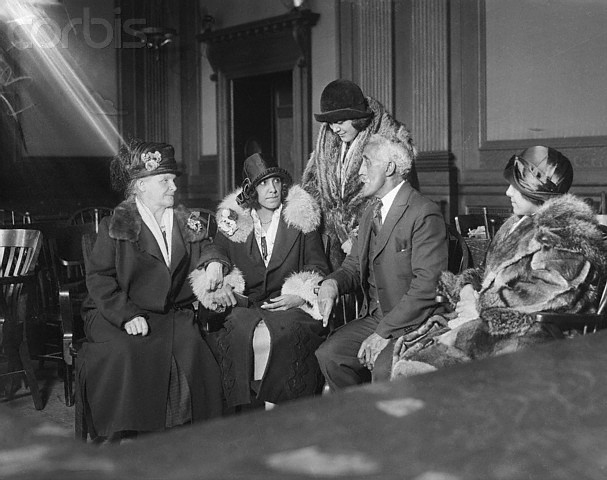
Original caption: Photo shows Mrs. Alice Rhinelander surrounded by relatives as jury decides case…Rhinelander jury locked for night; both sides anxiously await verdict. “Sentiment, passion, and prejudices should not interfere with your honest determination,” Justice Morschauser charged jury deciding Rhinelander case. Having failed to reach a verdict by 5:50 p.m. December 4th, they were ordered locked for the night. Left to right: Mrs. Jones, Alice, Grace, Jones, and Emily awaiting verdict.

SOURCE

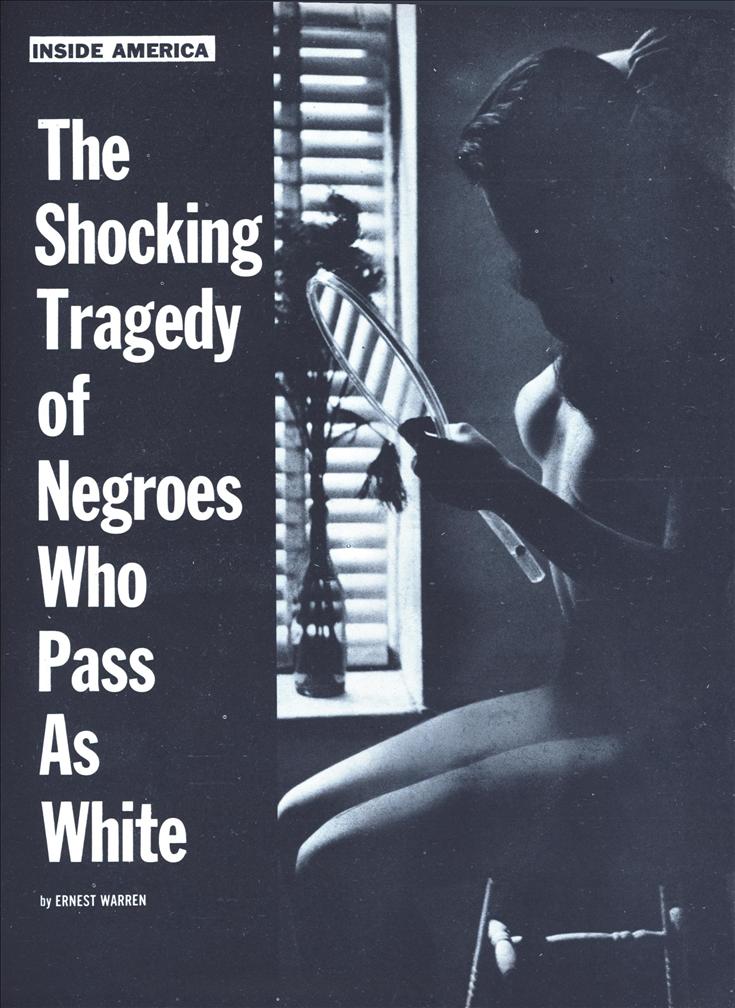
passers

Thank you, Lee, for turning me on to this little “gem.”  Horrifying sums it up well.  I don’t know what content I find most horrifying.  I’m picking up lots of “tragic mulatto” and “jezebel” (the cover page photo!) innuendo though those specific terms aren’t used.  In fact, the passers don’t have to be mulatto at all.  As I’m constantly told, as a nation and a people we’re all mixed and there are plenty of “black” people that are lighter than some mulattoes such as myself.   I do like this notion of “one honest goal: the elimination of the invisible color boundary which for so many years unfairly kept him from his rightful place in the sun.”  We’re still workin’ on it.

ENTIRE ARTICLE

…it seems well-nigh incredible that some five million Negroes have turned their backs on their own race and are passing as white. For almost a quarter of a century, this fantastic lie has been lived by large groups of Negroes with no sign of abatement despite the strong gains that have been made by the champions of anti-segregation.

In the year 1960 alone more than 60,000 negroes are expected to “disappear”, cross the invisible color line into the world of whites. These are not just dreamed up figures. They are actual facts. Just as it is a fact that no one ever reports a Negro to the Missing Persons Bureau unless they are absolutely sure the missing human isn’t passing.

Many shocking incidents were brought to light some years back in a sensational book, ‘Black Metropolis’ by St. Clair Drake and Horace R. Cayton. The authors claim that many “white negroes” as passers are called— hold strong positions in the white world as physicians, scientists, and public administrators—despite the fact that many such jobs are also held by Negroes unashamed of their race.

The late Walter White, himself a Negro, and one of the prime movers in the National Association for the Advancement of Colored People, once attempted to clarify the problem of passing. He said: “Negroes naturally resent the loss of some of the brilliant minds which would be an asset to them in their grim struggle for survival. But if any Negro believes he will be happier living as a white and thereby escape the barbs and handicaps of prejudices, or if he believes he can use his ability and training to greater advantage on the other side of the racial line, most Negroes wish him well.”

When it comes to passing, although most Negroes today refuse to condone it, they will not tell on one another. Most seem to understand the reasoning that prompts lighter-hued members of their race wanting to cross over.

“We know there are stronger anti-discrimination laws than ever before,” they will tell you, “but when a negro has a white skin, he seems to have a compulsion to live the way of the people who have so long opposed him. He doesn’t seem to realize that scientists have proven that the very people who condemn him might not be in a position to do so.”

A scientist like those mentioned above is Dr. Caroline Day, of Atlanta University, who wrote in her famous Harvard African Studies: “The grim joke of the whole matter is that for 150 years and more the Negro has been absorbed and his descendants are constantly rubbing elbows with some of the very ones who are discussing them.”

Even the fact that people, who believe all passers are eventually found out because their children are sure to be black, are merely deluding themselves, hasn’t deterred the practise of passing. Science took the inherited color theory apart a long time ago, with the aid of such eminent savants as Amram Schienfeld, Dr. Ernest A. Hooten and the late Dr. Edward M. East, who theorized thus; “If one of the parents is pure white, the baby cannot he darker than the darker parent. If they both have Negro blood, the baby may be slightly darker than its parents hut the chances are against it.”

With the legalization of racial intermarriage approved in some 22 states, nobody has been able to upset their theory – though, obviously, chances to do so have been many.

Yet the “passers” themselves seldom worry about theories. The “permanent passer”, going over the line, never comes back. He prefers to end his days living a big white lie; and women passers who marry bear children and keep their secret for life.

Only under unusual circumstances, such as the one that befell the wife of a prominent socialite, does a sensational exposure ever occur. This was the Leonard Kip Rhinelander case, which rated lurid headlines when the socialite playboy sought to have his marriage to Alice Jones set aside. Rhinelander claimed his wife was colored and failed to tell him so. In her defense, Alice stripped to the waist and bared her breasts to the jury, thus providing the sensation-seeking New York Graphic with a classic composite-photo of this closed door session for its front page.

Besides the “permanent passer”, the “segmental passer” stands without guilt or censure. The “segmental passers” lead a dual life; whites by day, Negroes by night. You’ll often find them in jobs where opposition to Negroes is strong but secret-Some are telephone operators, receptionist, typists, clerks in large corporations and in department stores, where, though some Negroes are employed the unspoken policy is “Enough is enough.”

On Broadway, particularly, the Negro girl has a tough time getting a chorus or showgirl job. There is a story current of a Negro showgirl, allegedly passing as white, who was recognized by a popular Negro singer, but he refused to reveal her secret. He also reportedly wouldn’t talk to the girl, not because of her “passing” but because of her more than passing interest in a white socialite-playboy who met her nightly.

“Obviously she hasn’t learned yet that mixed marriages are no longer looked on with horror,” a Negro artist told INSIDE STORY, “so she’ll go on living her lie and, in the long run, probably find her heart broken because she feels she can’t reveal her secret to the man should he want to marry her. Life will never be easy for her. She not only sometimes has to listen to blasts against her race, but worry every moment about being exposed.”

While there’s no way of truly gauging the number of passers operating, some estimate is arrived at by studies of census reports, immigration records, vital statistics and information from other sources. Yet this does not take into account the ‘’segmental passer” or the passer who, in the past, was known as an “occasional” a reference to light-hued Negroes who occasionally went downtown to segregated areas and, as a lark, spent their money on white entertainment.

Actually, when it comes to “passing”, the shocked might as well face these facts: Passers not only go through life as white, they have children who look (and are) white. Any anthropologist will tell you that if a person has one-sixteenth or less of Negro blood—it is impossible to determine his or her ancestry.

Yet, the practice of passing still continues, much to the chagrin, not necessarily the shame, of the Negro who believes in living as he was born. To such a Negro, there can be only one honest goal: the elimination of the invisible color boundary which for so many years unfairly kept him from his rightful place in the sun. The passer, working in the movies, working as a white actress or a showgirl, or a model or a clerk, or a receptionist doesn’t think of this. He’s thinking of himself. Or herself. And that, to a good many Negroes, is a “shameful secret!


grateful for the choice

I mailed my Census form yesterday.  I must say that after all the hype, I was totally underwhelmed by the experience.  I checked the two boxes.  I can’t say it brought me any great feelings of validation.  I guess I thought they’d be asking some questions that went beyond race.  I also thought that “Negro” would be the only African American classification term offered since there was so much buzz about the word being used in 2010.  At any rate, I enjoyed this article.

More than black or white

By Annette John-Hall

Inquirer Columnist

SOURCE

For Kathrin P. Ivanovic, racial identity means a whole lot more than just black or white.

Her makeup runs the gamut.

“My mother is German and my birth father is African American with Cuban ancestry,” says Ivanovic, 29, director of development at the Nationalities Service Center, a Philadelphia nonprofit that services immigrants and refugees.

“Plus, my adopted dad is white, and I’m queer. Unfortunately, they don’t have a box for that.

“. . . I call myself a mixed chick.”

But when her 2010 U.S. Census form arrives in the mail this week (the 10-question form is being touted as the shortest in census history), Ivanovic will be satisfied to check black and white – which is really how she sees herself anyway.

Since the 2000 census, for millions of Americans like Ivanovic, “check one or more” will apply.

There is plenty to choose from, with the number of racial and ethnic categories at 63. In the 1990 census, there were only five designations offered.

It can be dizzying. If you’re, say, Asian, you can check any combination of Asian American, Chinese, Japanese, Filipino, Korean, Vietnamese, Hawaiian, Guamanian, or Chamorro, Samoan, as well as write-in categories for Other Asian or Other Pacific Islander.

In addition, you can also note if you’re of Hispanic, Latino, or Spanish origin. That’s because since 1970, Hispanic was no longer recognized as an overarching classification.

Still with me? (And here I thought having Negro on the same line as the black or African American box was confusing.)

But I’m all for it, especially if it paints a more genuine picture of who we are – all 300 million of us. Doesn’t matter if only 2 percent of Americans were identified as more than one race in 2000. Nowadays, we’ve got more multiracial and multiethnic couples and children than ever before, which means the percentage is sure to increase this year.

Which in turn enables the government to allocate funds more equitably. Census data are used in everything from determining the number of congressmen your region gets to the assessing the amount of funding for your town’s bridge project to supporting health centers.

Race data also have driven the nation’s civil rights laws (how many people were denied the right to vote, how many were discriminated against in housing, for example) and are still used to monitor inequalities in health and education.

But it wasn’t always that way.

Truth is, the U.S. Census was historically more of an oppressor than an advocate, especially when it came to African Americans.

Racial count

From the time census data were first collected in 1790, when enumerators listed categories of free men and slaves, whites used the census to diminish African Americans.

“You can see why they had a slave category,” says MIT professor Melissa Nobles, author of Shades of Citizenship: Race and the Census in Modern Politics. “Southern slave owners wanted the least amount of information, thinking it would help abolitionists. And abolitionists wanted the most amount of information [to make their case].”

Throughout the 19th century and until 1930, census counters used categories such as quadroon (one-quarter black), octoroon (one-eighth black), and mulatto (half black) to describe any person who had a discernible amount of African American blood.

Like they could tell just from looking.

Even after 1930, Southern laws imposed the “one-drop rule” to its census enumerating, meaning they were to count as mulattos anyone who even looked remotely black – a mandate loosely applied by census counters nationwide.

“They used it for racial social science,” Nobles says. For example, they used census data to prove skewed theories (arguing, for instance, that biracial people – “the tragic mulatto” – were somehow weaker and suffered from higher death rates), which in turn helped legislators make the case against interracial marriage.

But even as the categories have expanded, some today are pushing for a separate, generic multiracial designation.

Ralina L. Joseph, a professor of communications at the University of Washington, worries that even though the data will show us as more diverse and multihued, they could be misinterpreted once again.

“I don’t want people to read the numbers and think that racism is over, that this is a post-racial moment,” says Joseph, who is biracial. “We should hope that people who are disenfranchised through race, class, and poverty levels should be identified as such.”

Some sociologists even insist that racial designations have no place on a census form, if it is indeed as simple as an objective count.

But in a multiracial, multiethnic society where even the president is a self-described “mutt,” Kathrin Ivanovic is grateful for the choice.

“I am mixed. It’s how I view the world, and in some ways it’s how the world views me,” she says. “To not be able to identify that way is dishonest to me personally.”

“The Census Taker” (1870) Harper’s Weekly

making the best of it

Taking into consideration the lunch counter sit-ins of 1960, I think this is a remarkable story…

Area Woolworth’s first black sales clerk calls hiring proud moment

Jean Fisher Curry was hired in 1961 to work a cosmetics counter in the front of the store.

By Tom Stafford

SPRINGFIELD — There were no lunging police dogs with bared fangs, no fire hoses knocking people to the ground, no instigators putting cigarettes out in the hair of protesters at lunch counter sit-ins.

The first apparent outward sign that Springfield’s F.W. Woolworth store would have its first ‘‘Negro’’ employee — to use the word customary at the time — was a note Jean Fisher, 15, received in class during the fall of 1961, her junior year at South High School.

“I was never in trouble,” said Jean Fisher Curry of Springfield. So when she got the note from the counselor’s office, “I thought, what did I do?”

It wasn’t what she did that was notable but rather what she was about to do.

Like other Distributive Education students, she was told she’d have to meet the standards: keep a B average and take special classes in the department.

“I think (Distributive Education) was the forerunner of the vocational school,” Curry explained.

But if she met the standards, she could work at Woolworth’s — the downtown one at High and Limestone streets.

The importance of that was not lost on Curry: “They didn’t have black people working in the store.”

A happy clerk

“I thought I’d be cleaning,” Curry said.

That might have been OK. Her mother had done that for years in what was called “private family work” — working as a domestic at the Tanglewood Drive home of Seymour and Anne Klein.

Jean Curry hugs her mother, Alberta Fisher, whose encouraging words helped her break new ground as the first black sales clerk at Springfield's Woolworth store. Staff photo by Marshall Gorby

Jean Curry hugs her mother, Alberta Fisher, whose encouraging words helped her break new ground as the first black sales clerk at Springfield’s Woolworth store. Photo by Marshall Gorby.

Being a domestic “never bothered her,” Curry said, “because that was honest work.”

And when the Kleins asked Alberta Fisher to run the lunch counter at Victory Lanes, it showed “they trusted her,” Curry said. “And she was happy with that.”

The job at Woolworth’s wasn’t a cleaning job, however — likely because the Distributive Education program didn’t train people for that task.

“They told me it was a sales clerk,” said Curry,” and I said, ‘Yeah.’ ”

As it turned out, her post would be at the cosmetics counter in front of the store, where she’d be seen by all who walked in the main entrance.

The sightings began soon after she turned 16 on Sept. 15, 1961, and got her work permit.

Shades of discrimination

Curry discovered a shade of racial reasoning involved in her placement in the store.

“They hired a black girl from North and me from South,” she explained. “Because I was light (-skinned), I worked at the front of the store. Because she was darker she worked in the back of the store with the pets.”

Asked whether that was the real reason for the assignments, Curry was emphatic: “There’s no doubt. I knew it, she knew it, and she resented it.”

Curry said that colored her attitude toward her own work: “What was I going to be mad about? I didn’t feel discrimination like somebody darker.”

The attitude ran in her family.

When the census came, the light-skinned Curries listed their race as mulatto., and in the militant black pride era, they joked about being “high yellow.”

Still, they had to follow rules of the racial road.

Springfield then was a town in which blacks weren’t allowed in the Liberty Theater and in which blacks were suspicious of drinking out of segregated fountains, wondering what white people put in them.

Blacks also tended to “stay within our culture,” Curry said, taking the elevator in the Arcade to the music store that catered to their tastes and frequenting the Center Street YMCA.

Woolworth’s also had its rules: Blacks could order only carry-out from the food counter.

And when Curry started, “we were told when we gave people change to lay it on the counter,” she said, thus avoiding problems with white customers who were uncomfortable having physical contact with blacks.

“But like I told (the girl from North),” Curry added, “we may get some money.”

At first, the pay was 65 cents an hour. The following year, it would go up to 85 cents — this in an era when $1 an hour was considered decent pay, Curry said.

In her youthful enthusiasm, “I didn’t think it was a job. I thought it was a career.”

In the same spirit, Curry, who knew that the actress Betty Hutton’s sister, Barbara, was part owner of the chain, half expected one or the other Hutton sister to show up some day, coming through the front door right into her area.

When she told people she worked at Woolworth’s “I always said ‘F.W.’ like I knew him.”

“I couldn’t even tell you what F.W. stood for.”

Her mother and God

The non-Hutton whites who came into her area in the front of the store fell into a couple of categories, Curry said.

“The older ones, the little white-haired ladies, they liked me,” she said.

“They were used to black people working in their homes and knowing their place. And I knew my place.”

“The other ones, I had to grow on them,” she said.

And she did, using the enthusiasm and bedrock values her mother taught her.

Part of it was common courtesy. “I was always very friendly. You just do that,” Curry said.

Also, “we were very religious,” she said. “We went to church. I think God had a place in that.

Constantly on her mind at that time was the desire “to make my mom and dad proud of me,” Curry said.

Finally, there was the work ethic her mother sought to instill in her children.

Throughout their childhoods, Mrs. Fisher recited a saying to her children to encourage them to do the best they could in everything they did.

“She said it so much to me that I knew it by heart,” Curry said.

All that you do, do with your might.  Things done by half are never done right.  All that you do, do with a zeal.  Those that reach the top, have to climb the hill.

Touching moments

If some of the white people of the time were uncomfortable touching blacks, the black friends and family who came to the store were the opposite.

They’d reach out, touch her and say “It’s so good to see you” when they came in, Curry recalled.

Her mother was especially proud.

“Out of all the girls, they chose her to be there,” said Mrs. Fisher, now 91, who also lives in Springfield.

“I was excited about it, really I was,” she continued. “All my whole family — my sisters, everyone — I was just telling everybody. And I still tell it now.”

Curry said the Woolworth’s experience helped her to feel a part of the larger community.

Already with a sense that Woolworth’s was a cut above the competitors of Kresge and McCrory’s, Curry soon got to know the downtown merchants as they stopped into Woolworth’s — people like William Greene, owner of an exclusive dress shop.

“I could go into stores and they’d let me lay things away. A lot of time black people couldn’t go into those stores,” she said.

Knowing as a customer, the mistress of one of the downtown businessmen also marked her as an insider.

“I felt like I was part of Springfield because I was doing those things,” Curry said.

“It wasn’t that I wanted to be white. I was being accepted for who I was, making the best of it. And I said some day I’ll tell these stories to my grandchildren, and they’ll love it.”

SOURCE

a rare testament of harmony

This is a fascinating story of interracial marriage, institutional racism, blended families, and mixed race ideology.  I am inspired by the courage of conviction this woman maintained in the face of so much opposition.  Oh! And… um…. excuse me South Carolina… 1998!?!?  Yes, Michigan!

How one woman overcame the racial barriers that divide us

By DAVID LAUDERDALE

Laura Markovich came to Beaufort County in 1965 because it had one of the few places in the South where whites and blacks could gather.

She came from Michigan to attend a religious “summer school” of her Bahá’í World Faith at Penn Center on St. Helena Island.

What unfolded here became a rare testament of harmony in the messy struggle of race relations in America.

At the secluded Penn Center, on sandy soil where the first school for freed slaves was erected in 1862, the young white widow met a tall and striking black widower.

On the surface, the only thing they had in common were children underfoot. Laura had four children, all white, and Elting B. Smalls Sr. of St. Helena had six children, all black.

Three years later, they were married. They lived in the Tom Fripp community on St. Helena and together had four more children.

Laura and Elting Smalls, center, on St. Helena Island with two of her daughters, one of their sons, and two family friends.

It was a life so odd for that era in the Deep South that it demanded hard-to-reach courage, resolve and unity.

Those characteristics — and Laura Smalls’ devotion to her faith, early childhood education and family — were cited Tuesday when a standing-room-only crowd gathered back at that same Penn Center for her funeral. She died Feb. 27 at age 79.

Her children composed a eulogy that makes it sound like they were raised in the world of Ozzie and Harriet:

“Her greatest loves were arts and crafts, playing and teaching children, talking to everyone and anyone, and dancing. You can see this evidenced through her children’s passions….Can’t you yet see her sweet smile?”

‘WEDDED WIFE’

That smile was a triumph of the spirit over harrowing details.

To set the stage, their marriage took place days after Dr. Martin Luther King Jr. was assassinated and America’s streets erupted into racial violence. King himself had gathered his troops for retreats at the Penn Center for the same reason the Bahá’ís did. They believed in unity, and this was one place they could find it. Just months before he died, King stood at Penn Center to ring home a point to the antsy civil rights activists: “So I say to you tonight that I have taken a vow. I, Martin Luther King, take thee, nonviolence, to be my wedded wife.”

For Elting Smalls to take Laura Markovich to be his wedded wife was not much easier.

Her faith required written permission from her father, and he didn’t want to give it. It took her three years to get it. Her father never did agree to meet Smalls, a Penn School graduate and career civil service worker at Parris Island Marine Corps Recruit Depot.

And then there was the matter of the law. In June 1967, the U.S. Supreme Court overturned state laws, like South Carolina’s, that banned interracial marriage. But it took South Carolina until 1998 to officially amend the state Constitution to remove what had been ruled a violation of the 14th Amendment. The Smalls wedding was a quiet affair in the home of one of the bride’s closest friends — in Michigan.

Thus a family of whites from up North and a family of black Sea Island Gullahs became one. They lived united, years before integration was forced on the local schools, much less accepted in the home.

BLACK AND PROUD

Sometimes Laura Smalls would take her troupe of white, black and mixed-race children into the historically white waiting room at the doctor’s office, and sometimes into the historically black waiting room, and always let the odd stares fall where they may.

Family members say the white community in town had a stand-offish attitude, but the blacks of St. Helena welcomed them all, as family.

“She didn’t do it to make a statement,” said daughter Lynn Markovich Bryant of Lady’s Island. “She fell in love with Elting and she wasn’t going to let anything stand in her way.”

Bryant gives the world a look at race it rarely sees in her 2002 autobiography, ” ‘I’m Black and I’m Proud,’ Wished the White Girl.”

As a child she was stunned by the ingrained racism she saw in her little classmates. She struggled with white attitudes toward blacks because in her world, there was no racial divide. She chose to attend the predominately black St. Helena Elementary School, where she felt welcomed as a fifth-grader. Today, she has taught there for almost 30 years after finishing second in her class at Beaufort High School, earning a full scholarship to Clemson University, graduating with honors and earning a master’s degree with a 4.0 grade point average.

She sounds like a black person, and she married a black man, joking that she would have had to marry a white for it to have been considered an interracial marriage. Her husband, Wilbert Bryant, teaches at Battery Creek High School.

One day as an adolescent, Lynn Bryant blurted out, “Mama, I hate white people.”

In her book, Bryant writes: “Being a mother to such a multitude of children, this was hardly her first or last problematic situation to resolve. … She ever so warmly and calmly responded as only she could, ‘Well, Lynn don’t you love the Bahá’ís? There are white Bahá’ís.”

EMBRACED

…Smalls was embraced on St. Helena because she was not a white who ignored the natives or said, “My way is better than your way — move over.”

She saw racial progress, her daughter said, but not the level of social interaction that’s necessary for people of different races, cultures and beliefs to quit being so judgmental.

“She taught us that we have more commonality than differences,” Bryant said.

Together, Laura Smalls’ 13 surviving children and stepchildren of all colors wrote: “Our mother did not tell us how to sacrifice and serve others; instead she showed us how to walk the walk.”

SOURCE