speaking of norman rockwell

This post is completely reblogged.  I came across it HERE yesterday while looking for more of Jason Claiborne’s work.  I became curious about Norman Rockwell’s own views on race.  Angelo Lopez broke it down pretty well, as far as Rockwell’s work is concerned anyway, and I thought I’d share.

Norman Rockwell and the Civil Rights Paintings

By Angelo Lopez

Fifty years after he first started doing work for the magazine, Norman Rockwell was tired of doing the same sweet views of America for the Saturday Evening Post in the early 1960s. The great illustrator was increasingly influenced by his close friends and loved ones to look at some of the problems that was afflicting American society. Rockwell had formed close friendships with Erik Erickson and Robert Coles, psychiatrists specializing in the treatment of children and both were advocates of the civil rights movement.

His most profound influence was his third wife, Mary L. “Molly” Punderson, who was an ardent liberal and who urged him in new directions. On December 14, 1963, Rockwell did his last cover for the Saturday Evening Post and he began working for Look magazine. Look magazine finally gave Norman Rockwell the opportunity to express his social concerns.

Rockwell’s first painting was The Problem We All Live With, one of his greatest paintings. This painting depicts Ruby Bridges, the little girl who integrated the New Orleans school system in 1960, being escorted to her class by federal marshals in the face of hostile crowds. It’s a simple picture, the disembodied figures of 4 stiff suited men and the vulnerable yet defiant figure of a school age African American girl marching lockstep. To the right is a tomato staining a wall, obviously thrown at the girl but just missing. My eyes focus on the girl and her immaculate white, a contrast to the graffiti stained wall in the background. As a painting it’s a wonder, with it’s composition conveying Rockwell’s message in a few simple figures. To look at the picture, go here.

An even greater departure from Rockwell’s usual sweet America paintings is Southern Justice, painted in 1963. Rockwell did a finished painting, but the editors published Rockwell’s color study instead, and I think his color study conveys the terror of the scene more successfully. It depicts the deaths of 3 Civil Rights workers who were killed for their efforts to register African American voters. It is done in a monochrome sienna color, and it is a horrifying vision of racism. A look of it can be seenhere.

Rockwell’s most optimistic view of the civil rights movement wasNegro In The Suburbs, painted in 1967. It depicts an African American family moving into a white suburban neighborhood. The African American children look over by the kids in the neighborhood, with all the children sharing a love of baseball, America’s game. This painting can be found in this gallery.

remembering king

newfilosofee:think4yourself:julyshewillfly:      King said in an interview that this photograph was taken as he tried to explain to his daughter Yolanda why she could not go to Funtown, a whites-only amusement park in Atlanta. King claims to have been tongue-tied when speaking to her. “One of the most painful experiences I have ever faced was to see her tears when I told her Funtown was closed to colored children, for I realized the first dark cloud of inferiority had floated into her little mental sky.” (TIME)

King said in an interview that this photograph was taken as he tried to explain to his daughter Yolanda why she could not go to Funtown, a whites-only amusement park in Atlanta. King claims to have been tongue-tied when speaking to her. “One of the most painful experiences I have ever faced was to see her tears when I told her Funtown was closed to colored children, for I realized the first dark cloud of inferiority had floated into her little mental sky.” (TIME)

Back on the BusLife photographer Don Cravens documented Rosa Parks’ first ride on the integrated bus system. Of the strike, King wrote, “We came to see that, in the long run, it is more honorable to walk in dignity than ride in humiliation.” Time

Back on the Bus
Life photographer Don Cravens documented Rosa Parks’ first ride on the integrated bus system. Of the strike, King wrote, “We came to see that, in the long run, it is more honorable to walk in dignity than ride in humiliation.”
Time

fun website alert

www.onesentence.org

One Sentence - True stories, told in one sentence.

One Sentence is an experiment in brevity. Most of the best stories that we tell from our lives have one really, really good part that make the rest of the boring story worth it.

This is about that one line.

This is about telling the most interesting or poignant story possible in the least amount of words.

This is about small bite-sized pieces of extraordinary lives and ordinary lives alike… the happy, the sad, the funny, the depressing.


My 8-year-old sister proudly declared that she knows that “WTF” means “Wow, That’s Funny” and has been using it all over the internet.

I couldn’t help but smile as my third grader threw the ball through the hoop and yelled, ”Touchdown!”

Only after stepping on a lego in the middle of the night and ignoring the pain in order not to wake up the little princess I was carrying to bed did I realize that I was really a dad and not just a father.

A man was abusing his dog so I stole the dog, got arrested and fought a legal battle, and now every night when the dog jumps in bed with me I know it was worth it.

When I was 5 or so my mom would tell me to lie down before she tied my tie and I just now realized at the age of 19 that she did this because she’s a funeral director.

I knew God had a sense of humor when I hesitantly answered the ringing K-Mart payphone, only to hear my best friend, who had misdialed my home phone number, on the other end.

Today you shaved your hair into a mohawk to make my mom laugh over losing hers to chemo and today I realized that you are my hero.

When asked to name the one person absent from her life that she missed the most, she responded, “The person I hoped I’d be by this point in my life.”

I conduct job interviews for a living and nothing gives me a better sense of wielding karma than giving the job to the nervous kid instead of the better qualified arrogant prick.

As I woke up from my nap to find written on my feet “This is my momma and you can’t have her,” I realized that my child is very, very strange.

I know 18 digits of pi and can recite the quadratic equation, but I still need to make an L with my hand to find out where left is.

Supporting gay rights does not make me a lesbian any more than supporting the civil rights movement made my mother black, you idiot.

segregated orphans

A discarded term!?  I guess Bill Kemp has never visited this blog.  I’m grateful for this little piece of our history.

Booker T. Washington Home offered safe haven for black children

By Bill Kemp Archivist/librarian McLean County Museum of History | Posted: Saturday, December 12, 2009

For much of the 20th century, Bloomington-Normal residents thought it necessary to maintain segregated group homes for underprivileged children. One would be hard-pressed to find a better illustration of the embarrassing state of race relations over the decades than the fact that impoverished, neglected and unwanted children were separated by race until the 1960s.

From World War I until JFK and Camelot, African-American children lived at the McLean County Home for Colored Children, later renamed for Booker T. Washington, on Bloomington’s far west side.

This institution dates to 1918 when Alexander Barker and his wife Cedonia, with assistance from Margaret Wyche, took it upon themselves to care for six orphaned black children. Not long after, the Missionary Union, a group of four local churches stepped in to lend much-needed assistance. Though chartered by the state of Illinois in December 1920, the home was a rather primitive operation, with 25 children and 2 adults living in a six-room house with no plumbing or running water.

Improvements in the home, both in its physical plant and operation, soon followed. Located on the 1200 block of West Moulton Street, now MacArthur Avenue, the home’s mission was to “foster self respect, independence and good character.”

Overseen by a 15-member board of progressive-minded women, the home expanded to an adjacent residence. Also acquired in the early years were five nearby lots that were converted to truck gardens so the home could grow much of its own food. The boys generally worked the garden plots and the girls handled the laundry and canning, along with other duties.

The 1920 U.S. Census identified 15 of the 18 children at the home as mulatto, a since-discarded term for someone of mixed-race heritage. Back then, children with one black parent and one white were often outcasts, and into the 1940s, if not later, the home served as a safe haven for mixed-race children abandoned by their parents and local communities.

Money was always tight and the needs of the new arrivals great. “A special effort has been made to give each child his full quota of milk and butter fat, as many of the children were underweight,” read one report from 1921.

“There is absolutely no place of good repute open to such children in Illinois, except this one,” noted The Pantagraph two years later. “The question arises, shall a child be permitted to subsist on the contents of garbage cans … simply because of their race? Paraphrasing the Biblical interrogatory, ‘Who is thy brother’s keeper?’”

re: sometimes the apple does fall far from the tree

Here are excerpts from two stories similar to the one I posted yesterday.  You can read them in their entirety HERE.

Her Father’s Daughter

Cindy Foster will never forget the face in the window.

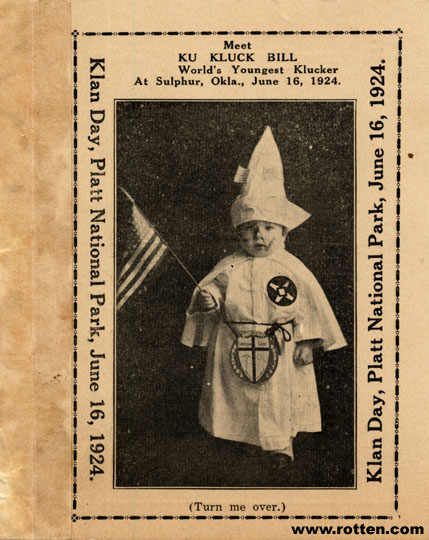
She woke up in the middle of the night, sat up in bed, and saw a man — she believes it was a white man — peering through her bedroom window. It was the early 1960s in a small Alabama city, and her family had just received a bomb threat from the Black Panthers because of her father’s notoriety as a Klan leader.

Foster, then about 6, tried to scream for help but her voice failed. Then the face disappeared. She later found out it was probably an FBI agent checking on her family’s safety.

The midnight memory is just one example of how her late father’s Klan activities cast an uneasy shadow over her childhood. The family received other threats; she recalls long stretches of wariness punctuated by moments of fear. That legacy continued to haunt her as an adult. She suffered from nightmares, was constantly vigilant, and didn’t easily trust others. She saw a therapist for several years and was diagnosed with post-traumatic stress disorder, an anxiety condition that can develop after frightening events. And she struggled to assert her own identity in the hometown where nearly everyone knew who her father was and assumed she shared his views about race.

“I just wanted to be me — not my father’s daughter,” said Foster, who now lives in northern Florida. (The Intelligence Report agreed not to identify her father, who died in 2003, to protect Foster’s privacy.)

In fact, Foster held beliefs very different from her father’s — a phenomenon she attributes partly to her faith. As a child of about 4 attending Sunday school in her family’s Methodist Church, she sang that Christ’s love is colorblind: “Jesus loves the little children/all the children of the world/black and yellow, red and white/They’re all precious in his sight.”

“I realized at a very young age that you either had to believe what the church taught or what my father stood for,” she said. “And what I saw my father doing was wrong.”

…Foster became a nurse, married and raised two children. For several years she volunteered as a Girl Scout leader, often working with black children from poor families. “I wanted to go out and do something for humanity and show that I believed differently than he did,” she said.

The Price of Hate

When Stephan Mills was 10 or 11, his father sat him and his older sister down after supper one night and told them that if they ever became emotionally involved with someone of color, he would kill them.

“I just nodded in agreement,” said Stephan, now 16.

The incident seemed normal to a boy who for years had been steeped in his father’s bigotry. Arthur Kemp, a South African white supremacist who has ties to British and American hate groups, indoctrinated his children with racist and anti-Semitic beliefs from the time they were very young. Stephan mostly adopted those views as his own. Several years ago, however, he rejected all that his father stood for. The experience would radically change his life and lead to his ongoing estrangement from his father, who’s now divorced from his mother and believed to be living in England.

“Stephan’s resentment toward his father is based partly on the fact that, in his sister’s words, he had to relearn to be a civilized human,” said his mother, Karen Mills.

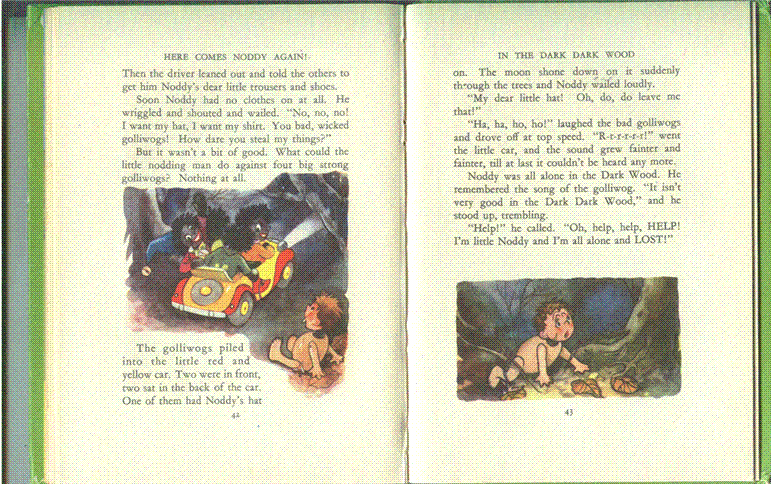
There was a lot to relearn. Arthur Kemp “was a very involved and doting father” when his children were small, Karen Mills said. He read to them often, carefully choosing books he felt would reinforce his ideology. Among them were the original “Noddy” series, English children’s books that featured Golliwogs, dark-skinned caricatures that were later removed from the text because they were deemed racist. In one of Kemp’s favorite Noddy books, the Golliwogs steal Noddy’s car. Kemp enjoyed telling his children that the Golliwogs’ theft of the car amounted to typical behavior for blacks.

…He also forbade socializing with non-white children. If they arrived at a friend’s party to find that a black child had also been invited, Kemp made his children go home. When Stephan was six, his father reluctantly took him and his sister to swimming lessons at a public pool where one of the children turned out to be black. “He told us to get out and that we were leaving,” said Stephan, who now uses his mother’s maiden name. “I was still pretty young so I didn’t really understand what was going on.”

…He also relished showing them articles and statistics that purported to prove that blacks were inferior. He contended that blacks could never be race car drivers because they have poor depth perception, that they cannot swim because their bones are too dense, that they are not as intelligent because their brains are smaller.

“The children were actively encouraged to be vocal about their views and to challenge their peers,” Karen Mills wrote. “In Stephan’s case in particular, this resulted in him being ostracized and made an outcast as he followed his father’s lead.”

Stephan said he had few friends until his first year of high school. At times, he suffered from depression because his father’s brainwashing had so alienated him from his peers, his mother said.

“I wasn’t really someone that people wanted to hang around with,” Stephan said. “They regarded me as weird because I was constantly talking about Hitler.”

…Karen Mills said Kemp has had almost no contact with his children since their divorce. “I don’t think there’s any way that Arthur could fix the broken relationship with Stephan,” she said. Nonetheless, “Stephan has gone through something of a catharsis.” In addition to his posts on Lancaster Unity, he chose to discuss his father when he was assigned to give a school speech on someone who had influenced him — only he said his father’s influence had been entirely negative. Now, his social life is improving, and he has resolved to be as unlike his father as possible. “I am stuck with some of his traits and characteristics — Mom used to joke with me that I have the Kemp laziness gene — but definitely not his political views,” he said.

Yet there’s no bringing back the years he lost to his father’s hate. “You,” he wrote to him in the September 2008 Lancaster Unity post, “will never understand what you have done to me.”

sometimes the apple does fall far from the tree

Thank God!  This is such an amazing story.  I’m so fascinated.  Not only by the bravery of a little white girl who crossed KKK, but also the shades of “mulatto” history sprinkled throughout.  Coon-hunting based on the supposed threat that black males posed to white women.  The “black” member of the Klan.  Passing.  Male chauvinism.  Homophobia. This is our sordid past.  And it is still haunting us.

Taking on the Klan

One summer night in 1965, 12-year-old Carolyn Wagner watched as Klansmen bound a young black man to a tree in her father’s field, accused him of violating the “sundown” rules in nearby Booneville, Ark., that forbade blacks from staying in town after dark, and lashed him a few times with a bullwhip as he cried out in pain and fear.

It was no different from beatings at other Klan gatherings her father had attended, but what happened next remains vivid in her memory: the Klansmen decided to tie the man to the railroad tracks below the pasture. When they were done, they ambled back to the field to discuss crops and politics. Wagner, a reluctant witness to her father’s Klan meetings, couldn’t stand it anymore. She stole down to the tracks, used a knife she kept in her boot to slash the rope that bound the man, and told him he could follow the tracks to Fort Smith, the nearest large town.

“That was a turning point,” recalled Wagner, now 56 and living in Tulsa, Okla. “I felt like I had made a difference when I was able to cut that man free. I realized I can make a choice to be a passive observer or I can become involved to diminish the harm that they’re doing. And that’s what I did from that night on, and that’s what I’m still doing.”

After years working for civil rights and children’s organizations, Wagner co-founded Families United Against Hate, a nonprofit group that helps people affected by bias incidents. Her experience growing up with a father in the Klan made her determined and fearless in her fight against hate. “That image of my dad and those men, and even the smells, are still with me, and they’ll always be with me. And it was very important that my children never know the world I knew when I was growing up.”

It was a world where Wagner’s father, Edward Greenwood, and his acquaintances gathered at least once a month at each other’s farms for Klan meetings, often bringing their children and grandkids. Because her father, then in his late 50s, couldn’t see well enough to drive at night, Wagner ferried him to meetings in a 1951 Chevy pickup. (Back then in rural Arkansas, it wasn’t unusual for children as young as 12 to drive on country roads.) The men — including lawyers, judges, cops and pastors — would begin their gatherings with a prayer and eschew alcohol. “They felt like they were doing God’s work,” Wagner said.

Sometimes, the gatherings would feature a beating like the one Wagner witnessed at her family’s farm. The victims were usually young men who’d been picked up on a pretext, such as paying too much attention to a white woman. “We would hear terms like ‘coon’ hunting,” she said. “My father would say, ‘I’m going ‘coon’ hunting.'”

But more often, the men would talk big, complaining about Presidents John F. Kennedy or Lyndon B. Johnson or even threatening to blow up the Supreme Court building. They’d eat bologna sandwiches that Wagner had prepared. Campfire smoke would mingle with the sweet-sour odor of Brylcreem, sweat and Old Spice. It was the one place where her father seemed happy. “I don’t remember seeing him smile or laugh unless he was with those goons,” she said.

…But her father probably would not have found a home in the Klan if his comrades had known about his heritage. “We knew there was this dirty secret in the family,” Wagner said.

In fact, her father’s great-great-great grandmother, Elizabeth Greenwood, was part Cherokee and part black, a former slave who’d settled in Arkansas when it was still part of France’s Louisiana Territory, according to family lore. Her father had cousins who identified as black, though he would have nothing to do with them. Wagner believes part of his racism stemmed from shame about his origins.

Wagner’s mother didn’t share her husband’s views about race, but she felt powerless to oppose him. Divorce was taboo in her family; resources for victims of domestic abuse were nearly nonexistent. “Mother never asked what he did [at Klan meetings],” Wagner said. “It was like she couldn’t bear to know.”

Wagner did receive support from her maternal grandparents, who passionately disliked her father. After Wagner secretly untied the black man from the railroad tracks, her maternal grandfather taught her how to use a 12-gauge double-barrel shotgun. She cut away the springs in the seat of the pickup to create a compartment where she hid the weapon, loaded and wrapped in a blanket. Though she never used it, she says she would have done so to defend herself or to help a potential Klan victim.

It wasn’t the last time she would defy all that her father represented. In April 1968, Wagner drove him to Memphis to take part in a Klan protest during the sanitation workers strike made famous by the appearance of Martin Luther King Jr. She was there when the civil rights leader was assassinated. In a Memphis newspaper, she read that the Department of Justice was planning a crackdown on the perpetrators of civil-rights era violence. After the assassination of Robert Kennedy two months later, Wagner, then 15, wrote a letter to the FBI accompanied by a list of names and addresses she’d copied from her father’s Klan directory. She wanted to get them all arrested. “I included my dad on that list,” she said.

Wagner, who used her maternal grandparents’ home as the return address, never heard back from the FBI.

She left home the day she finished high school and at 19 eloped with Bill Wagner, now her husband of 37 years. Her father died in 1980 when she was pregnant with her younger child, William. “I am so grateful that my children will have no memory of him or his politics,” she said.

But her own memories of her father came back strongly on William’s 14th birthday, the day he told his parents that he was gay. That day she and her husband’s biggest concern was for their son’s safety. “I had a very clear understanding of who the hatemongers were,” she said. They decided to move from their farm in tiny Booneville, a conservative town where homosexuality was widely condemned, to the more liberal university town of Fayetteville, some 120 miles away.

Still, they couldn’t protect their son from hate. Harassment at school culminated in a brutal assault in 1996. William, then 16, left school with friends to get lunch at a nearby convenience store when six teenagers shouted anti-gay slurs. They knocked him off his feet, then kicked him as he lay bleeding on the ground. “I thought about how easily that could have been my father’s group,” Wagner recalled. “And I wasn’t there.”

Two of the attackers were convicted of assault. After the Wagners filed a complaint on behalf of their son under Title IX, the federal anti-discrimination law, Fayetteville became the first public school district in the nation to enter into an agreement with the Department of Education’s Office of Civil Rights that required it to protect all students, including gays and lesbians, from harassment. The Wagners continue to advocate for young people who are targeted because of their actual or perceived sexual orientation.

Looking back on her childhood, Wagner remembers reading novels by Pearl S. Buck and biographies about women such as Harriet Tubman and Florence Nightingale. She wanted to learn about people who had survived difficult circumstances to help others, because she was determined to do the same.

“I found ways to survive,” she said. “I found ways to more than survive — to endure, to become stronger and to make our little corner of the world in the South a little better.”

instead of being a white man (he) is a mulatto

Web Site Tells Forgotten Tales of Slavery

By Dan Nonte and Lanita Withers Goins, University Relations

GREENSBORO, N.C. The 1860 U.S. Census registered the names of slave owners and the age, gender and color of slaves. But there, as in much of the historical record, slaves are nameless.

UNCG’s new Digital Library on American Slavery provides the names of more than 83,000 individual slaves from 15 states and the District of Columbia.

The web site, created in cooperation with University Libraries, features petitions related to slavery collected during an 18-year project led by history professor Loren Schweninger. The petitions filed in county courts and state legislatures cover a wide range of legal issues, including wills, divorce proceedings, punishment of runaway slaves, calls for abolition, property disputes and more.

“It’s among the most specific and detailed databases and web sites dealing with slavery in the U.S. between the Revolutionary War and the Civil War,” said Schweninger, the Elizabeth Rosenthal Excellence Professor in History. “There’s no web site like this, either in extent or content. The amount of information in here to be mined is enormous.”

Started in 1991, the Race and Slavery Petitions Project collected, organized and published the petitions. The Digital Library on American Slavery is the final phase of the project.

A complete collection of the full petitions, “Race, Slavery, and Free Blacks: Petitions to Southern Legislatures and County Courts, 1775-1867,” has been published on 151 reels of microfilm. In addition to UNCG’s Jackson Library, North Carolina university libraries with all or part of the microfilm collection are located at Duke, East Carolina, N.C. A&T, UNC Chapel Hill and Wake Forest.

Schweninger knows the value of conducting research from primary sources, something he learned from his mentor, the late Dr. John Hope Franklin. The stories he found in legal records were often not preserved anywhere else. “This was info that was not tapped,” he said. “Very few scholars had gone to county courts.”

Building the database for the archive was painstaking work. Schweninger visited about 160 county courthouses in the South and 15 state archives between 1991 and 1995. “The first three years, I was on the road 540 days,” he said.

Marguerite Ross Howell, senior associate editor, worked on the project for 11 years and was responsible for entering tens of thousands of slave names and connecting them with their own family members as well as their owners, creating a unique resource from original documents. Nicole Mazgaj, associate editor, worked on the project for seven years and focused her analysis especially on the rich documentary evidence from parish court houses in Louisiana.

“The archive is chock-full of information detailing the personal life of slaves,” Mazgaj said. “It’s probably about the most detailed that you’ll find.”

…The library includes petitions by more than 2,500 slaves and free blacks who sought redress for numerous causes. For example, George Sears of Randolph County, a blacksmith and a free man of color, purchased his slave wife Tillah for $300. He then petitioned the North Carolina General Assembly in 1818 to emancipate his wife and daughters and “render them Competent in Law to inherit the Estate of your Petitioner.”

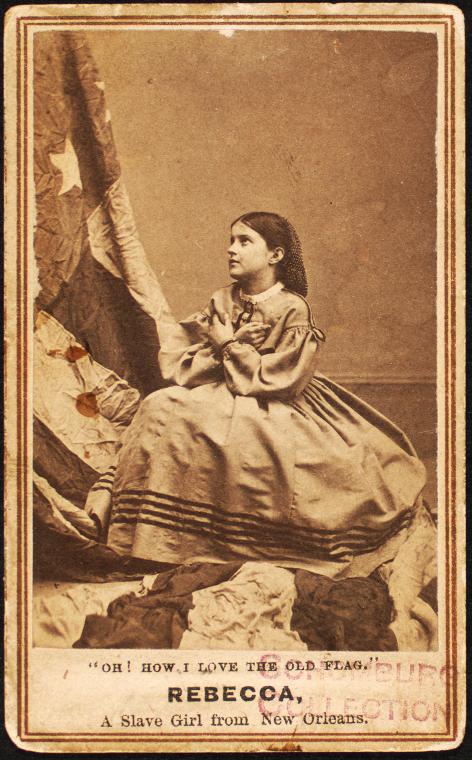
Other petitions show how race and slave status were sometimes in dispute. In one case, a Georgia slave owner sued one of his neighbors for slander for calling him a “damned negro,” averring that he was a black man. In another, a woman in Baltimore petitioned for divorce because her husband “instead of being a white man is a mulatto and in reality had been born a slave.” A New Orleans teenager who was put on the auction block to be sold as a slave asserted in her petition that she was in fact a free white woman.

A number of the petitions also speak to how slaves fought their enslavement, providing details of slaves who ran away, burned down plantations, or plotted to murder slave owners. As the petitions show, the position of free blacks in the South was also precarious, especially as certain states and counties sought to expel them or refused to allow them to enter.

Read more HERE

speaking of adoption

I’m not happy to be posting something connected to Ohio State University, BUT I’d never heard of an adoption like this one and I found it rather interesting, so pardon me fellow Wolverines…


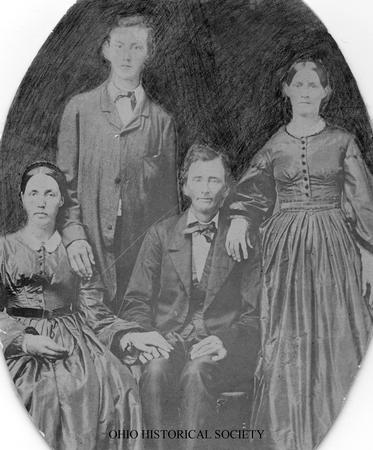
Mary C. Thorne and Family

This is a portrait of Mary C. Thorne of Selma, Clark County, Ohio, with her family. The woman standing is a mulatto fugitive slave that the Thorne family adopted. The image was collected by Ohio State University professor Wilbur H. Siebert (1866-1961). Siebert began researching the Underground Railroad in the 1890s as a way to interest his students in history.

SOURCE