Harvey Milk Day
May 22nd


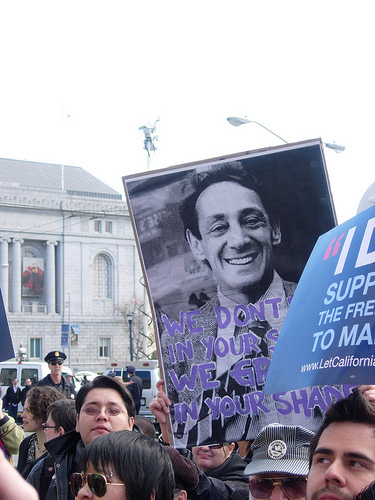

Harvey Milk Day
May 22nd
I’ve been meaning to post these things that have some correlation to a few of the week’s previous posts. So now I’m doing it.
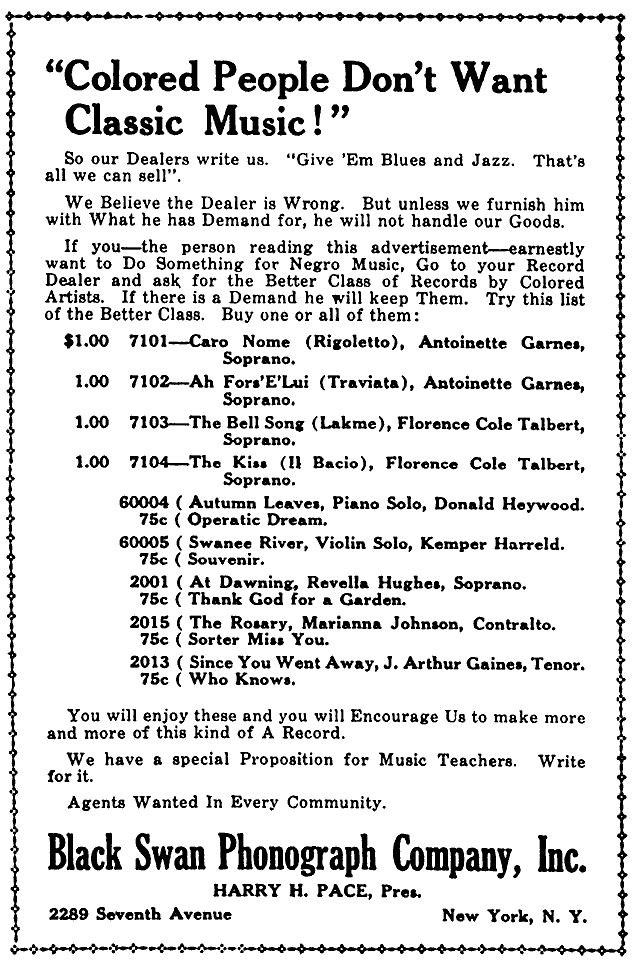


I’m going to try to get all of this Lena stuff out of my system today. It’ll actually never be out of my system, but as far as blogging goes… you know what I mean. I really enjoyed the following NPR blog post focusing on the racialization of Ms. Lena Horne. I wonder how different things would have been for her if things would have been different.
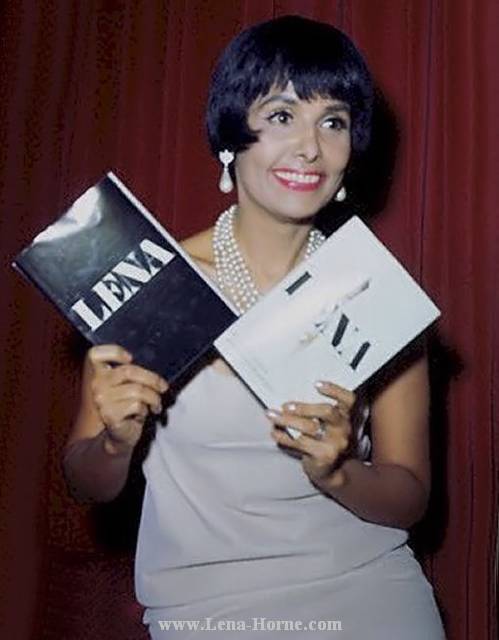
by PATRICK JARENWATTANANON
In the reports of Lena Horne’s death that have emerged so far, much has been made of the fact that she was a black woman in an age of popular entertainment dominated by white faces. Her talent was obvious, but her skin hampered her attempts to become a major movie star, assigning her to bit parts that could be removed for Southern audiences.
Eventually, after the civil rights movement, Horne would be recognized as an entertainment icon. Her work as a jazz singer, theatre performer and television actress did much for that legacy, as well. But she also knew that the skin color that worked against her also worked for her. In the obituary that came over the AP wire, she is quoted as saying this:
“I was unique in that I was a kind of black that white people could accept,” she once said. “I was their daydream. I had the worst kind of acceptance, because it was never for how great I was or what I contributed. It was because of the way I looked.”
“A kind of black that white people could accept.” Think on that for a moment, and beyond the idea of being a light-skinned African-American. You could write the entire history of jazz through that lens.

Jazz’s early black stars (Louis Armstrong, Duke Ellington, Nat “King” Cole, Billie Holiday and others) worked overtime to be somehow disarming, or mythologized, or otherwise acceptable to white bourgeois audiences. Meanwhile, the music they and all their colleagues were making was popularized by white musicians — Paul Whiteman, Benny Goodman, the Original Dixieland Jazz Band, the Dorsey Brothers — sometimes well, sometimes drained of its swing energy. This continuing process is a big part of jazz’s transformation from scourge of society into America’s classical music.
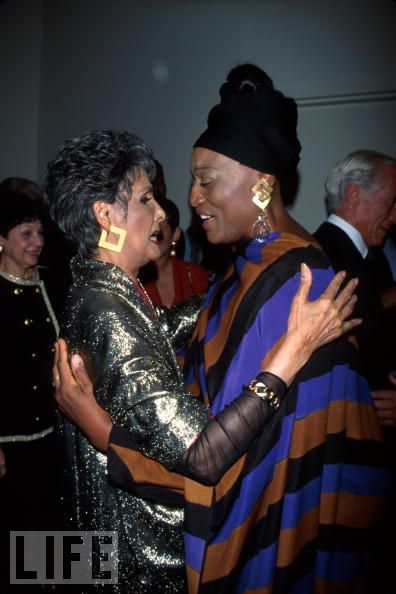
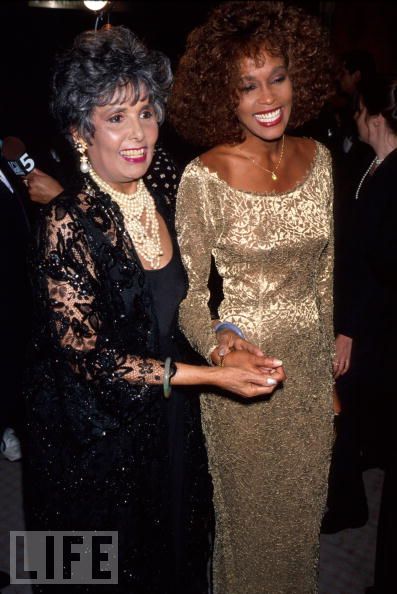
Indeed, the entire cultural history of the U.S. in the 20th century could be viewed like that. Even today, where ethnic identity comes in many more shades, the middle-class white audience still plays arbiter and co-opter of what hits the mainstream. That’s admittedly a reductive viewpoint, ignoring the powerful experience of the art created, and perhaps it’s a bit cynical, too. But it would be true to Lena Horne’s experience, both marginalized and a trailblazer for who she, biologically, was.
So what’s to do about this? Can’t we just remember Horne as a great singer and actress, the woman who did “Stormy Weather,” and the person whose friendship with Billy Strayhorn brought out the best in both of them?
Sure, but I’d rather not do only that. For one, it negates how she stood up against demeaning portrayals in what roles she took, and how she spoke out strongly against discrimination throughout her career. By omitting all that from our narrative of her life, it allows even the most well-meaning of people to conveniently forget how racism profoundly shaped the creation, marketing and embrace of American art, and continues to do so today.

The New York Times‘ obituary has another illustrative quotation:
My identity is very clear to me now. I am a black woman. I’m free. I no longer have to be a ‘credit.’ I don’t have to be a symbol to anybody; I don’t have to be a first to anybody. I don’t have to be an imitation of a white woman that Hollywood sort of hoped I’d become. I’m me, and I’m like nobody else.
Lena Horne didn’t choose to be racialized based on her genetic assignment, but she was. Remarkably, she ran with it, using it as a source of strength and pride and artistic inspiration. That’s worth remembering, to0.

I am deeply saddened by the loss of the legendary Lena Horne. I don’t think I have much personal commentary at this moment. I met Lena Horne once. I was four or five. My mom had a friend in Ms. Horne’s Broadway show.
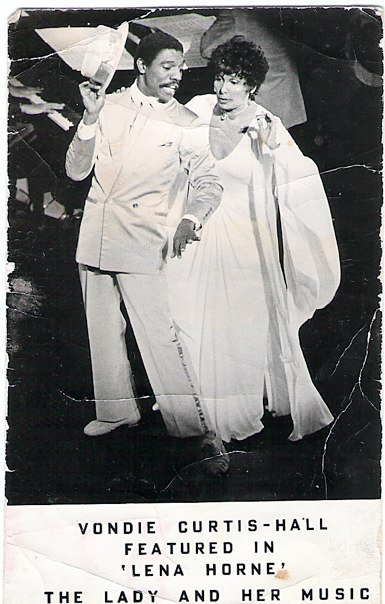
She took me to see it. We went backstage. My mom says that with Lena and I it was love at first sight. From what I can recall, I agree. On my end anyway. When I think back on that night the images that come up are all glowy and glittery with a hazy quality. Almost like a dream. Lena was truly magical. She seemed to think I was as well. Heck, when I was four or five I thought I was magical, too. Or, should I say that I knew I was. That I hadn’t forgotten. And nobody had tried to tell me otherwise yet. I imagine now that Lena sprinkled some kind of fairy dust on me with a whisper never to forget who I am. Not any part of it. Especially not the magic.
I digress.
Needless to say I am extremely grateful to my mother and to Vondie and to Lena for that moment. And also to Lena for breaking down barriers and speaking out against injustices and for paving the way for me to stand here today thinking these thoughts and trying to be a beacon for positive social change.

NEW YORK — Lena Horne, the enchanting jazz singer and actress known for her plaintive, signature song “Stormy Weather” and for her triumph over the bigotry that allowed her to entertain white audiences but not socialize with them, has died. She was 92.
Horne died Sunday at NewYork-Presbyterian Hospital, said hospital spokeswoman Gloria Chin, who would not release details.
Quincy Jones, a longtime friend and collaborator, was among those mourning her death Monday. He called her a “pioneering groundbreaker.”
“Our friendship dated back more than 50 years and continued up until the last moment, her inner and outer beauty immediately bonding us forever,” said Jones, who noted that they worked together on the film “The Wiz” and a Grammy-winning live album.

“Lena Horne was a pioneering groundbreaker, making inroads into a world that had never before been explored by African-American women, and she did it on her own terms,” he added. “Our nation and the world has lost one of the great artistic icons of the 20th century. There will never be another like Lena Horne and I will miss her deeply.”
“I knew her from the time I was born, and whenever I needed anything she was there. She was funny, sophisticated and truly one of a kind. We lost an original. Thank you Lena,” Liza Minnelli said Monday. Her father, director Vincente Minnelli, brought Horne to Hollywood to star in “Cabin in the Sky,” in 1943.


Horne, whose striking beauty often overshadowed her talent and artistry, was remarkably candid about the underlying reason for her success: “I was unique in that I was a kind of black that white people could accept,” she once said. “I was their daydream. I had the worst kind of acceptance because it was never for how great I was or what I contributed. It was because of the way I looked.”
In the 1940s, Horne was one of the first black performers hired to sing with a major white band, to play the Copacabana nightclub in New York City and when she signed with MGM, she was among a handful of black actors to have a contract with a major Hollywood studio.
In 1943, MGM Studios loaned her to 20th Century-Fox to play the role of Selina Rogers in the all-black movie musical “Stormy Weather.” Her rendition of the title song became a major hit and her most famous tune.
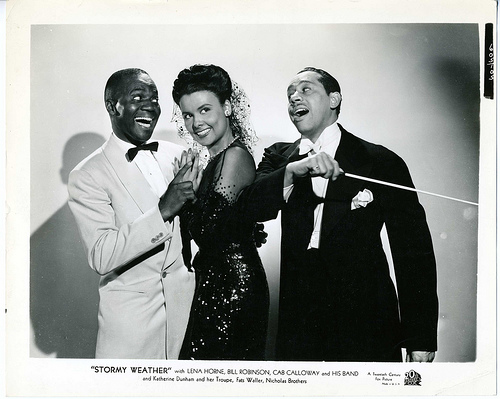
Horne had an impressive musical range, from blues and jazz to the sophistication of Rodgers and Hart in such songs as “The Lady Is a Tramp” and “Bewitched, Bothered and Bewildered.” In 1942’s “Panama Hattie,” her first movie with MGM, she sang Cole Porter’s “Just One of Those Things,” winning critical acclaim.
In her first big Broadway success, as the star of “Jamaica” in 1957, reviewer Richard Watts Jr. called her “one of the incomparable performers of our time.” Songwriter Buddy de Sylva dubbed her “the best female singer of songs.”
“It’s just a great loss,” said Janet Jackson in an interview on Monday. “She brought much joy into everyone’s lives – even the younger generations, younger than myself. She was such a great talent. She opened up such doors for artists like myself.”
Horne was perpetually frustrated with racism.
“I was always battling the system to try to get to be with my people. Finally, I wouldn’t work for places that kept us out. … It was a damn fight everywhere I was, every place I worked, in New York, in Hollywood, all over the world,” she said in Brian Lanker’s book “I Dream a World: Portraits of Black Women Who Changed America.”
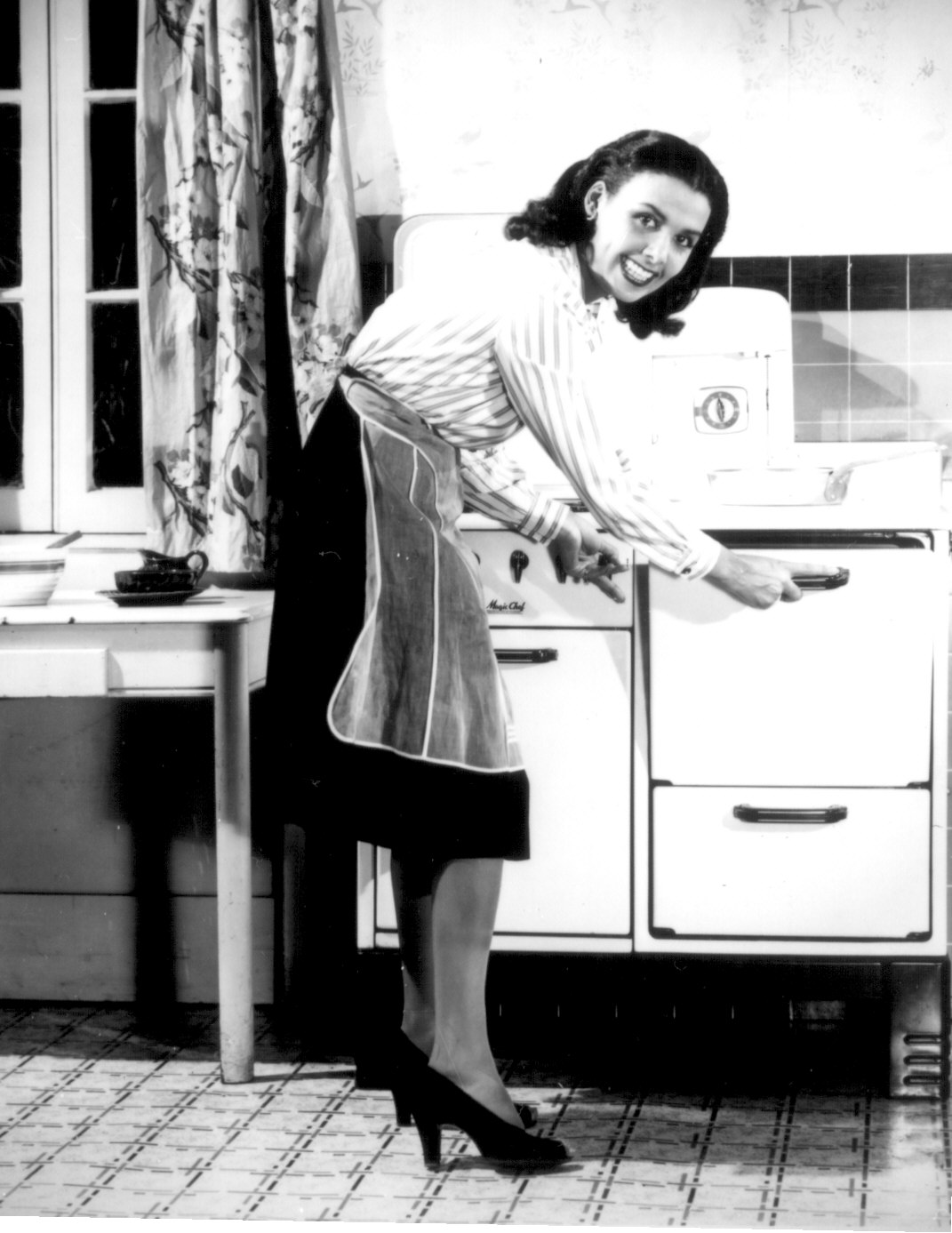
While at MGM, Horne starred in the all-black “Cabin in the Sky,” but in most movies, she appeared only in musical numbers that could be cut when shown in the South and she was denied major roles and speaking parts. Horne, who had appeared in the role of Julie in a “Show Boat” scene in a 1946 movie about Jerome Kern, seemed a logical choice for the 1951 movie, but the part went to a white actress, Ava Gardner, who did not sing.
“Metro’s cowardice deprived the musical (genre) of one of the great singing actresses,” film historian John Kobal wrote.
“She was a very angry woman,” said film critic-author-documentarian Richard Schickel, who worked with Horne on her 1965 autobiography.
“It’s something that shaped her life to a very high degree. She was a woman who had a very powerful desire to lead her own life, to not be cautious and to speak out. And she was a woman, also, who felt in her career that she had been held back by the issue of race. So she had a lot of anger and disappointment about that.”
Early in her career, Horne cultivated an aloof style out of self-preservation. Later, she embraced activism, breaking loose as a voice for civil rights and as an artist. In the last decades of her life, she rode a new wave of popularity as a revered icon of American popular music.
Her 1981 one-woman Broadway show, “Lena Horne: The Lady and Her Music,” won a special Tony Award, and the accompanying album, produced by Jones, earned her two Grammy Awards. (Horne won another Grammy, in 1995 for “An Evening With Lena Horne.”) In it, the 64-year-old singer used two renditions – one straight and the other gut-wrenching – of “Stormy Weather” to give audiences a glimpse of the spiritual odyssey of her five-decade career.

Lena Mary Calhoun Horne was born in Brooklyn on June 30, 1917, to a leading family in black society. Her daughter, Gail Lumet Buckley, wrote in her 1986 book “The Hornes: An American Family” that among their relatives was Frank Horne, an adviser to President Franklin D. Roosevelt.
She was largely raised by her grandparents as her mother, Edna Horne, who pursued a career in show business and father Teddy Horne separated. Lena dropped out of high school at age 16 and joined the chorus line at the Cotton Club, the fabled Harlem night spot where the entertainers were black and the clientele white. She left the club in 1935 to tour with Noble Sissle’s orchestra, billed as Helena Horne, the name she continued using when she joined Charlie Barnet’s white orchestra in 1940.

A movie offer from MGM came when she headlined a show at the Little Troc nightclub with the Katherine Dunham dancers in 1942.
Her success led some blacks to accuse Horne of trying to “pass” in a white world with her light complexion. Max Factor even developed an “Egyptian” makeup shade especially for her. But she refused to go along with the studio’s efforts to portray her as an exotic Latina.
“I don’t have to be an imitation of a white woman that Hollywood sort of hoped I’d become,” Horne once said. “I’m me, and I’m like nobody else.”
Horne was only 2 when her grandmother, a prominent member of the Urban League and the National Association for the Advancement of Colored People, enrolled her in the NAACP. But she avoided activism until 1945 when she was entertaining at an Army base and saw German prisoners of war sitting up front while black American soldiers were consigned to the rear.
That pivotal moment channeled her anger into something useful.
She got involved in various social and political organizations and, partly because of a friendship with singer-actor-activist Paul Robeson, was blacklisted during the red-hunting McCarthy era.
By the 1960s, Horne was one of the most visible celebrities in the civil rights movement, once throwing a lamp at a customer who made a racial slur in a Beverly Hills restaurant and, in 1963, joining 250,000 others in the March on Washington for Jobs and Freedom when Martin Luther King Jr. gave his “I Have a Dream” speech. Horne also spoke at a rally that year with another civil rights leader, Medgar Evers, just days before his assassination.
The next decade brought her first to a low point, then to a fresh burst of artistry. She appeared in her last movie in 1978, playing Glinda the Good in “The Wiz,” directed by her son-in-law, Sidney Lumet.
Horne had married MGM music director Lennie Hayton, a white man, in Paris in 1947 after her first overseas engagements in France and England. An earlier marriage to Louis J. Jones had ended in divorce in 1944 after producing daughter Gail and a son, Teddy.

Her father, her son and Hayton all died in 1970 and 1971, and the grief-stricken singer secluded herself, refusing to perform or even see anyone but her closest friends. One of them, comedian Alan King, took months persuading her to return to the stage, with results that surprised her.
“I looked out and saw a family of brothers and sisters,” she said. “It was a long time, but when it came I truly began to live.”
And she discovered that time had mellowed her bitterness.
“I wouldn’t trade my life for anything,” she said, “because being black made me understand.”

I’ve been meaning to post more about these AfroGerman children since blogging about the holocaust memorial last month. This post is mostly a reblog from MochaJuden.com. As someone who has a hard time embracing my German heritage (none of which is “afro”), I find myself fascinated by this piece of our history. I would love to track down some of these “brown babies” and interview them about their experiences in Germany and in the U.S. The Black German Cultural Society website is definitely worth checking out. So many resources, so much information. I have a feeling I’ll be touching on this topic again…. and again.
Many of our constituents are children who were born to German mothers who were abandoned by African American soldiers during the U. S. Occupation following World War II. While some remained in Germany, many were raised in orphanages or with foster families; a few remained with their natural mothers. Many were offered for International Adoption to African American Families and accepted into the US under the Displaced Persons Act of 1948 (amended June 16, 1950) , where it was assumed that they would “more easily assimilate into the culture.”
This result is a generation of culturally displaced persons who remain disconnected and alienated from the mainstream of the societies in which they lived and from both ethnic communities to which they belong.
Adoption is a wonderful concept and is generally accepted as an ideal social mechanism for improving lives and circumstances for abandoned or orphaned children. However, recent psychological and sociological research has determined that these children often suffer significant lifelong emotional and social problems such as identity deficits, separation and attachment disorders, and chronic depression, as well as other problems as a result of separation trauma and what has been identified as “the primal wound.”
The issue is magnified and the outlook becomes ever more complicated when we explore the international adoption and abandonment of interracial children who were created by opposing forces following a major global war. For the most part, there was no professional follow up in terms of the physical, social and emotional well being of these children once they were placed.
Historians in the last decade have begun to study and write publications about the Brown Baby Plan and the cooperative attempt between the two governments to place and provide for these unwanted and displaced children. Autobiographical Interviews and publications have given voice to the trauma and lifelong suffering stemming from the dramatic loss of identity and heritage and the cultural alienation that these children faced, particularly while growing up both in post war Germany and in the US during the Civil Rights era, a period when intense racism and discrimination was under scrutiny and identified as a major problem in both societies.
“We struggled through childhoods filled with confusion, fear, anger, and feelings of inferior self-esteem. Navigated adolescence in extreme conformity to perceived structures of authority, in order to redeem our existence, or in defiance to them in utter rebellion. Adulthood was either accomplished successfully by integrating the powerful nuances of our diversified selves, or postponed until safety could be found in the distanced wisdom of experience. Some of us didn’t make it. Some of us are just now coming of age.” ~ Rebecca, Black German Cultural Society.
American Homes For Germany’s Brown Babies Are Scarce – Jet Mag, May 15, 1952

Tan Tots Attend German Schools – Jet Magazine, July 24, 1952

Brotherly Love – Jet Magazine, December 18, 1952

German Brown Babies Arrive in US – Jet Magazine, January 29, 1953

Brown Babies Become Americanized – Jet Magazine, May 21, 1953

Brown Babies Find New Homes In America – Jet Mag, Oct 8, 1953

all photos found at: Vieilles_annonces of Flickr
What a life! From the seemingly extreme “Take that eugenics!”attitude of her parents, to the prodiginous achievements of her childhood, on to the “passing” years Philippa Schuyler’s story encompasses so many fascinating facets of the “biracial” experience of old.
1931-1967
Classical pianist, writer
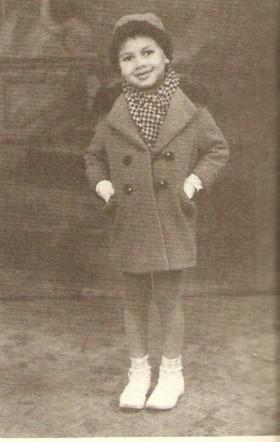
One of the most unusual and perhaps most tragic figures in American cultural history, Philippa Schuyler gained national acclaim as a child prodigy on the piano. Her picture graced the covers of weekly news magazines, and she was hailed as a young American Mozart. Schuyler’s life during adulthood, however, was a difficult one. She struggled with racial discrimination and with issues related to her mixed-race background, traveling the world in an attempt to find not only musical success but also an identity and a place in the world. She turned to writing in the early 1960s, visiting war zones as a newspaper correspondent, and she was killed in a helicopter crash in Vietnam in 1967. After her death she was mostly forgotten for several decades, but her life story was told in a 1995 biography.
Philippa Duke Schuyler was born on August 2, 1931, in New York and brought up in Harlem at the height of the area’s cultural flowering. The complexities of her life began with her background, for she had two singular parents. Her father George Schuyler was a journalist who wrote for one of the leading black newspapers of the day, the Pittsburgh Courier, and he was well acquainted with numerous writers in both black and white journalistic circles. He was not a civil rights crusader like many of his Harlem contemporaries, but rather a conservative satirist who rejected the idea of a distinctive black culture and later in life joined the ultra-right-wing John Birch Society. Philippa Schuyler’s mother, Josephine Cogdell Schuyler, was a white Southern belle from a Texas ranch who had married George Schuyler after coming to New York to escape a wealthy family of unreconstructed racists. They all refused to attend concerts Philippa Schuyler gave in Texas at the height of her fame.

Schuyler’s parents were in the grip of several novel theories and fads, some of which they devised themselves. They fed Philippa raw vegetables, brains, and liver, believing that cooking leached vital nutrients out of food. And, in contrast to the now-discredited but at the time widely held belief in eugenics, which formed the basis for Nazi ideas of racial purity, they claimed that racial mixing could produce a superior “hybrid” sort of human. That notion had strong effects on Philippa Schuyler’s life, for the Schuylers planned to make their daughter into Exhibit A for the gains that could be realized from black-white intermarriage.
And, indeed, the plan seemed to work. Schuyler walked before she was a year old, was said to be reading the Rubaiyat poems of Omar Khayyam at two and a half, and playing the piano and writing stories at three. When she was five, Schuyler underwent an IQ test at Columbia University; it yielded the genius-level figure of 185. She made rapid progress on the piano, and due to Mr. Schuyler’s connections it wasn’t long before stories about Philippa began to appear in New York newspapers.
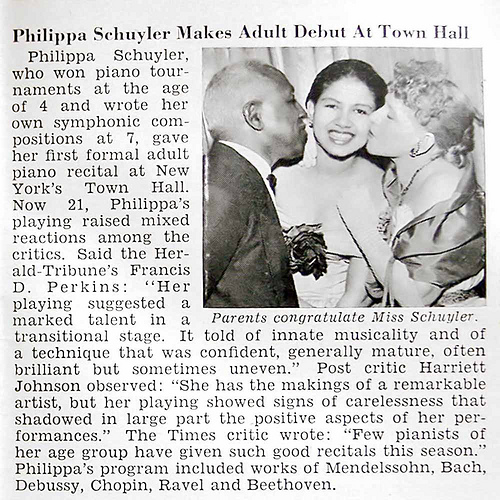
Schuyler’s mother, described by the New York Times as “the stage mother from hell, blending a frustrated artist’s ambition with an activist’s self-righteousness,” started to enter her in musical competitions. Schuyler did spectacularly well and was a regular concert attraction by the time she was eight. Just short of her ninth birthday, New York mayor Fiorello LaGuardia named a day after her at the New York World’s Fair. But her childhood was an isolated one; she was taught mostly by private tutors and had no friends her own age. Her mother, who fired her piano teachers whenever she began to get close to one emotionally, beat her regularly.
For a period of time during World War II, Schuyler was a national child star. She wrote a symphony at age 13, and leading composer and critic Virgil Thomson pronounced it the equal of works that Mozart had written at that age after the New York Philharmonic performed it in 1945. A concert Schuyler performed with the Philharmonic soon after that was attended by a crowd of 12,000, and profiles of the attractive teen appeared in Time, Look, and The New Yorker. Schuyler was promoted by the black press in general, not just in her father’s Pittsburgh Courier, as a role model, and she certainly inspired a generation of black parents to sign their kids up for piano lessons.
But there were pitfalls ahead for the talented youngster. When she was 13, she discovered a scrapbook her mother had kept of her accomplishments, and more and more she began to feel like an exotic flower on display. On tour, especially in the South, she began to experience racial prejudice, something of which she had been mostly unaware during her sheltered upbringing. Bookings began to dry up, except in black-organized concert series. Observers have offered various explanations as to why. Schuyler herself and many others pointed to discrimination; the world of classical music has never been a nurturing one for African-American performers, and in the 1940s very few blacks indeed had access to major concert stages. Some felt that Schuyler’s playing, although technically flawless, suffered from an emotionless quality brought on by the strictures of her demanding life. And Schuyler faced a problem she had in common with other teenage sensations—the tendency of the spotlight to seek out the next young phenomenon.

Schuyler and her mother reacted by once again calling in George Schuyler’s connections; he had friends in Latin American countries, and Schuyler began to give concerts there. In 1952 she visited Europe for the first time. Schuyler enjoyed travel, and, like other black performers, found a measure of unprejudiced acceptance among European audiences. Over the next 15 years she would appear in 80 countries and would master four new languages, becoming proficient enough in French, Portuguese, and Italian that she could write for periodicals published in those languages. She traveled to Africa as well as Europe, performing for independence leaders such as Kwame Nkrumah in Ghana and Haile Selassie in Ethiopia—but also passing for white in apartheid-era South Africa. Schuyler began to resist the pressure that still came from her parents, but she remained close to them, writing to her mother almost daily and becoming their chief means of financial support.
Her income came not only from music but also from lectures she gave to groups such as the virulently anti-internationalist John Birch Society, for Schuyler had come to share her father’s conservative politics. Despite her performances in newly independent African capitals, she came to adopt a positive outlook on European colonialism.
Confused and fearful about the future, Schuyler took steps in two new directions. First, since her ethnic identity seemed uncertain to those who had never encountered her, she began in 1962 to bill herself as Felipa Monterro or Felipa Monterro y Schuyler. She even obtained a new passport in that name. Her motivation seems to have been split between a desire to have audiences judge her without knowing of her African-American background, and a broader renunciation of her black identity. The ruse convinced audiences for a time, but the reviews of her concerts were mixed, and she soon abandoned the effort.
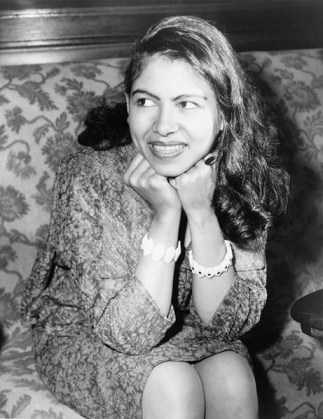
Second, Schuyler began to write. Traveling the globe, she filed stories from political hot spots for United Press International and later for the ultraconservative Manchester Union Leader newspaper in New Hampshire. She wrote several books and magazine articles as well, and at her death she left several unpublished novels in various stages of completion. One of them evolved into an autobiography, Adventures in Black and White, which was published in 1960.
She traveled to Vietnam to do lay missionary work, supporting U.S. military action there and writing a posthumously published book about American soldiers, Good Men Die. She founded an organization devoted to the aid of children fathered by U.S. servicemen, and on several occasions she assisted Catholic organizations in evacuating children and convent residents from areas of what was then the nation of South Vietnam as pro-North Vietnamese guerrillas advanced. It was on one of those evacuation missions, on May 9, 1967, that Schuyler’s helicopter crashed into Da Nang Bay. She drowned, for she was unable to swim. Shortly before her death, she had written a letter that seemed to suggest a political change of heart, expressing sympathy with black activist leader Stokely Carmichael.
Schuyler’s funeral was held at New York’s St. Patrick’s Cathedral, and in death she was once again in the headlines. Two years after her death, Schuyler’s mother hanged herself in her Harlem apartment. A New York City school was named after Schuyler, but her name dropped into temporary obscurity. She became better known with the publication in 1995 of Composition in Black and White: The Life of Philippa Schuyler, a biography by Kathryn Talalay. In 2004, star vocalist Alicia Keys was signed to portray Schuyler in a film co-produced by actress Halle Berry. “This story is so much about finding your place in the world,” Keys told Japan’s Daily Yomiuri newspaper. “Where do we really fit in, in a world so full of boxes and categories?”


This entire post is reblogged from Renegade South: histories of unconventional southerners. I find it to be a fascinating piece of American history. It’s one of those stories in which “american” history and “african-american” history are so intertwined that a distinction between the two can hardly be made. That’s just how it always should be, in my opinion. This country has just one history. It’s black and white and everything in between. The story is long and may be hard to follow, but I think it’s worth the effort.
Vernon F. Dahmer, a well known Mississippi civil rights worker, was murdered in 1966 by white supremacists connected to the Ku Klux Klan. Before the night of January 10, 1966, when the Dahmer grocery store and home were firebombed, Vernon had been leading voter registration drives in his community. To facilitate that effort, he had recently placed a voter registration book in the grocery store he owned.


It took many years and five court trials to convict KKK Imperial Wizard Sam Bowers in 1998 of having ordered the murder of Vernon Dahmer. Today, Dahmer is revered for his courageous work on behalf of black civil rights. In honor of his memory, both a street and memorial park in Hattiesburg bear his name.
In the essay that follows, Dahmer’s grandniece, Wilmer Watts Backstrom, and Yvonne Bivins, a member of his extended family, enrich our understanding by telling the story of his family roots in southern Mississippi. Dahmer’s multiracial heritage included white, black, and Indian ancestors. The narrative begins with the story of his grandmother, Laura Barnes.
The Family Origins of Vernon F. Dahmer, Mississippi Civil Rights Activist
By Wilmer Watts Backstrom and Yvonne Bivins
Laura Barnes was born in Jones County, MS in October 1854. According to her daughter, Roxanne Craft, “she was given to a black family to raise because she was born out of wedlock to a white girl.”
The 1870 census for Twp 9 in NE Jones County, Mississippi, shows that fifteen-year-old Laura was living in the household of Ann Barnes, a 55-year-old mulatto woman born in Mississippi whose occupation was housekeeper. A young mulatto boy, Augustus, age 12, also lived in the home. Living next door to the Barnes family were Andrew and Annice (Brumfield) Dahmer.

After the Civil War, Andrew Dahmer and his brothers became traveling salesmen who peddled their wares in Wayne, Jones, and Perry Counties in Mississippi. Andrew soon met and married Annice Brumfield, whose mother, Altamarah Knight Brumfield, was the daughter aunt of Newt Knight and Serena Knight.
Andrew and Annice’s neighbor, Laura Barnes, met Andrew’s brother, Peter Dahmer, in the early 1870s. They began a relationship that resulted in the birth of a baby boy in 1872, who Laura named George Washington Dahmer. Peter apparently did not acknowledge his child, and soon moved to Chickasaw County with several brothers, where they farmed and built a mercantile business.
For giving birth out of wedlock, Laura became a “marked woman.” During this period in her life, she operated a boarding house for the railroad and sawmill workers in northeast Covington County and near “Sullivan’s Hollow” in Smith County. The “Hollow” was notorious for its lawlessness and racial bigotry. Blacks were not welcome there. Black families that did live there were descendants of Craft and Sullivan slaves.
Laura hired a black man from the hollow named Charlie Craft. Working closely together on her place, they soon fell in love and developed a relationship. This would bring trouble, because although Laura was raised by a mulatto woman and listed as mulatto on census records, whites still considered her off limits to a black man.

Charlie Craft was born in Smith County, MS, around 1853. According to family history, he was part Creek Indian and part African, with piercing eyes and coal black straight hair. A former slave of Bryant Craft, Charlie was known as a man who had never run from a fight. Story has it that after a shootout with the infamous Sullivans, he left Smith County, but doubled back to spirit away his siblings. Because newly freed slaves were not welcome in Smith County, they moved to Covington County, where they settled on a ridge south of the Hollow in the Oakohay area. Here, they established a prosperous community called Hopewell.
By 1880, thirty-year-old Charlie and twenty-eight-year old Laura lived in the Oakohay District. Four children lived with them: George (Laura’s son by Peter Dahmer), age 10; [Roxanne] Viola, age 7; Bettie, age 5; and Elnathan, age 2. All, including Laura and her son George, were listed as “mulattos” on the 1880 federal manuscript census for Covington County. Living nearby were Charlie Craft’s mother, Melvina, and several siblings.
One night a local white mob filled with home brew surrounded and attacked their home. Both Laura and Charlie were excellent shots. Laura shot and killed one of attackers as they tried to protect their children from the mob and, in so doing, the couple had to flee “the ridge.” Laura’s son, George Dahmer, helped them escape. Upon arriving in the Kelly Settlement, they moved off in the swamps on the Leaf River on the old “William Jenkins Place.”

The area commonly known as Kelly Settlement was settled by John Kelly, a white man born in North Carolina about 1750. John and his wife, Amelia, left Hancock County, GA, and arrived in Mississippi in late 1819, settling in Perry County. By 1820, the Kelly household included John, Amelia, sons Green, 16, and Osborne, 18, Osborne’s wife Joene, and nine slaves. Among these slaves were the parents of Sarah, whose descendants later formed Kelly Settlement. Although the 1820 federal manuscript census for Perry County listed no free blacks living in the household of John and Amelia Kelly, descendants claim that Sarah’s folks were not slaves, but free people who accompanied the Kelly family to Mississippi.
After the Civil War, Sarah’s children began to homestead land, marry, and raise children. Working together as they had down on John Kelly’s place, they cleared the land to raise crops, cut timber, and hauled it to the Leaf River by oxen to float it down to the Gulf Coast.
Laura Barnes Craft’s son, George Dahmer, moved to the Kelly community ahead of the rest of the Crafts. In 1895, George married Ellen Louvenia Kelly, the daughter of Warren Kelly and Henrietta McComb. Like his own mother, Laura, Ellen’s mother, Henrietta, was a white child born out of wedlock and given to a black family, the McCombs, to raise. The McCombs were living on the William Jenkins place when the Crafts arrived in Perry County. Ellen Kelly’s father, Warren Kelly, was the mulatto son of Green H. Kelly and the grandson of John Kelly, the original white settler of the area. Warren Kelly’s mother was Sarah, the daughter of John Kelly’s slaves (or perhaps free black servants).

Charlie was employed by Green Kelly as a night watchman on the Leaf River. He died before 1910 in Forrest County, MS. By that year, several of his and Laura’s children were married and living in Kelly Settlement, MS. Although Laura’s name does not appear on the 1910 Census, she was still alive that year. In 1920, she lived with her oldest child, daughter Roxanne Craft Watts, on the Dixie Highway, Forrest County, MS. Laura died on 5 June 1922.
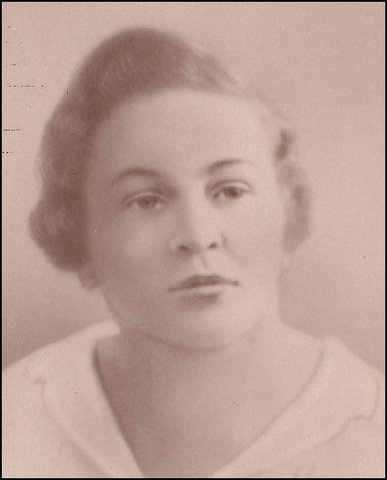
Laura’s son and Charlie’s stepson, George Dahmer, identified as a black man even though his mother and biological father were white, demonstrating how strongly one’s racial identity is shaped by social experience.
George and Ellen Kelly Dahmer were the parents of Vernon Dahmer. George was known as an honest, hardworking man of outstanding integrity, rich in character rather than worldly goods. Like his father, Vernon worked hard and became a successful storekeeper and commercial farmer. Before his tragic death, he served as music director and Sunday school teacher at the Shady Grove Baptist Church, as well as president of the Forrest County Chapter of the NAACP. He and his wife, Ellie Jewell Davis, were the parents of seven sons and one daughter.


March 24, 1912 – April 20, 2010
Thank you, Dr. Dorothy Height!
Here’s an excerpt of a 2008 NPR interview with Dr. Height. You can read the transcript in its entirety HERE.
hosted by Michel Martin
MARTIN: Dr. Dorothy Height began a lifetime of activism during the Great Depression, a time when the simple right to vote free of the fear of violence seemed like an impossible dream for many African-Americans. And at the of 96, she is still going to the office just about every day trying to further the cause of equal rights for all Americans. She’s serving as chair and president emerita of the National Council of Negro Women. She was kind enough to receive us at her office on historic Pennsylvania Avenue yesterday. We’re talking about President-elect Barack Obama’s historic win.
MARTIN: I wanted to ask you about that because you have been working in this field since you were a very young woman. I mean, really, your entire adult life. Since your early 20s you’ve been an activist. Did you believe this day would come in your lifetime?
…Dr. HEIGHT: Well, you know, I guess I got to – my faith was renewed working for 33 years with the YWCA of the United States. And I went there as a secretary or a staffer or something related to interracial education. After 33 years, I retired as a director of the Center for Racial Justice, and I split this organization, that from 1946 really set out to open its services to all women, regardless of race or with full regard for race, and so I saw the way an organization that was founded by white, Protestant women that now is very inclusive, and I was a part of that development.
When the YWCA in 1946 adopted an interracial charter, that was ahead of the Supreme Court’s decision on Brown versus the Board of Education, so that in a sense I had already the experience. And I listened to people when they kept saying – well, some people, particularly white people, will say this but they won’t go in. I also know that I worked with many white women who took a strong stand but they didn’t discuss it at home because their husbands didn’t agree with them, but they worked hard to see that the YWCA was integrated, as they called it. And today, the YWCA has Empower Women and Eliminate Racism as its slogan. And I think that made me know that there are many people who know that this is right to do and that they were willing to do it, but they didn’t necessarily announce it.
MARTIN: I remember that, reading in your memoir how your organization, the YWCA, was one of the first – and some precursor organizations were among the first to have integrated meetings, and how dangerous it was for some of these women to participate.
Dr. HEIGHT: At that time there were – when we had meetings, sometimes we were talking about the klan. Sometimes we found that we were denied services that we had been promised when they realized fully what it meant that we would be women of different races. But you know, I found that were strong women in all racial groups, and I think that’s what Barack Obama has shown us. There are people in every group who know what is right and who want to move, and they just need some kind of direction and some kind of feeling that other people are with them. I remember Dr. Mayo(ph) saying, I hear people say the time isn’t right. And he said, but if it isn’t right then it’s your job to ripen the time, and that’s the way I feel about it.
 12 Nov 1960, New York, New York, USA — Eleanor Roosevelt is presented the Mary McLeod Bethune Human Rights Award by Dorothy Height, President of the National Council of Negro Women. — Image by © Bettmann/CORBIS
…MARTIN: What role do you think civil rights organizations have now?
Dr. HEIGHT: Well, there’s still a lot of unfinished business. Right now you have going across the country a whole effort to destroy affirmative action. In other words, we’re finding that people are using civil rights in a negative way, and they’re calling it, this is a civil right. In a sense, these bills that are being introduced are really anti-civil rights, and they just use the term civil right in order to fool people and make them vote.
MARTIN: Are you speaking about Ward Connerly and some of his efforts to reverse affirmative action…
Dr. HEIGHT: Yes, Connerly has gone into several states, and he has does this in a misleading way, and I think people ought to be alert to it and realize that if you vote for what he is talking about, you’re cutting back something that got started during the days of Lyndon Johnson and was a part of the whole civil rights effort. It is not a preference. It is a way of saying, those who have been denied should be given an opportunity to be sought in (ph) so they can move ahead.
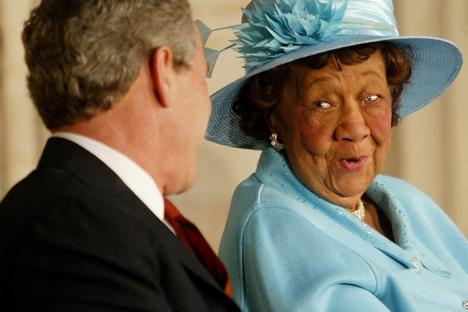 In 2004 President Bush presented Dr. Dorothy Height with the Congressional Gold Medal of Honor.
MARTIN: There are those who would argue, though, that – to be blunt about it – that Barack Obama takes these so-called excuses off the table. People look at that, and they say, look at Barack Obama in the White House. And they say, what discrimination? What could they possibly – what barriers?
Dr. HEIGHT: Yes. I think they will, but I would hope that they would also say to themselves, we need to look at who has the opportunities. We need to look at – Obama himself pointed that to us, that you can’t have a flourishing Wall Street and a destroyed Main Street. He could have also said, I’m working for the middle class, but we still have poverty. And we cannot divide up like that. We cannot say who’s hurting the most. We have to make sure they be dealing with everyone.
I have been working since my teenage days when I did an oration and won my college scholarship on the Constitution of the United States. I chose the 13th, 14th and 15th Amendments. And I looked and realized, here, now, at this age, I’m still working to make the 14th amendment and its promise of equal justice under law, making it real for everybody. That’s what you have to do.
MARTIN: Is there anything that you fear about an Obama presidency, about having an African-American – the first African-American in the White House?
Dr. HEIGHT: I suppose it’s not a real fear. It’s a hope that we will not take it for granted, that now we have achieved and all of our problems are answered. I think we will (unintelligible), as he did, as he said, I will be president of all the people. And by that he meant that he will work for all of us and that we all have to realize that there is unfinished business in civil rights.
It will – we don’t need the marches that we had in the past. But we need more consideration in looking at the boardroom tables and at the policies that are going on, looking at what’s happening in industry, what’s happening in terms of employment opportunities, housing and the like. So that I think it opens up a new way for us to look at our community.
And one thing, I go down now to Deep South and Mississippi and places, where during the ’60s, we moved with fear. I go down now and people are so welcoming that I forget what part of the country I’m in. And I think the people who are saying, we have no problem, have the biggest problem, that they really need to see how we can all work together and recognize that we need each other and see how we can really make this a society in which a person is judged, as Dr. Hayes(ph) said, on the basis of their character and what they do rather than on color of their skin or the language which they speak or their sexual preference, or any of those things.
MARTIN: Since you were a young woman yourself, you’ve been famous when you work with young people. Do you have any wisdom to share, perhaps, to a young Dorothy Height who might be listening to us?
Dr. HEIGHT: I like to say to young people today, you are the beneficiaries of what a lot of people worked and gave their lives for. And you are enjoying things – no matter how bad it may seen, you are still better off than any of those who worked to bring us to this point. And the important thing now is not to go it alone on your own, by yourself, but see how you will join with others. Get organized in how you will serve others and how you will help to move this forward.
And I was so excited to hear President-elect Obama, like they call him now, to hear him say that he needed our help. And I think he does. And we need it not by thinking just of what we want, but how can we help achieve the kind of roles that he has said. Because when you do that and we’re for something bigger than yourself, there’s no way you can help but grow, and that will help to prepare you for the future.

I posted this picture a couple of weeks ago, but just came across an article (found HERE) with details on those in the photograph. Wow!

In honor of Confederate History Month, I present a group of emancipated Louisiana slaves. The following letter was written by Colonel George Hanks, who commanded a Union Corps composed entirely of black troops. Hanks was attempting to raise money for the education of freed slaves:
To the Editor of Harper’s Weekly:
The group of emancipated slaves whose portraits I send you were brought by Colonel Hanks and Mr. Phillip Bacon from New Orleans, where they were set free by General Butler. Mr. Bacon went to New Orleans with our army, and was for eighteen months employed as Assistant-Superintendent of Freedmen, under the care of Colonel Hanks. He established the first school in Louisiana for emancipated slaves, and these children were among his pupils. He will soon return to Louisiana to resume his labor.
Rebecca Huger is eleven years old, and was a slave in her father’s house, the special attendant of a girl a little older than herself. To all appearance she is perfectly white. Her complexion, hair, and features show not the slightest trace of negro blood. In the few months during which she has been at school she has learned to read well, and writes as neatly as most children of her age. Her mother and grandmother live in New Orleans, where they support themselves comfortably by their own labor. The grandmother, an intelligent mulatto, told Mr. Bacon that she had “raised” a large family of children, but these are all that are left to her.
Rosina Downs is not quite seven years old. She is a fair child, with blonde complexion and silky hair. Her father is in the rebel army. She has one sister as white as herself, and three brothers who are darker. Her mother, a bright mulatto, lives in New Orleans in a poor hut, and has hard work to support her family.
Charles Taylor is eight years old. His complexion is very fair, his hair light and silky. Three out of five boys in any school in New York are darker than he. Yet this white boy, with his mother, as he declares, has been twice sold as a slave. First by his father and “owner,” Alexander Wethers, of Lewis County, Virginia, to a slave-trader named Harrison, who sold them to Mr. Thornhill of New Orleans. This man fled at the approach of our army, and his slaves were liberated by General Butler.The boy is decidedly intelligent, and though he has been at school less than a year he reads and writes very well. His mother is a mulatto; she had one daughter sold into Texas before she herself left Virginia, and one son who, she supposes, is with his father in Virginia. These three children, to all appearance of unmixed white race, came to Philadelphia last December, and were taken by their protector, Mr. Bacon, to the St. Lawrence Hotel on Chestnut Street. Within a few hours, Mr. Bacon informed me, he was notified by the landlord that they must therefore be colored persons, and he kept a hotel for white people. From this hospitable establishment the children were taken to the “Continental,” where they were received without hesitation.
Wilson Chinn is about 60 years old, he was “raised” by Isaac Howard of Woodford County, Kentucky. When 21 years old he was taken down the river and sold to Volsey B. Marmillion, a sugar planter about 45 miles above New Orleans. This man was accustomed to brand his negroes, and Wilson has on his forehead the letters “V. B. M.” Of the 210 slaves on this plantation 105 left at one time and came into the Union camp. Thirty of them had been branded like cattle with a hot iron, four of them on the forehead, and the others on the breast or arm.
Augusta Boujey is nine years old. Her mother, who is almost white, was owned by her half-brother, named Solamon, who still retains two of her children.
Mary Johnson was cook in her master’s family in New Orleans. On her left arm are scars of three cuts given to her by her mistress with a rawhide. On her back are scars of more than fifty cuts given by her master. The occasion was that one morning she was half an hour behind time in bringing up his five o’clock cup of coffee. As the Union army approached she ran away from her master, and has since been employed by Colonel Hanks as cook.
Isaac White is a black boy of eight years; but none the less intelligent than his whiter companions. He has been in school about seven months, and I venture to say that not one boy in fifty would have made as much improvement in that space of time.
Robert Whitehead–the Reverend Mr. Whitehead perhaps we ought to style him, since he is a regularly-ordained preacher–was born in Baltimore. He was taken to Norfolk, Virginia, by a Dr. A. F. N. Cook, and sold for $1525; from Norfolk he was taken to New Orleans where he was bought for $1775 by a Dr. Leslie, who hired him out as house and ship painter. When he had earned and paid over that sum to his master, he suggested that a small present for himself would be quite appropriate. Dr. Leslie thought the request reasonable, and made him a donation of a whole quarter of a dollar. The reverend gentleman can read and write well, and is a very stirring speaker. Just now he belongs to the church militant, having enlisted in the United States army.


 mulatto diaries