re: sometimes the apple does fall far from the tree

Here are excerpts from two stories similar to the one I posted yesterday.  You can read them in their entirety HERE.

Her Father’s Daughter

Cindy Foster will never forget the face in the window.

She woke up in the middle of the night, sat up in bed, and saw a man — she believes it was a white man — peering through her bedroom window. It was the early 1960s in a small Alabama city, and her family had just received a bomb threat from the Black Panthers because of her father’s notoriety as a Klan leader.

Foster, then about 6, tried to scream for help but her voice failed. Then the face disappeared. She later found out it was probably an FBI agent checking on her family’s safety.

The midnight memory is just one example of how her late father’s Klan activities cast an uneasy shadow over her childhood. The family received other threats; she recalls long stretches of wariness punctuated by moments of fear. That legacy continued to haunt her as an adult. She suffered from nightmares, was constantly vigilant, and didn’t easily trust others. She saw a therapist for several years and was diagnosed with post-traumatic stress disorder, an anxiety condition that can develop after frightening events. And she struggled to assert her own identity in the hometown where nearly everyone knew who her father was and assumed she shared his views about race.

“I just wanted to be me — not my father’s daughter,” said Foster, who now lives in northern Florida. (The Intelligence Report agreed not to identify her father, who died in 2003, to protect Foster’s privacy.)

In fact, Foster held beliefs very different from her father’s — a phenomenon she attributes partly to her faith. As a child of about 4 attending Sunday school in her family’s Methodist Church, she sang that Christ’s love is colorblind: “Jesus loves the little children/all the children of the world/black and yellow, red and white/They’re all precious in his sight.”

“I realized at a very young age that you either had to believe what the church taught or what my father stood for,” she said. “And what I saw my father doing was wrong.”

…Foster became a nurse, married and raised two children. For several years she volunteered as a Girl Scout leader, often working with black children from poor families. “I wanted to go out and do something for humanity and show that I believed differently than he did,” she said.
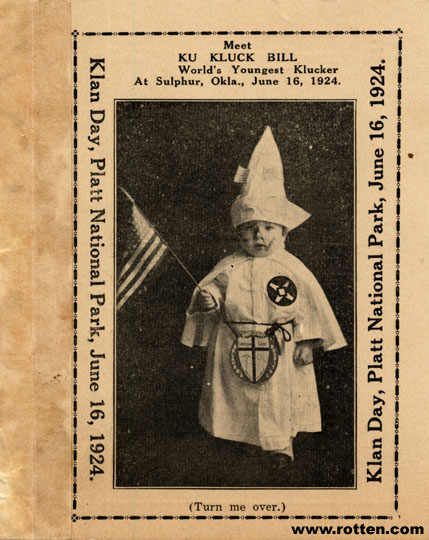
The Price of Hate

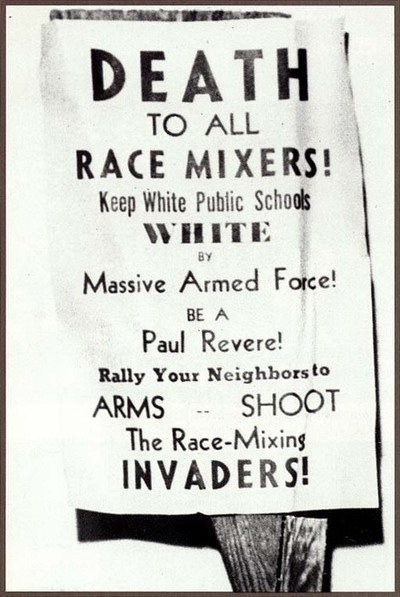
When Stephan Mills was 10 or 11, his father sat him and his older sister down after supper one night and told them that if they ever became emotionally involved with someone of color, he would kill them.

“I just nodded in agreement,” said Stephan, now 16.

The incident seemed normal to a boy who for years had been steeped in his father’s bigotry. Arthur Kemp, a South African white supremacist who has ties to British and American hate groups, indoctrinated his children with racist and anti-Semitic beliefs from the time they were very young. Stephan mostly adopted those views as his own. Several years ago, however, he rejected all that his father stood for. The experience would radically change his life and lead to his ongoing estrangement from his father, who’s now divorced from his mother and believed to be living in England.

“Stephan’s resentment toward his father is based partly on the fact that, in his sister’s words, he had to relearn to be a civilized human,” said his mother, Karen Mills.

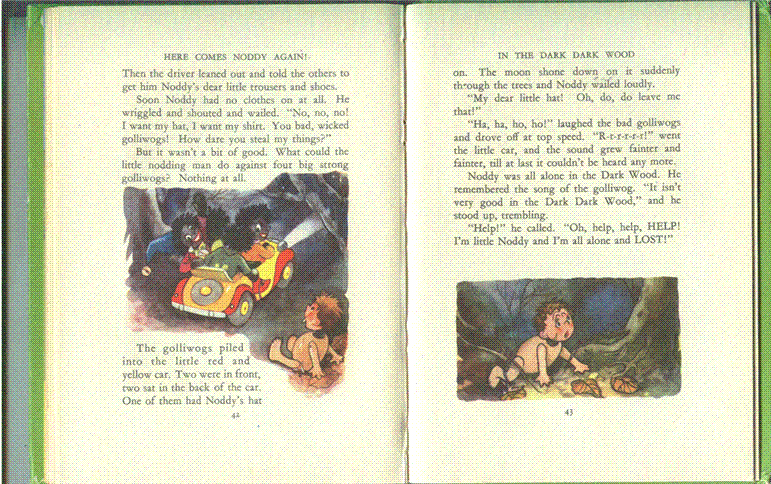
There was a lot to relearn. Arthur Kemp “was a very involved and doting father” when his children were small, Karen Mills said. He read to them often, carefully choosing books he felt would reinforce his ideology. Among them were the original “Noddy” series, English children’s books that featured Golliwogs, dark-skinned caricatures that were later removed from the text because they were deemed racist. In one of Kemp’s favorite Noddy books, the Golliwogs steal Noddy’s car. Kemp enjoyed telling his children that the Golliwogs’ theft of the car amounted to typical behavior for blacks.

…He also forbade socializing with non-white children. If they arrived at a friend’s party to find that a black child had also been invited, Kemp made his children go home. When Stephan was six, his father reluctantly took him and his sister to swimming lessons at a public pool where one of the children turned out to be black. “He told us to get out and that we were leaving,” said Stephan, who now uses his mother’s maiden name. “I was still pretty young so I didn’t really understand what was going on.”

…He also relished showing them articles and statistics that purported to prove that blacks were inferior. He contended that blacks could never be race car drivers because they have poor depth perception, that they cannot swim because their bones are too dense, that they are not as intelligent because their brains are smaller.

“The children were actively encouraged to be vocal about their views and to challenge their peers,” Karen Mills wrote. “In Stephan’s case in particular, this resulted in him being ostracized and made an outcast as he followed his father’s lead.”

Stephan said he had few friends until his first year of high school. At times, he suffered from depression because his father’s brainwashing had so alienated him from his peers, his mother said.

“I wasn’t really someone that people wanted to hang around with,” Stephan said. “They regarded me as weird because I was constantly talking about Hitler.”

…Karen Mills said Kemp has had almost no contact with his children since their divorce. “I don’t think there’s any way that Arthur could fix the broken relationship with Stephan,” she said. Nonetheless, “Stephan has gone through something of a catharsis.” In addition to his posts on Lancaster Unity, he chose to discuss his father when he was assigned to give a school speech on someone who had influenced him — only he said his father’s influence had been entirely negative. Now, his social life is improving, and he has resolved to be as unlike his father as possible. “I am stuck with some of his traits and characteristics — Mom used to joke with me that I have the Kemp laziness gene — but definitely not his political views,” he said.

Yet there’s no bringing back the years he lost to his father’s hate. “You,” he wrote to him in the September 2008 Lancaster Unity post, “will never understand what you have done to me.”
speaking of adoption

I’m not happy to be posting something connected to Ohio State University, BUT I’d never heard of an adoption like this one and I found it rather interesting, so pardon me fellow Wolverines…


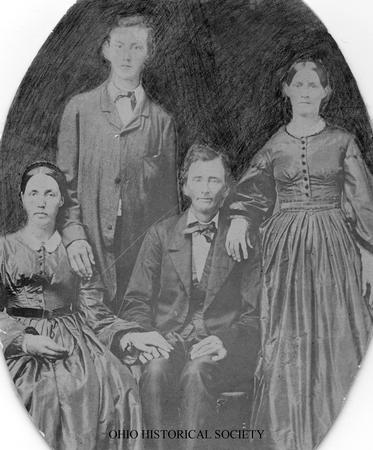
Mary C. Thorne and Family

This is a portrait of Mary C. Thorne of Selma, Clark County, Ohio, with her family. The woman standing is a mulatto fugitive slave that the Thorne family adopted. The image was collected by Ohio State University professor Wilbur H. Siebert (1866-1961). Siebert began researching the Underground Railroad in the 1890s as a way to interest his students in history.

SOURCE

re: the effect of skin tone

I thought that was such a great experiment and the findings so very revealing.  Coincidentally, I came across these new cameras yesterday and i thought to myself, “If these cameras are exactly the same (color aside), why’s the black one gotta be the devil while the white one’s an angel.”  I think it borders on modern day racist advertising if you consider it a bit too seriously (perhaps).

Which would you prefer?  You can buy one here

the effect of skin tone

The Science of How We See Obama’s Skin Color

Andrew Romano

When it comes to the policies and politics of Barack Obama, it’s no secret that liberals and conservatives don’t see eye to eye. But according to behavioral sciencist Eugene Caruso of the University of Chicago’s Booth School of Business, these differences in perspective may literally be a difference in perception. In a new study, Caruso and colleagues Emily Balcetis of New York University and Nicole Mead of Tillberg University asked a group of undergraduates which of a series of photographs of Obama–some of them secretly lightened and darkened–best represented who he is as a person. The results were striking: while self-described liberals tended to pick the digitally lightened photos of the president, self-described conservative students more frequently picked the darkened images. The more one agrees with a politician, in other words, the lighter his skin tone seems; the less you agree, the darker it becomes. To discuss how political affinities influence perception–and how politicians and the press could take advantage of these findings–NEWSWEEK’s Andrew Romano spoke to Caruso. Excerpts:

How did the study actually work?
Essentially we were interested in whether political party influences how people literally see the world, and how they may see different depictions of candidates as representative of who they really are. So to test this we gathered up a bunch of photos of Barack Obama and digitally altered them to create a version where his skin tone appeared a bit lighter and a version where his skin tone was a bit darker than it appeared in the original photograph. And then we just showed people several different photos and asked them to rate each one on how much they represented who he really is. What we found was that participants who told us that they had a liberal political orientation rated the lightened photographs as more representative of Obama than the darkened photographs, whereas participants who told us they had a more conservative ideology rated the darkened photographs as more representative of Obama than the lightened ones. 

I’m no expert here, but you’re confident that it’s the skin tone that changes “representativeness” in the eyes of the voter, as opposed to something else about the photographs—like pose, or background, or facial expression?
That’s a great question. What we did was essentially take three different photos with three different poses, and created for each photo a lightened and a darkened version. And then we randomly selected the combination of pose and skin tone that we showed each participant.

So your findings about “representativeness” were consistent across poses—the conservative will be twice as likely to say a “darkened” Obama was representative, regardless of which image of Obama was being darkened?
Right. We were experimentally able to isolate the effect of skin tone because some people saw a lightened version of pose #1 and others saw a darkened version of pose #1—and independent of the pose the lightened versions seemed most representative to liberals and the darkened most representative to conservatives.

Were you surprised by the results?
A little bit. Some of my research deals with how people who have different views on a subject are able to try to understand the views of someone on the other side, and the general finding is that people aren’t particularly good at really coming to understand the perspective of someone with whom they disagree. Beyond that, though, I got interested in this notion of whether our beliefs can actually affect the way we see the world—of whether they can actually affect our perception of objects or people in our environment. And it turns out they can.

Ultimately, what does it mean that someone believes a lightened version of Obama is more representative of him than a darkened version, and vice versa? What are the larger implications of these differences in perception?
Partisanship can affect all sorts of beliefs. It’s not surprising that a liberal and a conservative who read the same health care bill would come to very different conclusions about its merits. But I think our work is more akin to having a liberal and conservative look at the exact same physical copy of a bill sitting on the desk in front of them and disagreeing over how thick it is. That is, even something that we feel we should be able to see similarly, like a person’s racial identity or physical characteristics, can be influenced by our desire to see that person favorably or unfavorably.

But isn’t there a chicken or egg relationship here? Do conservatives see Obama as darker and are thus prone to dislike him, or do they dislike him first and then see him as darker because of it?
That’s a great question. One of the things we’re trying to do now is experimentally try to tease those two options apart. Basically, what we have in our current paper, the one that’s out now, is correlational studies of Obama where we don’t really know what comes first or what’s causing what. The first study in the paper tries to address part of what you’re asking. If we get people to think about a novel candidate and simply manipulate whether they agree with a candidate or not, we can show that people who think this novel biracial candidate agrees with them later report that the lightened photos are more representative of him, suggesting that if you agree with someone then you may come to see him as lighter. From that we can speculate, exactly as you have, about the reverse path—and that is, seeing images of someone when his or her skin tone looks darker may cause people to like that person less than seeing images of that person with lighter skin tone.

read the entire interview here