more on the racial ‘integrity’ act

Perhaps even more influential than John Powell was Walter Plecker.  Plecker dedicated his life to making sure that people like me could not exist.  And though the notion predated him, I believe that he further ingrained into the consciousness of the nation the myth of the “tragic mulatto.” But even worse than that, he stripped the Native Americans of Virginia of their rights and identity.  In my opinion Powell, Plecker, and the Eugenics movement in general are major pieces of this race in America puzzle. 

John Powell, the renowned Richmond-born composer and pianist, clutches an American flag in this news service photograph from 1920. Wealthy Virginians and powerful newspaper editors supported the white-supremacist sentiments espoused by Powell. Fear of racial mixing was particularly pronounced among genealogy-obsessed Virginians who wanted to maintain a “pure” bloodline.

Disdaining the Ku Klux Klan’s violent white supremacist policies and tactics, elite white Virginians embraced the scientific racism espoused by the Anglo-Saxon Clubs of America. Founded in Richmond in September 1922 by internationally renowned pianist John Powell, self-styled ethnologist Earnest Sevier Cox, and Walter Plecker, the ASCOA committed itself to preserving white “racial purity.” Powell provided the movement’s star power and publicity; Cox’s book White America (1923) provided the pseudoscientific, eugenic justifications; and Plecker backed the other two with the state’s police power. The ASCOA demanded legislation prohibiting interracial marriage and defining anyone with any non-white heritage—even one drop—as black.

Passed at the height of the eugenics movement, the Racial Integrity Act proclaimed the existence of only two racial categories in Virginia—”colored” and white.  The law stripped Native Americans, and members of other groups with dark skin, of their land, voting rights, and legal identity.

Walter Ashby Plecker was the first registrar of Virginia’s Bureau of Vital Statistics, which records births, marriages and deaths. He accepted the job in 1912.  For the next 34 years, he led the effort to purify the white race in Virginia by forcing Indians and other nonwhites to classify themselves as blacks. It amounted to bureaucratic genocide.

He worked with a vengeance.

Plecker was a white supremacist and a zealous advocate of—a now discredited movement to preserve the integrity of white blood by preventing interracial breeding. Unless this can be done,” he once wrote, “we have little to hope for, but may expect in the future decline or complete destruction of our civilization.”

Plecker would recall his early days in a letter to a magazine editor expressing his abhorrence of interracial breeding. He remembered “being largely under the control” of a “faithful” slave named Delia. When the war ended, she stayed on as a servant. The Pleckers were so fond of her that they let her get married in their house. When Plecker’s mother died in 1915, it was Delia “who closed her eyes,” he wrote.

Then Plecker got to his point. “As much as we held in esteem individual negroes this esteem was not of a character that would tolerate marriage with them, though as we know now to our sorrow much illegitimate mixture has occurred.” Plecker added, “If you desire to do the correct thing for the negro race … inspire (them) with the thought that the birth of mulatto children is a standing disgrace.”

Walter Plecker sits at his desk in 1935 at the Bureau of Vital Statistics

Plecker was a devout Presbyterian. He helped establish churches around the state and supported fundamentalist missionaries. Plecker belonged to a conservative Southern branch of the church that believed the Bible was infallible and condoned segregation. Members of Plecker’s branch maintained that God flooded the earth and destroyed Sodom to express his anger at racial interbreeding.

“Let us turn a deaf ear to those who would interpret Christian brotherhood as racial equality,” Plecker wrote in a 1925 essay.

Plecker saw everything in black and white. There were no other races. There was no such thing as a Virginia Indian. The tribes, he said, had become a “mongrel” mixture of black and American Indian blood.

Their existence greatly disturbed Plecker. He was convinced that mulatto offspring would slowly seep into the white race.  “Like rats when you’re not watching,” they “have been sneaking in their birth certificates through their own midwives, giving either Indian or white racial classification,” Plecker wrote.

Photograph of 1943 letter from Walter Plecker.

Many who came into Plecker’s cross hairs were acting with pure intentions. They registered as white or Indian because that’s how their parents identified themselves. Plecker seemed to delight in informing them they were “colored,” citing genealogical records dating back to the early 1800s that he said his office possessed. His tone was cold and final.

In one letter, Plecker informed a Pennsylvania woman that the Virginia man about to become her son-in-law had black blood. “You have to set the thing straight now and we hope your daughter can see the seriousness of the whole matter and dismiss this young man without any more ado,” he wrote.

In another missive, he rejected a Lynchburg woman’s claim that her newborn was white. The father, he told her in a letter, had traces of “negro” blood.

“This is to inform you that this is a mulatto child and you cannot pass it off as white,” he wrote.

“You will have to do something about this matter and see that this child is not allowed to mix with white children. It cannot go to white schools and can never marry a white person in Virginia.

“It is a horrible thing.”

Plecker demanded the removal of bodies from white cemeteries. He tried to evict a set of twins from a Presbyterian orphanage because they were illegitimate and, therefore, the “chances are 10-1 they are of negro blood.”

Plecker maintained that all of his racial designations were based on impeccable records. There was, however, a secret Plecker revealed to only a few trusted allies: A lot of the time he was just guessing.

He acknowledged the sham when a Richmond attorney questioned his authority to change the birth certificate of a woman classified as an Indian before 1924. Plecker quietly admitted he had no such power and rescinded his designation of the woman as “colored.”

Plecker fretted that he would lose his hold on Indians if word of his retreat got out. “In reality I have been doing a good deal of bluffing, knowing all the while that it could never be legally sustained,” he wrote to his cohort, John Powell. “This is the first time that my hand has been absolutely called.”

The setback was temporary, however. The attorney kept quiet.

Plecker’s racial records were largely ignored after 1959, when his handpicked successor retired. Virginia schools were fully integrated in 1963 and, four years later, the state’s ban on interracial marriage was ruled unconstitutional. In 1975, the General Assembly repealed the rest of the Racial Integrity Act.

Virginia has tried to erase Plecker’s legacy. It has established councils on Indian affairs and has conferred official state recognition on eight tribes, a designation that provides no privileges. But Indian leaders say recognition equals respect.

The approach to healing for mixed-race Indians must be holistic, inclusive of their bi-racial and tri-racial and Indian identity.

SOURCE

white top

White Top Folk Festival by Jason Riedy.

Text of the sign: “The White Top Folk Festival was held annually from 1931 to 1939 (except 1937) on Whitetop Mountain — the second highest peak in Virginia. Annabel Morris Buchanan, John Powell, and John A. Blakemore organized the event that featured banjo players, fiddlers, string bands, and ballad singers, as well as storytelling, clog dancing, morris and sword dancing, and theatrical presentations. Thousands of people attended the festival each year, including nationally known academic folklorists, art critics, composers, and in 1933, First Lady Eleanor Roosevelt. The festival was cancelled in 1940 because of heavy rains and floods and never returned.

A First Lady in a False Kingdom: A Curious

Convergence on White Top Mountain

CHRISTA SMITH ANDERSON

From 1932 to 1939, the Whitetop Folk Festival attracted people from far and wide to the small mountain community. In 1933, even First Lady Eleanor Roosevelt stopped by to celebrate.

It was August 12, and the tenure of America’s longest-running first lady was in its infancy. Franklin Roosevelt had been in office just over five months. The FBI was still called the Bureau of Investigation, and its director, J. Edgar Hoover, hadn’t started compiling what would become his largest secret file — the 3,271 pages on Eleanor Roosevelt’s activities, many of them anti-segregation and, thus, “subversive.” The Ku Klux Klan didn’t know Eleanor Roosevelt well enough yet to have a price on her head. Another six years would pass before her infamous resignation from the Daughters of the American Revolution (DAR) over that organization’s refusal to allow African-American contralto Marian Anderson to perform in Constitution Hall.

…One of the festival’s organizers, John Powell, proudly asserted that “the great proof of the importance and the significance of the great musical heritage of our people is in the fact that Mrs. Roosevelt should come.”

Like many a memorable character, John Powell, who was also a founder of the Anglo- Saxon Clubs of America, is both compelling and repelling. A classical composer and pianist from Richmond, Virginia, Powell studied in Vienna with Theodor Leschetizky, in Prague with Karl Navrátil. He made his debut in Berlin in 1907, when he was twenty-five years old; the performance was hailed by critics as one of the most successful the city had ever known.

In the first part of his career, Powell incorporated all forms of American music — notably, African-American music — into compositions like Sonata Virginianesque and Rhapsodie Nègre. But by the 1930s, when he was selecting and shaping the White Top Folk Festival musicians, he was committed to promoting what he considered “Anglo-Saxon” music: a pure, white music from a pure, white region of America, whose music was dangerously at risk of becoming defined by a black American baby called Jazz.

By excluding black musicians, probably of some Anglo heritage themselves, Powell and other festival organizers brought to the mountaintop the pernicious bias that would become Powell’s legacy.

In 1924, Powell was instrumental in a court case that prevented the marriage of Dorothy Johns and James Connor by proving that one of Johns’s ancestors was black, thus she could not legally marry Connor, who was white. Some thirty-four years later, Powell was also instrumental — by virtue of his efforts in the 1920s — in making sure that interracial newly-weds Mildred and Richard Loving didn’t get a full night’s sleep. A few weeks after they were married, the Lovings were awakened around two a.m. by flashing police lights and escorted from their bed so they could be booked into the Caroline County, Virginia, jail. Each was charged with a felony.

The Dorothy Johns case was the first test of Virginia’s Racial Integrity Act, the Lovings’ the last. The “one-drop” law made interracial marriage a felony in Virginia and was especially targeted at whites marrying blacks, blacks being defined, of course, as anyone with “one drop” of black blood. Powell worked with other racial eugenicists to get the law passed in 1924, and was the self-proclaimed originator of it. By 1967, when the U.S. Supreme Court overturned the Racial Integrity Act in Loving v. Virginia, there were similar laws in fifteen other states as far north as Delaware, and as far west as Oklahoma.

For Eleanor Roosevelt, this 1933 trip to Southwest Virginia was a sentimental journey. Her father, Elliott, lived out the Panic of 1893 — the Great Depression’s predecessor — in the Southwestern Virginia town of Abingdon, close to the Tennessee and North Carolina borders.

At the festival, Eleanor warmly addressed the crowd of some ten thousand attendees: “To the people who live here I want to say a special word of gratitude. They have given me the feeling that they remember affectionately my father, whom I adore.”  And then she ended her speech, “For the rest of the day I hope to be just a spectator.”

Hundreds of performers took the stage for the festival that year. Among the prizewinners was Jack Reedy from Marion, Virginia. He won first prize in banjo; tied for first in clog dancing; and performing with the Blevins Brothers in the band competition, tied for first.


Eleanor Roosevelt posed with White Top Folk Festival contestants Frank Blevins (fiddle), Jack Reedy (banjo), Edd Blevins (guitar), and six-year-old mandolin sensation, Muriel Dockery, in 1933.
Library of Virginia

Mrs. Roosevelt may very well have heard some of the same songs her father did. But didn’t she, or any of those reporters who’d read about the “quartette of negroes” singing to him in the 1890s, think it curious that in the 1930s, not a one of the singers, instrumentalists, dancers, or storytellers at this folk-music festival with a five-state view was black? Did they not find the complexion of this kingdom to be unusually fair?  I’d like to think the White Top Mountain Folk Music Festival was the fool-me-once in Eleanor’s evolution as a Civil Rights activist.  Eleanor never publicly criticized the White Top Mountain Folk Music Festival organizers for their exclusion of black performers. But her reaction to some of the people who did perform hints at the cost of Powell’s agenda on the music he was trying to elevate. In her “Passing Thoughts of Mrs. Franklin D. Roosevelt” column in the Women’s Democratic News, Eleanor wrote of the women ballad singers she saw and heard on White Top: “[They were] fine featured … showing in their carriage and expression that there is something in inheritance.” As for the music, “Their voices were not remarkable but the whole thing was of great interest to those who believe that there is value in preserving the folk lore which has come out of the early customs and experiences of the people of the country.”

For whatever Powell might have thought of Eleanor Roosevelt in 1933, it’s quite certain that his opinion would’ve changed drastically by the 1950s, when racists flat-out hated her, some of them wondering why on earth a white person would talk so much about civil rights, others coming to the conclusion that Mrs. Roosevelt must have some black ancestry. Eleanor was downright snide about the whole eugenics thing. In her “My Day” newspaper column, she wrote about receiving an “amusing postcard” from someone in Mobile, Alabama, who wrote: “Dear Mrs. Roosevelt:
You have not answered my questions, the amount of Negro blood you have in your veins, if any.”

To which she responded: “I am afraid none of us know how much or what kind of blood we have in our veins, since chemically it is all the same. And most of us cannot trace our ancestry more than a few generations.” She went on, “As far as I know, I have no Negro blood, but, of course, I do have some Southern blood in my veins, for my Grandmother Roosevelt came from Georgia.”

As for John Powell, he was too “refined” to wear a white sheet. His cloak was musical brilliance, and that brilliance was about as flooded out as the last-planned White Top Mountain Folk Music Festival. (The 1940 festival was rained out, and organizers never brought it back.)

But for all the record-industry packaging that would corral white into “hillbilly” and black into “blues,” making country music today seem the province of white folk, when it comes down to it, American country music got its start as a Virginia-born, biracial baby. Biracial unless, of course, you were to follow Powell’s one-drop definition — in which case it’s black music, just like Powell’s own early compositions, just like every song played on White Top Mountain with that African instrument, the banjo.

SOURCE

the black codes

Northern States had them, too.  I think these things are worth examining.  If we want to know more about why and how things got so out of hand in this country (I mean beyond slavery itself), we retrace our steps back to decrees such as these.

One measure of equality suggested by the British sociologist T.H. Marshall is “citizenship” – the “basic human equality associated with  . . . full membership of a community.”  African American history, from bondage through the civil rights movement, is often seen through the political lens as a struggle for citizenship and full membership in American society.

Legislated repression in post-slavery South

…[I]t shall not be lawful for any freedman, free Negro, or mulatto to
intermarry with any white person; nor for any white person to intermarry
with any freedman, free Negro, or mulatto; and any person who shall so
intermarry shall be deemed guilty of felony and, on conviction thereof,
shall be confined in the state penitentiary for life … — from
Mississippi Black Codes, enacted Nov. 22, 1865

As formerly enslaved Blacks would soon learn, freedom was not as they had
anticipated. White southerners were anxious to regain power over them and
used the law in order to achieve that objective. In 1865, southerners
created Black Codes, which served as a way to control and inhibit the
freedom of ex-slaves. Codes controlled almost all aspects of life and
prohibited Blacks from the freedoms that had been won.

Not only did whites want to control ex-slaves, but also they needed
laborers. While things could no longer be exactly the same as in slavery,
they found a way to guarantee that Blacks would serve as their laborers. To
do this, they created Black Codes. While Codes were unique to the
post-Civil War south, they encompassed some of the antebellum restrictions
on free blacks, northern apprenticeship laws, and the Freedmen’s Bureau and
the War Department regulations. Codes regulated civil and legal rights,
from marriage to the right to hold and sell property to the predestined
definition of Blacks as agricultural laborers.

Laws were different in each state but most embodied the same kinds of
restrictions. Commonly, codes compelled freedmen to work. In many states,
if unemployed, Blacks faced the potential of being arrested and charged
with vagrancy. Many of those that did work had their day regulated. Codes
dictated their hours of labor, duties, and the behavior assigned to them as
agricultural workers.

Black Codes left Blacks with little freedom. The choice of the type of work
was often regulated. Many white southerners believed Blacks were
predestined to work in agriculture. In addition, the advantage of
regulating occupations provided them with laborers. In South Carolina, for
example, a special license and certificate from a local judge, attesting to
a freedman’s skill, had to be obtained before a formerly enslaved person
could earn a living in agriculture or indomestic service.

Self-sufficiency was also discouraged. Codes prevented Blacks from raising
their own crops. In Mississippi, for instance, they were restricted from
renting or leasing any land outside of cities or towns and Black ownership
was left up to local authorities.

Almost every aspect of life was regulated, including the freedom to roam.
Often Blacks were prohibited from entering towns without permission. In
Opelousas, Louisiana Blacks needed permission from their employer to enter
the town. A note was required stating the nature and length of the visit.
Any Black found without a note after ten o’clock at night was subject to
imprisonment. Residency within towns and cities was also discouraged. Local
ordinances in Louisiana made it almost impossible for Blacks to live within
the towns or cities. Residency was only possible if a white employer agreed
to take responsibility for his employee’s conduct.

“This Week In Black History: Legislated repression in post-slavery South.” Michigan Citizen. 2001.

Black Codes in Georgia: 1865–1900

W. E. B. DuBois and his students included a comprehensive hand-written list of the Georgia Black Codes (laws affecting blacks 1865–1900) as part of The Georgia Negro exhibit in order to demonstrate how the law had specifically been used as a tool to discriminate against black people. Three hundred pages of legal material were tediously copied out by hand. DuBois had included a similar compilation of laws affecting the slave trade in his classic 1896 work, The Suppression of the African Slave Trade.

Black codes

Sample pages from DuBois’s list of Black Codes

SOURCE


yay, houston

Adoptive parents Austin and Thomasson love Houston’s open-mindedness….and the Tex-Mex, too

By Ben Austin

Ben Austin and his partner, Bill Thomasson, are adoptive parents to two former foster children, Ava and Elijah. They make their home in Sugar Land, and say they’ve been impressed by the community’s embrace.

Nearly three years ago, we relocated from the Bay Area in California to my hometown of Houston. We worried if an interracial gay couple with two adopted biracial children would be faced with prejudice and intolerance. After all, the South is not known for being a bastion of acceptance. Well the jury is in, and we have come out the other side of our relocation unscathed. Since coming to Texas we have met dozens of gay and lesbian couples, even more than we knew after several years together in California.

In addition to quickly gaining friendships, we were amazed at how accepting strangers were to our family structure. When we would go to Discovery Green, the Children’s Museum, an Astros game, the Zoo, or even the dog park, we were always casting sideways glances to see if people were staring. The beauty of it was that no one seemed to see us as novel, and if they did, we didn’t see any overt behaviors. In fact, my partner was surprised at the overall friendliness of people who would just strike up conversations for no apparent reason. What’s more is that we are big on family outings, and our experience — or non-experience — has been consistent regardless of the setting.

I am so glad to be home so I can enjoy authentic Tex-Mex cuisine. However, doing such in an inhospitable environment would make staying unbearable. Here, we get to have our enchilada and eat it too.

SOURCE

long awaited unfinished second novel

I remember reading Invisible Man at the University of Michigan and being uncomfortable wanting to discuss the biracial aspect in my African American studies class.  I did it anyway and of course came up against some opposition.  But I held my ground.  That was probably my first clue that this topic and the ensuing debate would become a passion of mine.

‘Important day for American literature’

CU prof helps publish Ralph Ellison’s unfinished novel

The Associated Press

BOULDER — Adam Bradley was a freshman in college and taking an African-American literature course when he first read “Invisible Man,” a novel that vivified America’s racial divide.

The book changed his life.

Ralph Ellison’s classic novel helped Bradley explore the complexity of his own biracial identity.

Adam Bradley is an associate professor of English at the University of Colorado in Boulder.

It also shaped the direction of his career, as Bradley became a writer and scholar — spending 15 years conducting the literary detective workneeded to bring Ellison’s second novel to fruition.

Ellison’s incomplete, posthumous piece “Three Days Before the Shooting … : The Unfinished Second Novel” goes on sale Tuesday (2/2/20).

Bradley, a University of Colorado associate professor, is one of two editors who made the book’s release possible.

In the book, a racist, “white” U.S. senator is assassinated by a black man who, it turns out, is the senator’s son. The senator’s surrogate father, who is black, tries in vain to save the senator.

“I’m feeling this tremendous degree of excitement at the prospect of sharing this book with Ellison’s readers,” Bradley said.

Bradley said he’s received e-mails from people who read “Invisible Man” in the 1950s and have since been waiting for a second book from Ellison.

“It’s an important day for American literature,” Bradley said.

He said that because the novel is incomplete, it prompts readers to become co-creators of the fiction.

“It’s a natural response — when presented with an incomplete story — to complete the story yourselves,” Bradley said. “

At the same time, it presents another opportunity to come to terms with indeterminacy.”

Later this year, Bradley will teach a CU graduate seminar on Ellison, and Yale University Press will publish “Ralph Ellison in Progress,” his critical exploration of Ellison’s fiction.

Ellison died in 1994, leaving behind 27 boxes of manuscript for his second novel that included handwritten notes, typewritten pages and 460-some computer files.

Just two months before his death, Ellison told The New Yorker Magazine that he was working on the second novel and that “there will be something very soon.”

As an undergraduate at Lewis & Clark College in Portland, Ore., Bradley became intrigued with Ellison, whose father died when he was a child.

A character in “Invisible Man” tells the protagonist: “Be your own father, young man.”

The rich theme of father-son relationships struck Bradley, who was raised by his white mother and met his black father for the first time in his 20s.

“Ellison was a clarifying voice for me during that part of my life,” Bradley said.

His professor at Lewis & Clark — John Callahan — happened to be a friend of Ellison’s and executor of Ellison’s estate.

Callahan, impressed with Bradley, asked him to co-edit the second novel.

At age 19, Bradley began cataloging Ellison’s writings. He earned his Ph.D. in English and American literature and language from Harvard University before fully devoting himself to the project.

In 1999, Callahan released a small portion of Ellison’s second novel in a work titled “Juneteenth.”

Today’s release of “Three Days Before the Shooting …” will give readers their first view of the most complete and cohesive version of Ellison’s magnum opus.

SOURCE

even more on adoption

This one isn’t so much about the fact that Biracial and African American children are “hard to place”, but about what they need once they’ve been placed. They need help finding their place.  Relationships are key.  Artifacts, not so much.

New research on multiracial adoption questions current practices

While many people who are adopted by members of another race still identify as black or mixed race, many lack the community and cultural connections with others who share those same identities. New research in the journal Family Process suggests that adopted children of mixed race need early and ongoing experiences within the cultural communities of their origin, and with other multiracial adopted persons, to help them to build healthy cultural identities. The labels black, biracial, multiracial, imply that the transracial adopted child has a healthy sense of that identity and all that it encompasses. Dr. Gina Miranda Samuels, author of a study and a multiracial, transracial adoptee herself, remarks, “we must question the meaning and cultural experiences (or lack thereof) beneath these labels. Furthermore, the idea of ‘colorblindness’ is now challenged as an effective approach in transracial parenting.”

Prior research on transracial adoptees often focused on self-esteem and school achievement in comparison to their non-adopted peers, but not in terms of their cultural sense of belonging. This study explores how transracial adoptees with mixed black-white heritage develop a sense of belonging and connection to their black heritage. Samuels also pays heed to how different racial-ethnic communities, and white adoptive parents, can support the identity development of their child by developing relationships in their child’s racial-ethnic communities.

The author asserts that diverse experiences (not confined to events, books, or dolls) can cause a family to become a truly multicultural as well as multiracial, family, and not a family of white parents with children of color.

Most adoptees interviewed for the study told of their search for their biological black fathers and extended black family in order to feel more deeply connected to their black heritage. This finding emphasizes the importance of culturally grounded relationships over cultural artifacts in identity development. Samuels found that there is often a stigma associated with transracial adoption in communities of color which can in turn diminish the “acceptance” of transracially adopted persons in those communities.

Samuels recommends that social workers and child welfare practitioners raise awareness of the importance of these experiences for transracial adoptees and adoptive families, and recognize both the strengths and challenges embedded in transracial adoption and mixed race identities.

SOURCE

darktown

I’ll never be able to sing “Sleigh Ride” again!  Ever!  Not even with Amy Grant.  Currier & Ives!?  Puh-lease!  I’ll take Norman Rockwell any day.  ANY day.

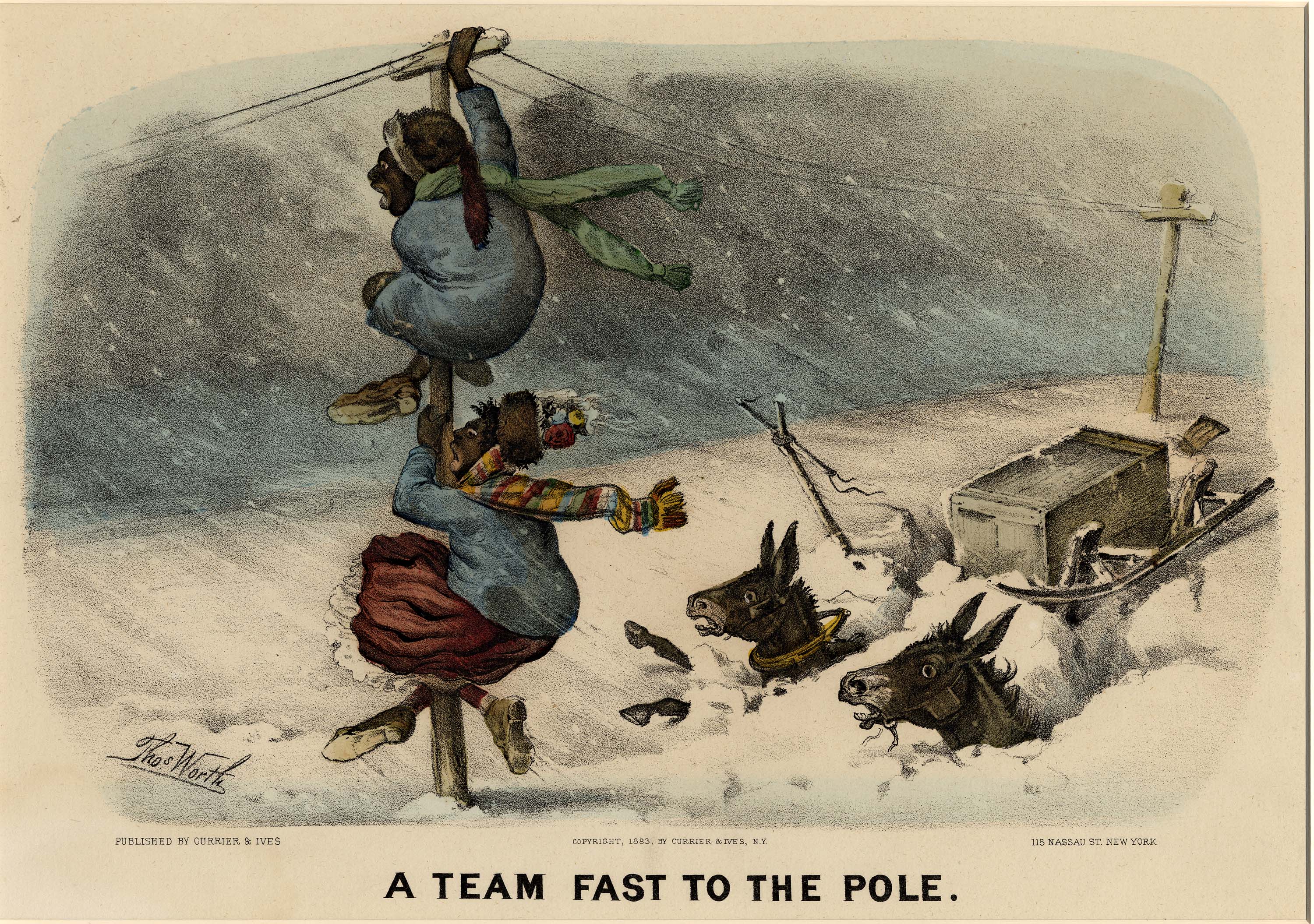
In 1857, Nathaniel Currier, a Massachusetts lithographer, and James Merritt Ives, a self-trained artist and bookkeeper for the business of N. Currier, formed a partnership. The result was the firm of Currier & Ives, which produced three to four prints every week for fifty years – a total of over 7,500 titles. The lithographs produced by the company were published by Currier & Ives, none were actually drawn or lithographed by them. Upon their deaths in 1888 and 1895 respectively, their sons, Edward West Currier and Chauncy Ives, directed the firm until its close in 1907 (American Historical Print Collectors Society).

Previous to the Emancipation Proclamation, Currier & Ives generally depicted blacks as individuals content with their lives and position in society; they were often pictured in the background of idyllic plantation images. Initially after the Proclamation was issued, the firm continued to depict blacks in a positive light, focusing more on individuals, publishing portraits of John Brown, Frederick Douglas, and black Union soldiers fighting for their freedom (222). As time went on, however, and the freedmen began to move north into the cities, it became more apparent that not all Northerners were unanimous in their support of emancipation and the status of the freedman. The political images published by Currier & Ives during this time were vicious attacks against the character and intelligence of blacks, depicting them as unsupportive and disobliging of the political figures who sought to free them, such as Abraham Lincoln, Horace Greeley, and Senator Charles Sumner (226).

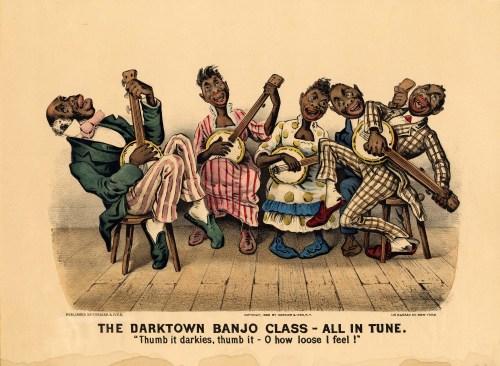
During and after Reconstruction, Currier & Ives, and America it seems, continued to appreciate these negative images of African Americans. Out of this, between the mid-1870s to the early 1890s, the Darktown Comics arose, mostly illustrated by Thomas Worth (1834-1917) and James Cameron (1828-1963). The company described the Comics as “pleasant and humorous designs, free from coarseness or vulgarity, being good natured hits at the popular amusements and excitements of the times”. It has been suggested that Darktown may have “served as satires on polite white behavior as well”, as could be supported by previously positive images of African Americans. Regardless of intent, the prints only reinforced negative racial stereotypes throughout the country.


The caricatures presented by the Darktown Comics consisted of “African Americans performing actions that were more or less normal for ‘ordinary’ folk, meaning whites…the implication being that the African Americans could not execute even the simplest tasks of everyday life without making themselves appear ridiculous”. The most common images depicted by Currier & Ives’ artists were of African Americans attempting to have horse, skull, and sulky races; ride in carriages and yachts; hunt; host lawn parties; play tennis; and fight fires–always with disastrous results. And the depiction of  African American lawyers, doctors and the clergymen as bumbling and dishonest were quite malicious. African American children were also featured in a poor light – as mischievous, out of control, disrespectful hoodlums. This is evident in prints by Thomas Worth such as “A Put Up Job” and “A Fall from Grace” (1883) and “Breaking In: A Black Imposition” and “Breaking Out: A Lively Scrimmage” (1881).


African American stereotypes that still exist today were begun here – the connection of African Americans to music, in Darktown specifically of banjo playing, and of their supposed eating habits, most notable in the Comics, that of eating watermelon. This can be seen in the prints that make up the set of the Darktown Banjo Class and in single prints like “O Dat Watermillion!”. As one can see, African American speech was attacked as well, through phonetic renderings steeped in the distortion of stereotypes and caricature.


The Darktown Comics did not develop or exist in a vacuum, however. In addition to theDarktown prints that came out of this time, Harper’s Weekly featured the Blackville prints; examples of which can be seen at HarpWeek’s exhibition, “Toward Racial Equality:Harper’s Weekly Reports on Black America, 1857-1874 or the Philadelphia Print Shop’sBlackville Prints.” These were similar in content to Darktownspoofs of African American attempts at high fashion, sports, etc. The most prevalent artists of this series were Sol Eytinge, Jr., William Ludwell Sheppard, S.C. McCutcheon and “Sphinx” (Philadelphia Print Shop, Ltd.). Other publications, such as Life, Puck and Judge, as well as Pulitzer’s New York World and Hearst’s New York Journal produced similar images but these were in the context of satire (Hays). Whether or not these images were taken as satire or at face value by the American populous is up for debate, however. Other news and editorial magazines, such as The Outlook and The Independent, also promoted these types of images through their illustrations and advertising—exemplifying the prevalence and acceptance of these racist stereotypes across the country (Hays).


The “high art” of this time, specifically that of southern artists, furthered these stereotypes as well, dehumanizing the African American through their depictions of coal black skin, thick red lips, oversized teeth, and patchwork clothing. It wasn’t until the impact of the Ashcan Society and the period of realism came into play that classical forms of art began to celebrate the figure of the African American as he really appeared. The art of Robert Henry, George Luks, and George Wesley Bellows are forefathers of this new view – a celebration of the African American.

SOURCE

speaking of norman rockwell

This post is completely reblogged.  I came across it HERE yesterday while looking for more of Jason Claiborne’s work.  I became curious about Norman Rockwell’s own views on race.  Angelo Lopez broke it down pretty well, as far as Rockwell’s work is concerned anyway, and I thought I’d share.

Norman Rockwell and the Civil Rights Paintings

By Angelo Lopez

Fifty years after he first started doing work for the magazine, Norman Rockwell was tired of doing the same sweet views of America for the Saturday Evening Post in the early 1960s. The great illustrator was increasingly influenced by his close friends and loved ones to look at some of the problems that was afflicting American society. Rockwell had formed close friendships with Erik Erickson and Robert Coles, psychiatrists specializing in the treatment of children and both were advocates of the civil rights movement.

His most profound influence was his third wife, Mary L. “Molly” Punderson, who was an ardent liberal and who urged him in new directions. On December 14, 1963, Rockwell did his last cover for the Saturday Evening Post and he began working for Look magazine. Look magazine finally gave Norman Rockwell the opportunity to express his social concerns.

Rockwell’s first painting was The Problem We All Live With, one of his greatest paintings. This painting depicts Ruby Bridges, the little girl who integrated the New Orleans school system in 1960, being escorted to her class by federal marshals in the face of hostile crowds. It’s a simple picture, the disembodied figures of 4 stiff suited men and the vulnerable yet defiant figure of a school age African American girl marching lockstep. To the right is a tomato staining a wall, obviously thrown at the girl but just missing. My eyes focus on the girl and her immaculate white, a contrast to the graffiti stained wall in the background. As a painting it’s a wonder, with it’s composition conveying Rockwell’s message in a few simple figures. To look at the picture, go here.

An even greater departure from Rockwell’s usual sweet America paintings is Southern Justice, painted in 1963. Rockwell did a finished painting, but the editors published Rockwell’s color study instead, and I think his color study conveys the terror of the scene more successfully. It depicts the deaths of 3 Civil Rights workers who were killed for their efforts to register African American voters. It is done in a monochrome sienna color, and it is a horrifying vision of racism. A look of it can be seenhere.

Rockwell’s most optimistic view of the civil rights movement wasNegro In The Suburbs, painted in 1967. It depicts an African American family moving into a white suburban neighborhood. The African American children look over by the kids in the neighborhood, with all the children sharing a love of baseball, America’s game. This painting can be found in this gallery.

“it’s like a job to search for identity”

Prejudice inspires filmmaker to discover Afro-German roots

By ABBY LIEBENTHAL

“It all started with a public threat on my life.”

Within the first few minutes of Mo Asumang’s documentary “Roots Germania,” students, faculty and Bloomington residents became part of a search for the director’s identity.

The documentary was presented Friday in Morrison Hall and was followed by a question-and-answer session.

“You don’t hear about German and African relations very often, so I thought it would be something different,” graduate student Sarah Keil said.

Asumang said the journey to find her identity was driven by a desire to understand where racism toward Afro-Germans originated.

“It’s like a job to search for identity,” Asumang said. “It starts when you’re born in Germany – it’s not so easy to be part of that country.”

The film was triggered by a song, written by a Neo-Nazi band the “White Aryan Rebels,” that calls for Asumang’s murder. Lyrics in the song include “This bullet is for you, Mo Asumang.”

Asumang wanted to create a film about racism in Germany and finding her heritage after hearing the song. Throughout the film Asumang illustrated the struggles of having biracial parents in scenes with right-winged Neo-Nazis and Ghanaians.

“I didn’t know who I was,” Asumang said. “I tried to be white when I was younger, so years later I tried to be black.”

Asumang said the movie proves individuals do not consider people of a different race to be German.

While filming, Asumang did not tell Neo-Nazis she was an Afro-German when she called to speak with them – surprising them at their meeting.

Asumang also used the movie as an opportunity to get to know her father and learn more about her mother’s experience with racism.

When Asumang visited Ghana, her father said she did not have to decide exactly who she is and he would always accept her as Ghanaian. Her mother also expressed ideas of acceptance and said that she was forced to move and put Asumang up for adoption because her daughter was Afro-German.

“I can be both, and it’s super,” Asumang said. “I can be on one side a German and on the other a Ghanaian.”

One similarity between her identities, Asumang noted in the film, was spirituality and rituals performed in forests.

Janice Levi, a graduate student, said she took note of the spiritual connection between these two cultures.

“It was interesting how she related it far back to Pagan culture in Europe and experiencing rituals in the forest to both areas,” Levi said.

Asumang ended her film saying that for every Neo-Nazi convention, there are at least three challenging it.

“Some people will never change, but you can change your own life,” she said.

SOURCE

segregated orphans

A discarded term!?  I guess Bill Kemp has never visited this blog.  I’m grateful for this little piece of our history.

Booker T. Washington Home offered safe haven for black children

By Bill Kemp Archivist/librarian McLean County Museum of History | Posted: Saturday, December 12, 2009

For much of the 20th century, Bloomington-Normal residents thought it necessary to maintain segregated group homes for underprivileged children. One would be hard-pressed to find a better illustration of the embarrassing state of race relations over the decades than the fact that impoverished, neglected and unwanted children were separated by race until the 1960s.

From World War I until JFK and Camelot, African-American children lived at the McLean County Home for Colored Children, later renamed for Booker T. Washington, on Bloomington’s far west side.

This institution dates to 1918 when Alexander Barker and his wife Cedonia, with assistance from Margaret Wyche, took it upon themselves to care for six orphaned black children. Not long after, the Missionary Union, a group of four local churches stepped in to lend much-needed assistance. Though chartered by the state of Illinois in December 1920, the home was a rather primitive operation, with 25 children and 2 adults living in a six-room house with no plumbing or running water.

Improvements in the home, both in its physical plant and operation, soon followed. Located on the 1200 block of West Moulton Street, now MacArthur Avenue, the home’s mission was to “foster self respect, independence and good character.”

Overseen by a 15-member board of progressive-minded women, the home expanded to an adjacent residence. Also acquired in the early years were five nearby lots that were converted to truck gardens so the home could grow much of its own food. The boys generally worked the garden plots and the girls handled the laundry and canning, along with other duties.

The 1920 U.S. Census identified 15 of the 18 children at the home as mulatto, a since-discarded term for someone of mixed-race heritage. Back then, children with one black parent and one white were often outcasts, and into the 1940s, if not later, the home served as a safe haven for mixed-race children abandoned by their parents and local communities.

Money was always tight and the needs of the new arrivals great. “A special effort has been made to give each child his full quota of milk and butter fat, as many of the children were underweight,” read one report from 1921.

“There is absolutely no place of good repute open to such children in Illinois, except this one,” noted The Pantagraph two years later. “The question arises, shall a child be permitted to subsist on the contents of garbage cans … simply because of their race? Paraphrasing the Biblical interrogatory, ‘Who is thy brother’s keeper?’”