oblivious to racial overtones

I am pained by this story.  I remember being this little girl.  I remember being singled out at times, usually not having anything to do with my hair unless it was mandatory school-wide lice check day.  No one wanted to deal with me then.  And that was fine with me.  But it wasn’t really.  I can only imagine the consequences this incident will have for this little girl.  Her parents really have their work cut out for them now.  I hope they sue and win big!  The damage is done.  Let’s hope it can be undone.  Oh, and I’d like to send the Mudede family a copy of Teri LaFlesh’s Curly Like Me.  All you need is conditioner people.  All you need is conditioner…

Biracial Girl Removed From Classroom Because Of Her Hair

by Amelia Thomson-DeVeaux

VIA

This story is an example of the sad fact that within schools, sensitivity training can only go so far – sometimes, there are unpredictable situations where teachers just have to intuitively react, and often they’re not prepared to do so.  And often, these issues are much larger than they appear on the surface.  Such is the case with the 8-year-old biracial student who was removed from her advanced-placement class because the teacher claimed that she was allergic to the girl’s hair moisturizer.  The teacher first put the girl in the hallway, and then moved her to a different classroom where she found herself in a lower-level class with predominately African-American students.

This behavior seems bizarre enough – but add the fact that the girl was the only student of color  in her school’s accelerated program, and the concerns of her angry parents, who may now sue the school (the NAACP, along with the Department of Education, have already filed a complaint), seem justified.  The girl’s father, Charles Mudede, is black, and says that he had talked to his daughter about resisting pressures to straighten her hair so that she would look more like her white classmates.  The product that so irritated the teacher was a compromise, Mudede said, “something light that kept her hair in its natural state.”

The girl’s parents have a host of questions to which there seem to be no adequate answers: “Why did the teacher think the problem was his daughter’s hair? Why hadn’t the school called the parents? What investigation was being done to pinpoint the source of the problem? And, finally, why did the school seem oblivious to the racial overtones of a white teacher singling out her only black student?”

Mudede says that the situation escalated because no one at the school seemed prepared to answer these basic questions.  He wrote on his blog,

“When we, her parents, were later informed of this incident, we also learned that once my daughter was removed from the class, the teacher felt much better. We were also told that the teacher had experienced something like a fainting spell because of our daughter’s hair. Feeling the seriousness of this situation, we decided not to send our daughter to school until the teacher had medical proof that our daughter’s hair or something in her hair was to blame for the nausea. (The last thing you want to happen to your daughter is for a teacher to faint or vomit at the mere sight of her.)

Days passed and the school took no action. This unresponsiveness left us with no other choice than to turn to a lawyer. The whole thing is a mess. Getting entangled in a racial dilemma is something most black parents do not want for their children. It’s just not worth the trouble. Then again, like I said, if not checked and confronted, the incident will have permanent consequences for my child.”

And although the school is now making limited comments because of the threat of a lawsuit, it definitely seems as though this situation was horrifically mismanaged; without communicating privately with the student and involving the parents, of course this would turn into a humiliating ordeal for a little girl who clearly was already suffering from self-esteem issues.  If the teacher had allergies, that’s something that she couldn’t help.  But to target the student in such a dismissive embarrassing way shows a level of insensitivity that no teacher should have.

yesterday’s history

When I started reading this article I thought, “This is about to be some ‘tragic mulatto’ b.s.”  Much to my surprise, it isn’t really.  I think Sarah played the part of the tragic mulatto very well, and got exactly what she wanted and deserved.  I wonder if the congregation’s response would have been different if “Pinky” hadn’t been quite so pink, but maybe “Brownie” instead.  Just a thought.  I also like this piece of our history because once upon a time, in a former life in which I considered myself black, I was a nanny and I worked in Brooklyn Heights and I walked by that church every day and was very drawn to it.  Part of me knew… And part of me was so clueless.

On This Day in History: June 1
Rev. Beecher’s Freedom Auction

by Vernon Parker

VIA

On June 1, 1856, Henry Ward Beecher, minister of Plymouth (Congregational) Church, and an ardent supporter of the antislavery cause, held a public “auction” of a young mulatto slave named Sarah to dramatize the evils of slavery.

The Brooklyn Daily Eagle reported that “she had been brought from a plantation near Staunton, Virginia.” When Sarah was called to the pulpit, she … “walked slowly, head bowed, and took a seat near the famous minister. She lifted her eyes, stared at the spellbound audience, and burst into sobs. Her plight tugged at the heart of the most stolid Congregationalist as Beecher’s inflamed rhetoric described her life. Daughter of a well-known white citizen, she had been put up for sale by her own father. The slave dealer involved contacted Beecher through a mutual friend and they struck a deal allowing Sarah to go north with the promise of either her return or the full manumission fee.”

The mock auction raised sufficient funds to purchase her freedom and buy her a modest home in Peekskill, New York.

The following is an excerpt from James H. Callender’s book Yesterdays on Brooklyn Heights: “As the anti-slavery agitation increased, Mr. Beecher thundered his invectives against the slave-owners of the South, and many of the leading men of his church were said to be directors of the famous ‘Underground Railroad’ by which fugitive slaves were passed along from the South across the border to Canada. It was at the close of one of his most powerful sermons that Mr. Beecher said he had a little matter he wished to present to the congregation. No one had any idea as to what he was going to say and the people waited in profound silence.

“He then suddenly burst forth, ‘Sarah, come up here!’ As the audience gazed, a little mulatto girl arose in the body of the church, ran up the pulpit steps and took Mr. Beecher’s hand. Turning to the assembled multitude, he said — ‘This little girl is a slave, and I have promised her owner $1,200, his price for her, or she will be returned to slavery. Pass the baskets.’ A scarcely stifled sob arose from the almost three thousand present. Bills of all denominations, jewelry, and watches and chains were flung in the overflowing baskets and when the total was counted, Mr. Beecher announced, amid thunders of applause, that Sarah was free, and enough remained to strike the shackles from the limbs of several others.”

A tintype of Sarah, also known as “Pinky,” the young mulatto slave whose freedom was “auctioned” by Rev. Henry Ward Beecher.

curly like me

It’s here!  The answer to our curly-headed prayers.  I’ve been referring people to Teri LaFlesh’s website for over a year now, and am thrilled to be able to point my fellow biracials, parents of mixies, and anyone else with a “wild” mane to her book Curly Like Me.  Teri was kind enough to send me an advanced copy so that I could write a blurb.  Here’s what I wrote…

“With Curly Like Me, Teri LaFlesh has provided us curly heads with THE Bible of hair care for our tightly curled manes.  If you thought your (or your child’s) hair was hard to manage, Teri will prove you wrong.  After suffering through relaxers, jheri curls, texturizing, dreadlocks, weaves, and extensions, Teri stopped fighting against her curls and embarked on a journey to embrace them.  The results are stunning!  Teri discovered a simple, easy to follow technique that produces healthy, happy, beautiful curls freeing us from chemicals, heat, and perpetual ponytails.  She’s layed it out step by step, providing us with the do’s, the don’ts, and even the why’s!  A more thorough hair care manual we could not ask for.  Perhaps even more momentous though is the journey toward self acceptance that lies in the pages of the book.  It seems as though Ms. LaFlesh learned that what happens when we try to make our hair into something that it is not, is a mirror of what happens when we try to make our SELF into something that it is not.  Curly Like Me is also about embracing every aspect of one’s authentic self. That beautiful and unique being that the world will not be able to experience if we waste our energy fighting against it in hopes of conforming to that which we’re told every day on television, in magazines, and in the movies is ‘normal’ and ‘good.’  The struggle against the “real” hair becomes symbolic of the inner struggle against the real self.  Teri says, ‘I treated my curls as if they weren’t good enough in their natural state.  Yet after all I had done to them they, couldn’t be crushed.’  The same can be said of the human spirit.  Thank you, Teri!!”

so, if you’d like your (or your child’s) hair to look like this someday….

…go buy this book!!  You can get it HERE.

re: previous posts

I’ve been meaning to post these things that have some correlation to a few of the week’s previous posts.  So now I’m doing it.

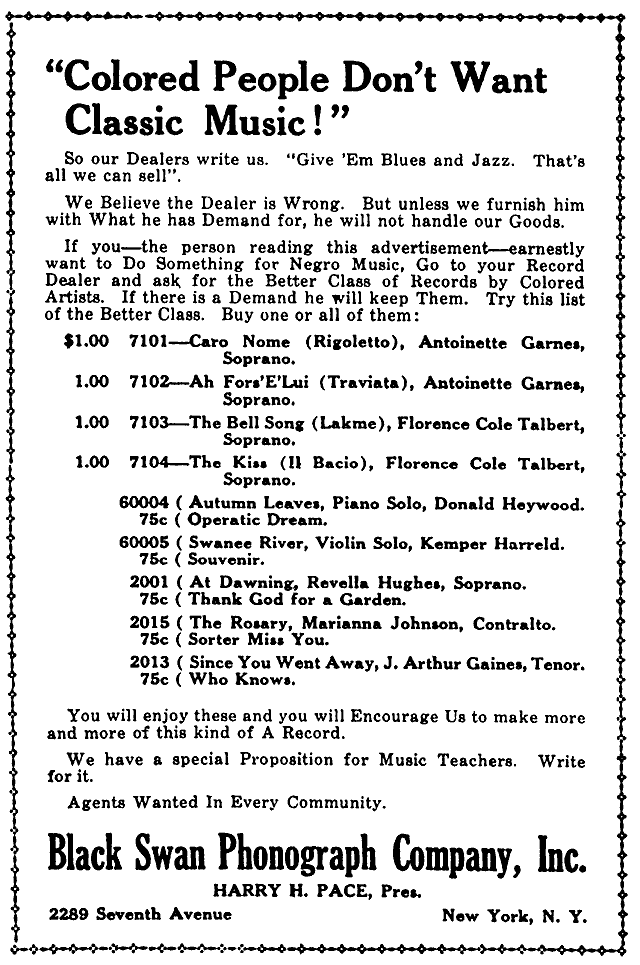
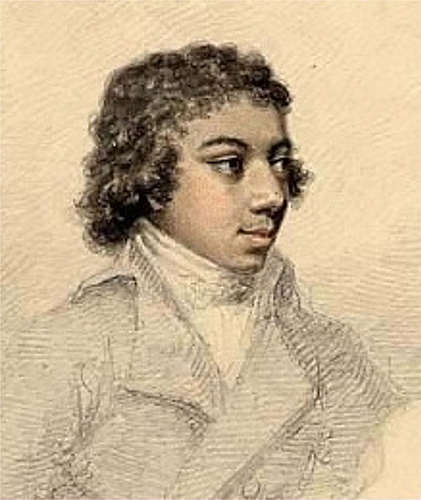
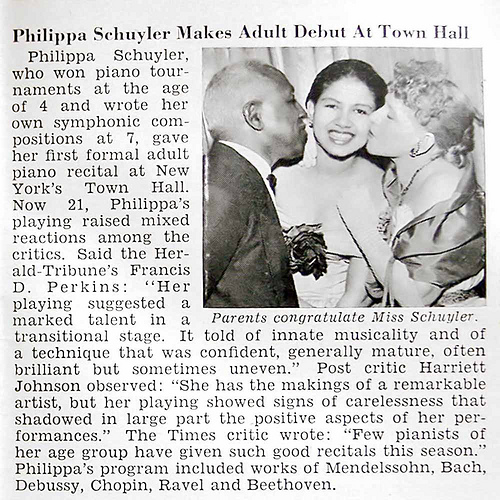
  • I think Philippa Schuyler and George Bridgetower help to disprove the theory that they were trying to disprove in this ad:

  • When I read about Stacey Bush,the white girl who (along with her biracial sister) was adopted by a black woman and is now on a multicultural scholarship, I thought of the mistake that Crayola made when naming this pack of crayons.  Maybe Stacey could explain to Crayola the difference between race and culture.  Throw in ethnicity and nationality too because a lot of people don’t seem to understand that those words are not synonyms:

  • This one goes along with the whole darn blog and it made me smile, so:

black polish virtuoso

Rita Dove has done us a great service by painstakingly digging up this forgotten history.  Like most people, I had never heard of Bridgetower before Sonata Mulattica popped up in a random google search.  What a fascinating story!  I imagine it was not only challenging, but exciting to imaginatively fill in the blanks of this discarded musicians unique experience.  I would like to know more about his parents.  How they met, how an interracial relationship was received in Poland circa 1780, if he considered himself a mulatto or if there was a one-drop kind of mentality.  I guess I’ll have to read the book to find out what insight Dove’s years of research led her to deduce about those race issues.

More than her standing as former US Poet Laureate, Pulitzer Prize winner, and Possibility Poet it is Dove’s own family that (in my opinion) makes her a perfect and trustworthy candidate to bring us this story:

Rita Dove and her husband Fred Viebahn, with their newborn daughter, Aviva, in Tempe, Arizona, January, 1983.

Rita Dove and her husband Fred Viebahn, with their newborn daughter, Aviva, in Tempe, Arizona, January, 1983.(© Fred Viebahn)

Rita Dove’s gorgeously engaging ‘Sonata Mulattica’ weaves the narrative of a black virtuoso all but erased from musical history.

By: Teresa Wiltz

Via: The Root

Way, way back in the day, there was an Afro-Polish violinist, a biracial child prodigy of such virtuosity that even Beethoven felt compelled to dedicate a sonata to him. There were honors and accolades and patronage from a prince.

But fortunes changed, as poet laureate Rita Dove describes in her novel-sized book of poems, Sonata Mulattica: A Life in Five Movements and a Short Play. The violinist, George Augustus Polgreen Bridgetower, and his composer, Ludwig van Beethoven,  performed the sonata together to thunderous acclaim.

The goodwill between them evaporated as the two quarreled over a woman. Beethoven furiously erased Bridgetower’s name and scribbled the name of another violinist when he dedicated the sonata.

That is how the “Sonata Mulattica” became the “Kreutzer Sonata,” one of Beethoven’s most famous works. Through that one fit of jealous retribution, Beethoven wrote Bridgetower out of history.

The Polish black virtuoso, once famous, now forgotten.

This bright-skinned papa’s boy

could have sailed his 15-minute fame

straight into the record books.

Dove first heard about Bridgetower years ago, when she was a musician studying the cello, and later, opera. It wasn’t until she saw Immortal Beloved, a film about Beethoven, that it triggered her memory. Fascinated with the thought of a mixed- race musician in 19th century Europe—“I thought there was more to it than this exotic creature who played the violin”—Dove set out to find out more about him. For five years, she researched and wrote, digging up little nuggets along the way, tucked in letters and diaries, like that of court lady Charlotte Papendiek, and in what little historical accounts she could find.

“It was like tracking the coordinates of some meteor,” Dove says. “ ‘Oh, he went there; he appeared here,’ mapping the trajectory of his life. Other than that, he was a blank slate.”

A blank slate onto which she poured all her imagination and musings about race and class and sexual competition. Bridgetower, the son of a self-proclaimed “African prince” and a Polish-German woman, was born in Poland in 1780. As it happened, his father, who was a bit of an operator, was working in the castle of the Hungarian Prince Esterházy, where Joseph Haydn worked as a musical director.

Even as a very young child, Bridgetower dazzled on the violin; Haydn took him under his wing. Later, Bridgetower traveled from Vienna to London, where he attracted the attention of the Prince of Wales, who would later become Kind George IV.  His was a life of comfort, adulation and high achievement. (He eventually received a degree from Cambridge University.)

Bridgetower, George Augustus Polgreen, 1780-1860.  His passport, obtained in Dresden, 27 July 1803, portrayed him as being of average height, beardless with dark brown hair and eyes, with a broad nose and swarthy complexion. Friends added that he was melancholic and discontent.

At the time, there were a good number of free blacks living in London, says Dove, who won the Pulitzer Prize in 1987. Some were Africans who’d never been enslaved; some were slaves who’d been freed. Class, rather than race, circumscribed one’s lot. So for a black boy with a knack for playing the violin, a child prodigy with a powerful patron, life was considerably sweeter than that of, say, Black Pearl, the young black servant in Dove’s book.

Pathological hit of the day: n****r on a golden chain.

Metaphorically, that is. The African

valet, the maidservant black

as aces in a hole….

Sonata Mulattica is a gorgeously engaging read, utilizing a mix of poetic styles, from nursery rhymes to free verse, until the narrative arc sweeps into the big confrontation between Bridgetower and Beethoven. At that point, the action shifts from poem to play, a play with a distinctly vaudevillian sensibility, complete with baudy references to Othello. Bridgetower becomes a rapping, preening braggadocio:

But I’m a natural man, born under a magical caul,

I’m that last plump raisin in the cereal bowl;

I’m the gravy you lick from your mashed potatoes,

I’m creamier than chocolate, juicier than ripe tomatoes!

But Beethoven soon brings him down to size:

Now you will taste the high price

Of my affection—“Mulatto Sonata,” indeed!

I would sooner dedicate my music

To a barnyard mule

If the two men had not quarreled, two egos run amok, would musical history have been different? Would, we find, as Dove writes, “rafts of black kids scratching out scales on their matchbox violins so that some day/they might play the impossible:/ Beethoven’s Sonata No. 9 in A Major, Op. 47/Also known as The Bridgetower”?

We will, of course, never know.  Still, it’s nice to imagine the possibilities of what could have and should have been.

Teresa Wiltz is The Root’s senior culture writer.

we want to look related

..but sometimes we don’t.  Or we do, but people can’t see it because of that skin color, hair color, eye color thing.  I don’t think looking alike means being the same shade.  Shapes are involved too.  That we toss all of our kindergarten training aside to rely solely on hue when it comes to this kind of thing is a symptom of this disease I’ll call colorism.  A descendant of our old friend racism.  Needless to say, I like this piece because it points all of that out.

Who does your baby look like?

BY AISHA SULTAN

ST. LOUIS POST-DISPATCH

I remember glancing into a bathroom vanity a few years back and doing a double take.

In the dim light, I could have sworn I saw my mother’s face staring back at me. It was her slightly curved nose, her oval face and heavy eyelids. What could have been an unwelcome reminder of aging instead took me back to my childhood. I remember watching intently, enamored by her face, as my mother applied her makeup for parties.

A homely sort of child, no one ever told me I looked like her when I was young.

Nonetheless, I was still stunned when the doctor handed me my newborn daughter. She looked nothing like me.

Perhaps we expect to replicate ourselves, at least to some degree. Her hair was much lighter than my black locks. Her skin was considerably paler. She looks so much like her paternal grandmother, Georgia Kelley, a Midwestern woman of European descent.

This baby girl looked just like her father, a product of a biracial marriage himself.

One visitor tried to tell me that all newborns resemble their fathers initially. It’s an evolutionary adaptation to reassure dad that he’s actually the daddy.

Dr. Alan Templeton, professor of genetics at Washington University School of Medicine, says he hasn’t ever seen any scientific research supporting that theory.

“I’m actually very skeptical of it,” he said. But, there is plenty of research on organisms, including humans, showing that they rely on resemblances as part of kin recognition. And, we treat those we recognize as kin differently than nonkin, he said.

“This is evolutionarily quite old, and not unique to humans,” he said.

It made me wonder if we subconsciously favor a child who looks more like us?

My sisters joke that I look like my daughter’s Mexican nanny when we are out in public.

Like any biased parent, I think she’s beautiful. But I was tickled when our second child arrived with the exact same almond-shaped eyes as my entire family. He looks like a miniature version of my younger brothers. It’s a public display of genetic prowess: We won round two.

There must be a biological imperative involved. We are hardwired to want to pass along our own very special DNA. The crooked smile and hazel eyes are genetic affirmation.

Almost immediately after a child is born, speculation begins on who the child looks like. It’s one of the most popular topics of discussion as babies’ faces change so rapidly in those early years. And when we tell someone their child looks like them, the typical response is usually a big smile.

But in this age of increasingly biracial and multiracial families, cross-cultural adoption and fertility treatments with donor eggs or sperm, there will be more children who look strikingly different from their parents.

I’ve known a few white women who have married Pakistani men and subtly changed their appearance once their children were born. Typically, blond hair gets dyed a shade or two darker. They get tired of answering the question: “Is she really yours?”
We want to look related. We want outsiders to know we are on the same team, a family.

Parents who adopt children from another ethnicity deal with intrusive (and sometimes obnoxious) questions fairly regularly. Questions such as “How much did they cost? and “Why didn’t you adopt a white baby?” make the old jokes about the milkman seem downright charming.

One mom delights in telling the story of taking her adopted son, who shares her blue eyes and blond hair, to restaurants. She’s been told by bystanders: “Oh, there’s no mistaking he’s your son.”

She smiles and says: “You’re right.”

I’ve heard my share of awkwardly phrased questions when people see pictures of my children. Sometimes, they’ll ask: What is their father? I’m always tempted to answer by species rather than race. But, I know the subtext. Skin color, hair color, eye color — those primitive markers signify if you’re one of us or one of them.

That shorthand just doesn’t work as well in today’s world.

When people tell me my daughter looks just like me, I am secretly delighted even though I don’t buy it. But, there is a reason she frequently makes me want to pull my hair out: her stubborn personality, her passionately held opinions, the smart remarks and proclivity to collect mounds of clutter. Looks notwithstanding, she is a 7-year-old reflection of myself.

what’s this world coming to!?

This is a great article chronicling the changing landscape of transracial adoption.  Best advice I’ve read on the matter: “those adopting must be educated to understand ‘the impact of race and racism on the country, their family and the child in particular.'”

Transracial adoptions: A ‘feel good’ act or no ‘big deal’?

By Jessica Ravitz

VIA

(CNN) — “White people adopt black kids to make themselves feel good… A black child needs black parents to raise it.” “Maybe she adopted one because the blacks in the community wouldn’t step forward and adopt?” “What’s the big deal? If no white person ever adopted a black child, they’d be saying why don’t white people adopt black children.” “Who cares what race they are? A woman got a child, a child got a mother…it’s BEAUTIFUL!!! And yes I am black…if it matters.”

These impassioned comments and thousands more poured in earlier this week when CNN published a story on the stirred-up debate surrounding Sandra Bullock’s recent adoption. A People magazine cover photo of the actress beaming at her newly adopted black infant son, and the discussions that have followed, clearly hit a nerve.

So when it comes to transracial adoptions in this country, where are we?

Stacey Bush is the white child of a black mother whose adoption sparked controversy and whose attitude forces people to think about the issue differently.

Stacey wouldn’t change a thing about her life, which is saying a lot for a young woman who spent her early childhood being neglected and bounced through the foster-care system. That was before a drawn-out legal case ended in 1998, allowing a single black woman, Regina Bush — the only mother Stacey had ever loved — to become her forever mom.

Regina Bush stands with her daughter, Stacey, whom she adopted after lengthy legal wrangling.

Regina Bush stands with her daughter, Stacey, whom she adopted after lengthy legal wrangling.

The Michigan lawsuit was filed when a county agency cited concerns about “cultural issues” in an attempt to keep the pair apart. Regina Bush’s adoption of Stacey’s biracial half-sister had already been completed, without challenge, and Bush says she wanted to keep the girls together. (As a matter of full disclosure, this CNN writer’s late father represented Regina Bush in the case.)

At 21, Stacey is thriving in college, well on her way to becoming an early-childhood educator and seamlessly moving between worlds. In one day, she might braid the hair of black friends, address faculty at Central Michigan University where she is on a partial multicultural scholarship, and then go salsa dancing with her Latina sorority sisters.

“People are sometimes startled. ‘She’s white, but she doesn’t seem white,'” she says with a laugh. “I can relate to everyone. I like being exposed to everything. … Seeing me, hearing me — it doesn’t matter what color you’re raised just as long as someone loves you.”

Forty percent of children adopted domestically and internationally by Americans are a different race or culture from their adoptive parents, according to a 2007 National Survey of Adoptive Parents, the most recent study of its kind conducted by the U.S. Department of Health and Human Services.  Legislation passed by Congress in 1994 and 1996 prohibits agencies getting federal help from discriminating against would-be parents based on race or national origin.

How adoptive parents have approached transracial adoptions has changed with time, says Chuck Johnson, acting chief executive of the National Council for Adoption.

“In the old days, meaning the ’70s and ’80s, there was this notion that these parents need to be colorblind. This sounds wonderful, but by being colorblind you’re denying they’re of a different race and culture,” Johnson says. “Families that are successful are those that acknowledge race. … It’s not a curse. It’s not an impossible feat. They just need to work harder to give a child a sense of self-identity.”

It may be ideal and less complicated to match children available for adoption with same-race, same-culture families, says Johnson, who advocates that children be raised in their own countries whenever possible, too.

“But timeliness is of the utmost importance,” he says. “It’s better to find permanency and a loving home.”

The latest figures show that there are 463,000 American kids in the foster-care system, of which 123,000 are available for adoption, Johnson says. Of those, he says, 30 percent are black, 39 percent are white, 21 percent are Hispanic and the rest are of other origins.

Seventy-three percent of official adoptions — including those arranged through foster care, private domestic arrangements and internationally — are done by whites, according to the 2007 survey of adoptive parents. But that doesn’t account for informal arrangements, when relatives take in other family members’ children, which is much more common in the black community, says Toni Oliver, vice-president elect of the National Association of Black Social Workers.  She says the black community takes in “more children than the whole foster care system does,” although Johnson adds that often these arrangements don’t have the safeguards and protections legal adoptions provide.

When handled well, transracial adoption is “a very positive thing,” says Rita Simon, who has been studying these adoptions for 30 years and has written 65 books, including “Adoption, Race & Identity: From Infancy to Young Adulthood.”

“But love is not enough,” said Simon, a professor of justice and public policy at American University in Washington. “You really have to make some changes in your life if you adopt a child of another race.”

In the case of a white parent adopting a black child, that might mean living in an integrated neighborhood, having pictures in the home of black heroes, seeking out other families in similar situations, attending a black church and finding role models or godparents who are black. The same need to integrate a child’s culture applies across the board, whether parents are adopting from Asia, Central America or elsewhere.

“It helps make our society more integrated,” said Simon, who has five biracial grandchildren. “Race becomes less important and other kinds of identity issues become more important.”

Bill Barry and his wife, Joan Jacobson, adopted two boys as newborns. Willie, 17, is biracial and Alex, 15, is black. Race never mattered to the white couple when they set out to adopt, after it became clear they wouldn’t be able to bear children on their own.

Bill Barry and Joan Jacobson pose with their two sons, Willie, left, and Alex, whom they adopted as newborns.

Bill Barry and Joan Jacobson pose with their two sons, Willie, left, and Alex, whom they adopted as newborns.

“We simply wanted a healthy newborn,” Barry says. “We didn’t care about race, didn’t care about sex, and we knew we wanted them locally.”

Had the family uprooted to white suburbia, he suspects, the journey might have been more challenging. As it is, the kids go to public schools in Baltimore, Maryland, live in a multiracial and multicultural environment and grew up in a house where pictures of Paul Robeson and Rosa Parks hung on the walls. But Barry says he and his wife didn’t “go way overboard.” The white pair didn’t, for example, suddenly start celebrating Kwanzaa.

“My wife is Jewish, though not so practicing, and we did Christmas and Hanukkah. Double the presents — they quickly celebrated that,” he says. “Kids are always trying to figure out their identity and who they are, and race is just part of it.”

That may be true, but the National Association of Black Social Workers has long argued for keeping black children in black homes. About 40 years ago, the association released a four-page position paper on transracial adoption in which it went so far as to call such adoptions “genocide” — and that word choice has dogged the organization ever since.

But Oliver, the vice-president-elect, says when that position was written decades ago, blacks were being discounted as adoptive parents, not being given the same resources to help keep families together and thereby prevent the need for child placements, and that agencies weren’t recruiting families within the community. By speaking strongly, the organization helped jolt the system — although more still needs to be done, she says.

The preference, Oliver says, remains that kids be placed in same-race households whenever possible. And if it isn’t possible, or if a birth parent selects an adoptive family of a different race, then those adopting must be educated to understand “the impact of race and racism on the country, their family and the child in particular,” she says.

“There is a negative impact that children and families are going to experience based on race,” she says. “The idea that race doesn’t matter is not true. We would like it to be true, but it’s not.”

Regina and Stacey Bush have faced challenges along the way. They’ve received their share of stares and under-the-breath comments like, “What’s this world coming to.” When a young Stacey once started climbing into the van to join her family at an Arby’s restaurant, patrons came running to grab her, yelling that she was going into the wrong car. The girl was given detention at school, accused of lying because she called a young black boy her little brother, which he was. At a movie theater one time, someone called the police because they feared Stacey had been abducted.

Regina says she got attacks from both sides.

“White babies were a precious commodity. ‘Blacks can’t take care of white children,'” she remembers hearing. “And blacks were outraged” because there are so many black children in the system who need homes, and “they didn’t understand why a black woman wouldn’t adopt one of her own.”

But she says she simply wanted to keep Stacey and her half-sister in the same home and give them a loving family, together.

Stacey says that upbringing taught her to embrace all people.

“It gave me so much opportunity to talk to so many different people. There were no limitations. I stood up for a lot of things, and it made me break peoples’ mind-sets,” she says. “We’re accountable for each other as brothers and sisters. We need to look out for each other because at the end of the day we’re all human beings.”

brown babies

I’ve been meaning to post more about these AfroGerman children since blogging about  the holocaust memorial last month.  This post is mostly a reblog from MochaJuden.com.  As someone who has a hard time embracing my German heritage (none of which is “afro”), I find myself fascinated by this piece of our history.  I would love to track down some of these “brown babies” and interview them about their experiences in Germany and in the U.S.  The Black German Cultural Society website is definitely worth checking out.  So many resources, so much information.  I have a feeling I’ll be touching on this topic again…. and again.

Germany’s Brown Babies

Many of our constituents are children who were born to German mothers who were abandoned by African American soldiers during the U. S. Occupation following World War II. While some remained in Germany, many were raised in orphanages or with foster families; a few remained with their natural mothers. Many were offered for International Adoption to African American Families and accepted into the US under the Displaced Persons Act of 1948 (amended June 16, 1950) , where it was assumed that they would “more easily assimilate into the culture.”

This result is a generation of culturally displaced persons who remain disconnected and alienated from the mainstream of the societies in which they lived and from both ethnic communities to which they belong.

Adoption is a wonderful concept and is generally accepted as an ideal social mechanism for improving lives and circumstances for abandoned or orphaned children. However, recent psychological and sociological research has determined that these children often suffer significant lifelong emotional and social problems such as identity deficits, separation and attachment disorders, and chronic depression, as well as other problems as a result of separation trauma and what has been identified as “the primal wound.”

The issue is magnified and the outlook becomes ever more complicated when we explore the international adoption and abandonment of interracial children who were created by opposing forces following a major global war. For the most part, there was no professional follow up in terms of the physical, social and emotional well being of these children once they were placed.

Historians in the last decade have begun to study and write publications about the Brown Baby Plan and the cooperative attempt between the two governments to place and provide for these unwanted and displaced children. Autobiographical Interviews and publications have given voice to the trauma and lifelong suffering stemming from the dramatic loss of identity and heritage and the cultural alienation that these children faced, particularly while growing up both in post war Germany and in the US during the Civil Rights era, a period when intense racism and discrimination was under scrutiny and identified as a major problem in both societies.

“We struggled through childhoods filled with confusion, fear, anger, and feelings of inferior self-esteem. Navigated adolescence in extreme conformity to perceived structures of authority, in order to redeem our existence, or in defiance to them in utter rebellion. Adulthood was either accomplished successfully by integrating the powerful nuances of our diversified selves, or postponed until safety could be found in the distanced wisdom of experience. Some of us didn’t make it. Some of us are just now coming of age.” ~ Rebecca, Black German Cultural Society.

American Homes For Germany’s Brown Babies Are Scarce – Jet Mag, May 15, 1952

Tan Tots Attend German Schools – Jet Magazine, July 24, 1952

Brotherly Love – Jet Magazine, December 18, 1952

2607979643_5a07458832_o

German Brown Babies Arrive in US – Jet Magazine, January 29, 1953

Brown Babies Become Americanized – Jet Magazine, May 21, 1953

Brown Babies Find New Homes In America – Jet Mag, Oct 8, 1953

all photos found atVieilles_annonces of Flickr

the gains to be realized from black-white intermarriage

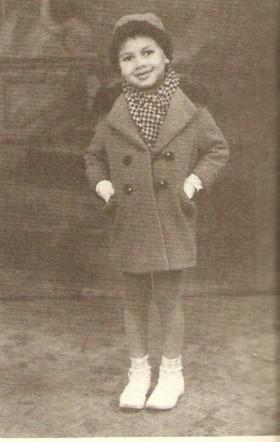
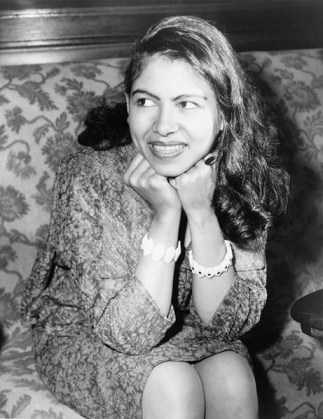
What a life! From the seemingly extreme “Take that eugenics!”attitude of her parents, to the prodiginous achievements of her childhood, on to the “passing” years Philippa Schuyler’s story encompasses so many fascinating facets of the “biracial” experience of old.

Philippa Schuyler

1931-1967

Classical pianist, writer

One of the most unusual and perhaps most tragic figures in American cultural history, Philippa Schuyler gained national acclaim as a child prodigy on the piano. Her picture graced the covers of weekly news magazines, and she was hailed as a young American Mozart. Schuyler’s life during adulthood, however, was a difficult one. She struggled with racial discrimination and with issues related to her mixed-race background, traveling the world in an attempt to find not only musical success but also an identity and a place in the world. She turned to writing in the early 1960s, visiting war zones as a newspaper correspondent, and she was killed in a helicopter crash in Vietnam in 1967. After her death she was mostly forgotten for several decades, but her life story was told in a 1995 biography.

Philippa Duke Schuyler was born on August 2, 1931, in New York and brought up in Harlem at the height of the area’s cultural flowering. The complexities of her life began with her background, for she had two singular parents. Her father George Schuyler was a journalist who wrote for one of the leading black newspapers of the day, the Pittsburgh Courier, and he was well acquainted with numerous writers in both black and white journalistic circles. He was not a civil rights crusader like many of his Harlem contemporaries, but rather a conservative satirist who rejected the idea of a distinctive black culture and later in life joined the ultra-right-wing John Birch Society. Philippa Schuyler’s mother, Josephine Cogdell Schuyler, was a white Southern belle from a Texas ranch who had married George Schuyler after coming to New York to escape a wealthy family of unreconstructed racists. They all refused to attend concerts Philippa Schuyler gave in Texas at the height of her fame.

Schuyler’s parents were in the grip of several novel theories and fads, some of which they devised themselves. They fed Philippa raw vegetables, brains, and liver, believing that cooking leached vital nutrients out of food. And, in contrast to the now-discredited but at the time widely held belief in eugenics, which formed the basis for Nazi ideas of racial purity, they claimed that racial mixing could produce a superior “hybrid” sort of human. That notion had strong effects on Philippa Schuyler’s life, for the Schuylers planned to make their daughter into Exhibit A for the gains that could be realized from black-white intermarriage.

And, indeed, the plan seemed to work. Schuyler walked before she was a year old, was said to be reading the Rubaiyat poems of Omar Khayyam at two and a half, and playing the piano and writing stories at three. When she was five, Schuyler underwent an IQ test at Columbia University; it yielded the genius-level figure of 185. She made rapid progress on the piano, and due to Mr. Schuyler’s connections it wasn’t long before stories about Philippa began to appear in New York newspapers.


Schuyler’s mother, described by the New York Times as “the stage mother from hell, blending a frustrated artist’s ambition with an activist’s self-righteousness,” started to enter her in musical competitions. Schuyler did spectacularly well and was a regular concert attraction by the time she was eight. Just short of her ninth birthday, New York mayor Fiorello LaGuardia named a day after her at the New York World’s Fair. But her childhood was an isolated one; she was taught mostly by private tutors and had no friends her own age. Her mother, who fired her piano teachers whenever she began to get close to one emotionally, beat her regularly.

For a period of time during World War II, Schuyler was a national child star. She wrote a symphony at age 13, and leading composer and critic Virgil Thomson pronounced it the equal of works that Mozart had written at that age after the New York Philharmonic performed it in 1945. A concert Schuyler performed with the Philharmonic soon after that was attended by a crowd of 12,000, and profiles of the attractive teen appeared in Time, Look, and The New Yorker. Schuyler was promoted by the black press in general, not just in her father’s Pittsburgh Courier, as a role model, and she certainly inspired a generation of black parents to sign their kids up for piano lessons.

But there were pitfalls ahead for the talented youngster. When she was 13, she discovered a scrapbook her mother had kept of her accomplishments, and more and more she began to feel like an exotic flower on display. On tour, especially in the South, she began to experience racial prejudice, something of which she had been mostly unaware during her sheltered upbringing. Bookings began to dry up, except in black-organized concert series. Observers have offered various explanations as to why. Schuyler herself and many others pointed to discrimination; the world of classical music has never been a nurturing one for African-American performers, and in the 1940s very few blacks indeed had access to major concert stages. Some felt that Schuyler’s playing, although technically flawless, suffered from an emotionless quality brought on by the strictures of her demanding life. And Schuyler faced a problem she had in common with other teenage sensations—the tendency of the spotlight to seek out the next young phenomenon.

Though Schuyler briefly fascinated the nation as a mulatto child prodigy, white America lost interest in her as she aged.

Schuyler and her mother reacted by once again calling in George Schuyler’s connections; he had friends in Latin American countries, and Schuyler began to give concerts there. In 1952 she visited Europe for the first time. Schuyler enjoyed travel, and, like other black performers, found a measure of unprejudiced acceptance among European audiences. Over the next 15 years she would appear in 80 countries and would master four new languages, becoming proficient enough in French, Portuguese, and Italian that she could write for periodicals published in those languages. She traveled to Africa as well as Europe, performing for independence leaders such as Kwame Nkrumah in Ghana and Haile Selassie in Ethiopia—but also passing for white in apartheid-era South Africa. Schuyler began to resist the pressure that still came from her parents, but she remained close to them, writing to her mother almost daily and becoming their chief means of financial support.

Her income came not only from music but also from lectures she gave to groups such as the virulently anti-internationalist John Birch Society, for Schuyler had come to share her father’s conservative politics. Despite her performances in newly independent African capitals, she came to adopt a positive outlook on European colonialism.

Confused and fearful about the future, Schuyler took steps in two new directions. First, since her ethnic identity seemed uncertain to those who had never encountered her, she began in 1962 to bill herself as Felipa Monterro or Felipa Monterro y Schuyler. She even obtained a new passport in that name. Her motivation seems to have been split between a desire to have audiences judge her without knowing of her African-American background, and a broader renunciation of her black identity. The ruse convinced audiences for a time, but the reviews of her concerts were mixed, and she soon abandoned the effort.

Second, Schuyler began to write. Traveling the globe, she filed stories from political hot spots for United Press International and later for the ultraconservative Manchester Union Leader newspaper in New Hampshire.  She wrote several books and magazine articles as well, and at her death she left several unpublished novels in various stages of completion. One of them evolved into an autobiography, Adventures in Black and White, which was published in 1960.

She traveled to Vietnam to do lay missionary work, supporting U.S. military action there and writing a posthumously published book about American soldiers, Good Men Die. She founded an organization devoted to the aid of children fathered by U.S. servicemen, and on several occasions she assisted Catholic organizations in evacuating children and convent residents from areas of what was then the nation of South Vietnam as pro-North Vietnamese guerrillas advanced. It was on one of those evacuation missions, on May 9, 1967, that Schuyler’s helicopter crashed into Da Nang Bay. She drowned, for she was unable to swim. Shortly before her death, she had written a letter that seemed to suggest a political change of heart, expressing sympathy with black activist leader Stokely Carmichael.

Schuyler’s funeral was held at New York’s St. Patrick’s Cathedral, and in death she was once again in the headlines. Two years after her death, Schuyler’s mother hanged herself in her Harlem apartment. A New York City school was named after Schuyler, but her name dropped into temporary obscurity. She became better known with the publication in 1995 of Composition in Black and White: The Life of Philippa Schuyler, a biography by Kathryn Talalay. In 2004, star vocalist Alicia Keys was signed to portray Schuyler in a film co-produced by actress Halle Berry. “This story is so much about finding your place in the world,” Keys told Japan’s Daily Yomiuri newspaper. “Where do we really fit in, in a world so full of boxes and categories?”

SOURCE

people don’t know how to treat you

This article is from 2005.  I wonder if the family has noticed a shift in attitudes over the last five years.  And of course I’d love to hear from little Toni.  The bridge between them.  I like that part a lot.

HOW DARE THEY TREAT US LIKE THIS?

by DIANA APPLEYARD

JAN LLOYD, 45, has been married to Tony, 48, for ten years. The couple have a four-year-old daughter, Toni. They run a successful martial arts business, Fighting Fit, with gyms around South London, where they live.

photo by Jenny Goodall

Jan says:

PEOPLE have spat at me in the street, stared at me, jostled me and shouted at me — all because I fell in love with a black man. But unless you have experienced it, you are unlikely to have any idea of the racism in British society.

It’s terrifying, but it’s something I am aware of every day of my life. We were taking our daughter Toni to see the GP when she was only two years old, when I was spat at in the street. It was completely random — a white man in his 40s looked us up and down and then spat at me.

It was so disgusting — I couldn’t believe it was happening. I looked for support, but everyone looked away. They were embarrassed and probably disgusted too, but no one wanted to get involved. I was shaking and tearful, but angry as well — how could someone behave like that in a civilised society?

As I walk down the street, go to the pictures, eat out in restaurants or go to the theatre, I am frequently aware of a kind of coldness and embarrassment around me. The only way I can describe it is that it’s like being disabled — people don’t know how to treat you.

They don’t know what to say to me. You can see the thought running through people’s minds: ‘Why is she with a black man?’
When I got together with Tony, a lot of my friends melted away. They’d invite me to a party with my new boyfriend, but then, mysteriously, they’d never invite us again. Once, early in our relationship, I’d booked a table at a nice restaurant. When we arrived, there were lots of empty tables — but they put us at the back, next to the toilets. I was going to complain, but Tony told me just to leave it. He’s used to it. Our backgrounds could not be more different. I was brought up in a well-off family in Sussex and was privately educated. I met Tony when I took up aerobics and he was my instructor.  I thought he was nice, but our relationship didn’t progress until I was in a horrid road-rage incident, when a man hit my car and then bashed on my window. It made me realise I ought to learn self-defence and Tony also taught martial arts. Before I fell for him, I’d been out with City types, public-school educated white men, so Tony was a real change. I thought he was intelligent and interesting — I was fascinated by the fact that his life was so different from mine.

He was born in Yorkshire, but his family moved to London when he was three. He had traditional values and an old-fashioned approach to relationships. There was also a lovely warmth about him. He was successful and welloff through his business and he was a real self-made man.

We started going out and six months later I met his family. He’s one of six and it was so different from my middle-class home — they were so loud, so welcoming, pressing food on me and firing questions at me.

Tony told me he’d been badly beaten up as a child by racist bullies and that nearly every day he faced some kind of prejudice or abuse — it hurt him so much.

But it wasn’t long before I started to experience the kind of hostility he’d faced most of his life. Suddenly, being with him, I was made to feel like a freak, a secondclass citizen. It was bizarre. There was so much disapproval in people’s glances. There seems to be this attitude like ‘Aren’t white men good enough?’ when all I had done was fall in love.

We had been together only six months when we decided to get married and it came as a shock to my parents, who asked me if I was sure it was going to work given our cultural backgrounds. But they have since mellowed and little Toni is the bridge between us.

My parents are very traditional, and all they could see were problems in a mixed marriage.

We married on a beach in St Lucia. Both sets of parents came and it made such a difference being there — we were surrounded by welcoming black people, and my parents felt less uneasy.  Now they are very supportive of Tony and can see what a good man he is. Before, they — like so many others — had only seen the stereotypes.

After our wedding I joined Tony in his business, and Fighting Fit is now very successful. We live in a lovely four-bedroom house, we enjoy great holidays, scuba dive, ride horses and have a happy, middle-class life. Now when I get the looks, I ignore them and carry on. They can’t harm our life or family.

I did worry a little about our daughter and whether she’d face any prejudice at school being mixed race, but she’s totally accepted — she’s just Toni, with a big personality for a little girl, so sunny and confident. Everyone loves her.

SOURCE