“it’s like a job to search for identity”

Prejudice inspires filmmaker to discover Afro-German roots

By ABBY LIEBENTHAL

“It all started with a public threat on my life.”

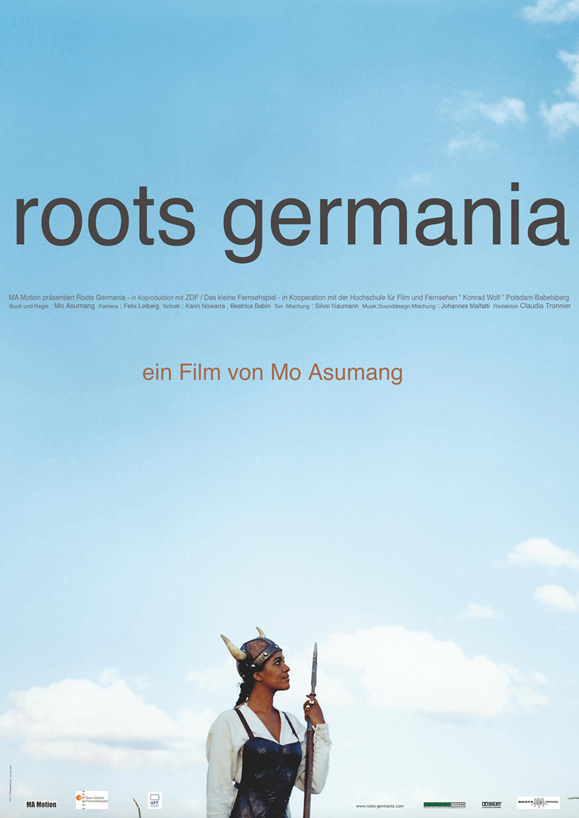
Within the first few minutes of Mo Asumang’s documentary “Roots Germania,” students, faculty and Bloomington residents became part of a search for the director’s identity.

The documentary was presented Friday in Morrison Hall and was followed by a question-and-answer session.

“You don’t hear about German and African relations very often, so I thought it would be something different,” graduate student Sarah Keil said.

Asumang said the journey to find her identity was driven by a desire to understand where racism toward Afro-Germans originated.

“It’s like a job to search for identity,” Asumang said. “It starts when you’re born in Germany – it’s not so easy to be part of that country.”

The film was triggered by a song, written by a Neo-Nazi band the “White Aryan Rebels,” that calls for Asumang’s murder. Lyrics in the song include “This bullet is for you, Mo Asumang.”

Asumang wanted to create a film about racism in Germany and finding her heritage after hearing the song. Throughout the film Asumang illustrated the struggles of having biracial parents in scenes with right-winged Neo-Nazis and Ghanaians.

“I didn’t know who I was,” Asumang said. “I tried to be white when I was younger, so years later I tried to be black.”

Asumang said the movie proves individuals do not consider people of a different race to be German.

While filming, Asumang did not tell Neo-Nazis she was an Afro-German when she called to speak with them – surprising them at their meeting.

Asumang also used the movie as an opportunity to get to know her father and learn more about her mother’s experience with racism.

When Asumang visited Ghana, her father said she did not have to decide exactly who she is and he would always accept her as Ghanaian. Her mother also expressed ideas of acceptance and said that she was forced to move and put Asumang up for adoption because her daughter was Afro-German.

“I can be both, and it’s super,” Asumang said. “I can be on one side a German and on the other a Ghanaian.”

One similarity between her identities, Asumang noted in the film, was spirituality and rituals performed in forests.

Janice Levi, a graduate student, said she took note of the spiritual connection between these two cultures.

“It was interesting how she related it far back to Pagan culture in Europe and experiencing rituals in the forest to both areas,” Levi said.

Asumang ended her film saying that for every Neo-Nazi convention, there are at least three challenging it.

“Some people will never change, but you can change your own life,” she said.

SOURCE

make your own definition

I enjoyed and appreciated this article about “us.”  I’ve been thinking lately about the choice we have to either “interact with the system the way it interacts with you,” or to come up with (and stick to and be ready to defend) our own definition of self.  In other words, you can let everyone else define you because it’s the path of least outward resistance, or you can follow the path of the least inward resistance.  I tried to go along with the system.  I think that was the primary source of my former discontent.  Now that I’m being true to myself, lots of things make a lot more sense and the possibilities seem greater.  Other things seem to make no sense at all and the obstacles loom large.  Yet I’m confident that I’m heading in the right direction.

For fast-growing group of Americans, race isn’t defined by one name

The question hit Tiffanie Grier like a hammer, and more than 15 years later, the impact lingers. She was just 9 years old, a third-grader at a school awards program, when she was asked by a friend’s mother about her ambiguous racial appearance.

What are you?

For Grier, now 26 and career placement director for the Boys & Girls Club of Greater Memphis, it was the first of many instances in which she confronted questions related to her heritage as the daughter of a white mother and an African-American father.

“I get asked a lot,” she said. “(People) feel the need to know.”

Far from being a rarity, however, Grier is part of what may be the fastest-growing demographic, both locally and nationally.

Between 2000 and 2008, the number of people of two or more races rose nearly 33 percent, from 3.9 million to nearly 5.2 million nationwide, according to census estimates.

In Shelby County, the growth rate was even faster. The number of multiracial residents increased some 43 percent, from 6,384 to 9,113 during the eight-year period in which the overall county population grew by only about 1 percent.

The 2010 Census, barely two months away, is expected to show even greater growth in the category, demographers say.

The reasons are twofold. First, the number of interracial marriages, and the children produced by them, has risen steadily since 1967, when the U.S. Supreme Court struck down state prohibitions on the unions.

Second, as a result of a growing acceptance of multiracial heritage, researchers say, people have become increasingly willing to check more than one category for race on the census forms. The election of a mixed-race president, Barack Obama, likely will reinforce that trend.

“It’s the wave of the future, for sure,” said William Frey, a demographer with the Brookings Institution in Washington. “I think symbolically … it might have an impact on how people view race.”

The upcoming census will be only the second in which respondents are able to identify themselves as multiracial.

The 2000 Census showed the emerging “two-or-more-races” group was poised for rapid growth. About 42 percent of them were under age 18, compared to only 25 percent of the general population that young, and 70 percent were younger than 35.

“What that’s telling you is that it’s a young population, and that it’s increasing,” said Nicholas Jones, chief of the Census Bureau’s racial statistics branch.

Among the most common combinations named by people in the two-or-more-races category in 2000 were white-Native American/ Alaskan (1.08 million), white-Asian (about 868,000) and white-black (nearly 785,000).

The significance of the emerging multirace demographic is anything but clear. Frey predicts it will diminish the importance of race — helping to propel society beyond a black-white divide — while others say the impact will be more on a personal level.

“I think it’s important to the people themselves — how they identify themselves,” said Darryl Tukufu, vice president for academic affairs and associate professor of sociology at Crichton College in Memphis.
Memphians (clockwise from top left) Felicia Scarpeti-Lomax, Tiffanie Grier, Cardell Orrin  and Desireé Robertson are members of what may be the fastest-growing demographic, both locally and nationally -- people who may identify themselves by two or more races.

(PHOTO BY MIKE BROWN: Memphians (clockwise from top left) Felicia Scarpeti-Lomax, Tiffanie Grier, Cardell Orrin and Desireé Robertson are members of what may be the fastest-growing demographic, both locally and nationally — people who may identify themselves by two or more races.)

Whatever other effects it might have, the relatively recent census acceptance of multiracial classification recalls the nation’s troubled and convoluted history regarding race.

Although many African-Americans have some white ancestry, the historic “one-drop rule” meant that anyone with so much as a drop of black blood was categorized as black and potentially subjected to disenfranchisement and other forms of discrimination.

That history, said Warner Dickerson, president of the Memphis Branch of the NAACP, blurs the significance of the new census categories.

“I happen to be a fair-skinned black man, and you and I both know why,” Dickerson said. “Most of us are mixed with black blood and white blood.”

Because society has labeled them as black, many people with one African-American and one white parent say they will continue to check only the black category on the census form.

“I will be addressed, especially here in the South, as an African-American,” said Cardell Orrin, 35, a Memphis business consultant and co-founder of a political action committee called New Path. “You decide to make your own definition or interact with the system the way it interacts with you.”

Tukufu said the labeling, and discrimination that accompanied it, tended to instill in many mixed-race people a pride in their black heritage. That’s why they’ve stuck with one racial category on census forms.

“But now you have more of the younger folks who identify with both,” he added.

Grier interviewed people of ambiguous racial appearance, including many of mixed heritage, for her master’s thesis at the University of Memphis. She found that the question of how mixed-race people identified themselves often depends on who raised them.

That was the case with Desireé Robertson, 37, of Millington, who was adopted by an African-American couple and didn’t discover until age 30 that her biological mother was white.

“That’s my primary identification,” Robertson said in explaining why she’ll stay with just African-American as her identity in the census.

But Felicia Scarpeti-Lomax, 39, who was raised by both her white Italian-American mother and her black father, plans to use both racial categories.

“For me to use one racial category, that would be eliminating one of my parents, and that’s not my heritage,” Scarpeti-Lomax said.

She formerly lived in New York City, where racial identity was never an issue, she said.

“I never faced this craziness until I moved to the South,” she said.

Scarpeti-Lomax, like many others of biracial heritage, said she’s glad the Census Bureau finally began offered the choice of multiple categories.

“This is 2010 …” she said, “and I just refuse to live my life identified by a color.”
corinne bailey rae: true and genuine

Corinne Bailey Rae, an English literature graduate with a love of Alice Walker and Margaret Atwood, is talking about words, lyrics and punctuation. Her songs, she says, are an expression of her ‘unfettered self’.

…From the age of 15 she played the guitar and sang in an all-girl indie grunge band called Helen. Their first ‘proper’ gig was at the Duchess of York pub in Leeds in 1996. Her desire to make a go of the band was behind her decision to study at the University of Leeds. She had applied to Balliol College, Oxford, and achieved the necessary four As at A-level, but didn’t get in. She wasn’t hugely disappointed: she had found the Oxford interview process ‘quite alienating. There weren’t many people from my experiences. I didn’t meet any working-class people, I didn’t meet any black people.’

Bailey Rae grew up listening to all kinds of music. Her mother, from Yorkshire, and her father, who had moved from St Kitts in the Caribbean in his late teens, had a collection of Stax and Motown singles (they divorced when Bailey Rae was 12). The progressively minded youth leader at her church introduced her to Björk and the Cocteau Twins: music that he felt was ‘kinda trippy, a bit cerebral, a bit spiritual’. As a result of her mixed race – she dislikes the term but accepts that most people understand it (for a long time, if forced to describe her ethnicity, she preferred to say ‘brown’) – it has always been important to her to embrace all kinds of musical genres. She hates the notion that suggests that ‘Oh, black people only like R&B…

I don’t only like R&B,’ she says. ‘I always love in life when you see people acting in a way that is true and genuine to them but doesn’t fit into the perceived notion of how they would respond to something.’

SOURCE

sometimes the apple does fall far from the tree

Thank God!  This is such an amazing story.  I’m so fascinated.  Not only by the bravery of a little white girl who crossed KKK, but also the shades of “mulatto” history sprinkled throughout.  Coon-hunting based on the supposed threat that black males posed to white women.  The “black” member of the Klan.  Passing.  Male chauvinism.  Homophobia. This is our sordid past.  And it is still haunting us.

Taking on the Klan

One summer night in 1965, 12-year-old Carolyn Wagner watched as Klansmen bound a young black man to a tree in her father’s field, accused him of violating the “sundown” rules in nearby Booneville, Ark., that forbade blacks from staying in town after dark, and lashed him a few times with a bullwhip as he cried out in pain and fear.

It was no different from beatings at other Klan gatherings her father had attended, but what happened next remains vivid in her memory: the Klansmen decided to tie the man to the railroad tracks below the pasture. When they were done, they ambled back to the field to discuss crops and politics. Wagner, a reluctant witness to her father’s Klan meetings, couldn’t stand it anymore. She stole down to the tracks, used a knife she kept in her boot to slash the rope that bound the man, and told him he could follow the tracks to Fort Smith, the nearest large town.

“That was a turning point,” recalled Wagner, now 56 and living in Tulsa, Okla. “I felt like I had made a difference when I was able to cut that man free. I realized I can make a choice to be a passive observer or I can become involved to diminish the harm that they’re doing. And that’s what I did from that night on, and that’s what I’m still doing.”

After years working for civil rights and children’s organizations, Wagner co-founded Families United Against Hate, a nonprofit group that helps people affected by bias incidents. Her experience growing up with a father in the Klan made her determined and fearless in her fight against hate. “That image of my dad and those men, and even the smells, are still with me, and they’ll always be with me. And it was very important that my children never know the world I knew when I was growing up.”

It was a world where Wagner’s father, Edward Greenwood, and his acquaintances gathered at least once a month at each other’s farms for Klan meetings, often bringing their children and grandkids. Because her father, then in his late 50s, couldn’t see well enough to drive at night, Wagner ferried him to meetings in a 1951 Chevy pickup. (Back then in rural Arkansas, it wasn’t unusual for children as young as 12 to drive on country roads.) The men — including lawyers, judges, cops and pastors — would begin their gatherings with a prayer and eschew alcohol. “They felt like they were doing God’s work,” Wagner said.

Sometimes, the gatherings would feature a beating like the one Wagner witnessed at her family’s farm. The victims were usually young men who’d been picked up on a pretext, such as paying too much attention to a white woman. “We would hear terms like ‘coon’ hunting,” she said. “My father would say, ‘I’m going ‘coon’ hunting.'”

But more often, the men would talk big, complaining about Presidents John F. Kennedy or Lyndon B. Johnson or even threatening to blow up the Supreme Court building. They’d eat bologna sandwiches that Wagner had prepared. Campfire smoke would mingle with the sweet-sour odor of Brylcreem, sweat and Old Spice. It was the one place where her father seemed happy. “I don’t remember seeing him smile or laugh unless he was with those goons,” she said.

…But her father probably would not have found a home in the Klan if his comrades had known about his heritage. “We knew there was this dirty secret in the family,” Wagner said.

In fact, her father’s great-great-great grandmother, Elizabeth Greenwood, was part Cherokee and part black, a former slave who’d settled in Arkansas when it was still part of France’s Louisiana Territory, according to family lore. Her father had cousins who identified as black, though he would have nothing to do with them. Wagner believes part of his racism stemmed from shame about his origins.

Wagner’s mother didn’t share her husband’s views about race, but she felt powerless to oppose him. Divorce was taboo in her family; resources for victims of domestic abuse were nearly nonexistent. “Mother never asked what he did [at Klan meetings],” Wagner said. “It was like she couldn’t bear to know.”

Wagner did receive support from her maternal grandparents, who passionately disliked her father. After Wagner secretly untied the black man from the railroad tracks, her maternal grandfather taught her how to use a 12-gauge double-barrel shotgun. She cut away the springs in the seat of the pickup to create a compartment where she hid the weapon, loaded and wrapped in a blanket. Though she never used it, she says she would have done so to defend herself or to help a potential Klan victim.

It wasn’t the last time she would defy all that her father represented. In April 1968, Wagner drove him to Memphis to take part in a Klan protest during the sanitation workers strike made famous by the appearance of Martin Luther King Jr. She was there when the civil rights leader was assassinated. In a Memphis newspaper, she read that the Department of Justice was planning a crackdown on the perpetrators of civil-rights era violence. After the assassination of Robert Kennedy two months later, Wagner, then 15, wrote a letter to the FBI accompanied by a list of names and addresses she’d copied from her father’s Klan directory. She wanted to get them all arrested. “I included my dad on that list,” she said.

Wagner, who used her maternal grandparents’ home as the return address, never heard back from the FBI.

She left home the day she finished high school and at 19 eloped with Bill Wagner, now her husband of 37 years. Her father died in 1980 when she was pregnant with her younger child, William. “I am so grateful that my children will have no memory of him or his politics,” she said.

But her own memories of her father came back strongly on William’s 14th birthday, the day he told his parents that he was gay. That day she and her husband’s biggest concern was for their son’s safety. “I had a very clear understanding of who the hatemongers were,” she said. They decided to move from their farm in tiny Booneville, a conservative town where homosexuality was widely condemned, to the more liberal university town of Fayetteville, some 120 miles away.

Still, they couldn’t protect their son from hate. Harassment at school culminated in a brutal assault in 1996. William, then 16, left school with friends to get lunch at a nearby convenience store when six teenagers shouted anti-gay slurs. They knocked him off his feet, then kicked him as he lay bleeding on the ground. “I thought about how easily that could have been my father’s group,” Wagner recalled. “And I wasn’t there.”

Two of the attackers were convicted of assault. After the Wagners filed a complaint on behalf of their son under Title IX, the federal anti-discrimination law, Fayetteville became the first public school district in the nation to enter into an agreement with the Department of Education’s Office of Civil Rights that required it to protect all students, including gays and lesbians, from harassment. The Wagners continue to advocate for young people who are targeted because of their actual or perceived sexual orientation.

Looking back on her childhood, Wagner remembers reading novels by Pearl S. Buck and biographies about women such as Harriet Tubman and Florence Nightingale. She wanted to learn about people who had survived difficult circumstances to help others, because she was determined to do the same.

“I found ways to survive,” she said. “I found ways to more than survive — to endure, to become stronger and to make our little corner of the world in the South a little better.”

congrats, maya rudolph

Maya Rudolph Welcomes a Girl

by Sarah Michaud

After playing pregnant in this summer’s Away We Go, Maya Rudolph has welcomed a real-life bundle of joy: her second child with director Paul Thomas Anderson.

Maya Rudolph Welcomes a Girl

Maya Rudolph and Paul T. Anderson

The couple’s daughter, Lucille, was born Nov. 6 in Los Angeles, the Saturday Night Live alum’s rep tells PEOPLE exclusively.

Lucille joins big sister Pearl, 4. As with their first child, Rudolph and Anderson, 39, chose not to find out the sex of the baby prior to delivery.

“We didn’t find out with [Pearl], which was kind of fun,” Rudolph, 37, told David Letterman.

“Because when you’re ready to throw in the towel and you’ve got nothing positive to think about or feel, because you’re so heavy and you want to float in a pool of salt water to be buoyant, it was nice to have something to look forward to.”-SOURCE

-I thought this was a cute interview, too.  Not nearly as cute as little Pearl though!-

Actress Maya Rudolph, who is currently pregnant with her second child, sat down recently withBlackBookmag to talk about her daughter Pearl,3. Read below as Maya answers a few questions about being a mother to her first-born.

Q: Did you set out thinking that you’d be a specific type of mother to Pearl?

A:  There’s definitely this fantasy that’s like, “I’m not going to be a mother, I’m going to be Mother-f#$%^*&-Theresa.” And then you realize that you’re still the same person, the same things still bother you, you’re not perfect, but you can still be someone’s parent, someone’s mother, and it can still be okay. There’s no question that you want to give them everything and you want their lives to be perfect. Has any human achieved that? No, probably not.

Q: Once Pearl was born, was she just as you imagined she’d be?

A: We didn’t know if she was going to be a boy or a girl, and, when she finally came out, there was a really quick snip and suddenly, she was resting on my chest, staring at me. And her eyes were super-black. She looked like Marlon Brando in The Island of Doctor Moreau, because she was covered in all of these white blankets staring at me. I remember, in that moment, thinking, Yes, this is my baby. I’d always tried to picture what my baby would look like, and in that second, I was like, Yes, this is the baby I’ve been expecting. And then the doctor said, “Oops, we forgot to see what it was.” I didn’t know if it was a boy or a girl, but I knew it was my baby—you spend so much time being pregnant, not knowing who the hell is coming.

Q: how has it been for you to watch a person forming her own world, using you as her mothership and then going off on her own.

A: There’s no question: you get that proud mom grin sometimes, when it’s like, Check it out. That’s my kid. But, yeah, she is who I thought she’d be in a lot of ways. Let’s put it this way: If she had come out as a total wallflower, and said stuff like, “I hate reading and I don’t like to perform,” then I’d be like, That’s not my kid. So it doesn’t really surprise me that she’s like, “Hey, I’m funny and I like to hang out.”

fair and good features….on the dark half

Good Lord!!

Ebony & Ivory

San Jose Mercury Evening News, November 30, 1887. Here’s the “tragic mulatto” principle taken to extremes by cruel Nature. Or then again, maybe circus life would have offered more to this kid than whatever hardscrabble misery awaited him in post-Redemption Florida. If only we had a name other than “it” for the child in question, I might be able to find out what happened to him.

Ebony & Ivory2

reblogged from The Hope Chest

art by Kaadaa

re: willing to accept

Here’s another article that references the perils of placing biracial babies in adoptive homes.  Is adoptive a word?  Anyway, this just reinforces my strong desire to adopt a brood of biracial kids.  I guess it’s not going to be that difficult once I’m ready.  Getting ready is the difficult part.

Adoption fulfills dream of blended family for Erie County couple

By DANA MASSING

A chatty little social butterfly, 5-year-old Grace Ann May can be sassy and likes to show off a little.

That’s how Annette May describes the daughter who is most like May was as a child.

“Other than she’s brown and I’m white,” May said.

Grace is one of two girls and two boys who became part of the May family, of Greene Township, through adoption.

Gracie, as she’s called, and two of the others are biracial. The children, who range in age from 5 to 12, were joined by Annette and Scott May’s first biological child, a daughter born on Mother’s Day.

“White, black, purple with pink polka dots, it really doesn’t matter to us,” Annette May said. “Everybody deserves a family that loves them.”

…The Mays’ four adoptions were done through Catholic Charities, even though the family is Presbyterian. The agency works with families of all faiths. It had more adoption options and lower fees than other agencies, Annette May said.

Heather Hough, adoption counselor for the agency, said cute babies with blonde hair and blue eyes are the easiest to find families for.  “Everybody wants those,” she said.

Some children up for adoption have physical, mental or behavioral issues, said Ellen Miller, Catholic Charities’ special-needs adoption coordinator. She worked with the Mays on their adoptions.

The Web site for the Statewide Adoption and Permanency Network, or S.W.A.N., states that “special needs” refers to “children waiting to be adopted who are older, of minority heritage, part of a sibling group or have a disability” or “for whom finding an adoptive family may be more challenging.”

“A lot of our kids, their need is they need a family more than (they) have special requirements,” Miller said.

Annette May said one of the most difficult parts of adopting was answering questions about what she and her husband would accept in a child.

“You can’t make those decisions when you have a child naturally, so I felt very awkward feeling like I could make those decisions in this circumstance…  We had fertility issues,” Annette May said. “We’re kind of traditional folk. We never really financially could afford in-vitro (fertilization) or things like that, and I’m just not that type of person, not interested in going through all that. It sounds very cliché, but as a kid, I always thought it would be very neat to have a blended family.”

That family started with Grace Ann. She was 10 days old when the Mays took her home. They were early in the adoption process and hadn’t expected results so soon, but no other family wanted a biracial baby at the time, Annette May said.
“We’ve always been open to pretty much any age and any race,” she said.

When Gracie was 6 months old, the couple heard from Miller at Catholic Charities again.

“She called and said, ‘We have a biracial little boy, born at Hamot yesterday, needs somebody to pick him up tomorrow. Are you willing?'” Annette May recalled.

“At the time, we just kind of thought, ‘This is so unusual.’ We had those thoughts of, ‘People say it takes forever. It’s a boy and a girl. Are we ever going to have the opportunity if we turn it down?  And so we said yes, and I thought, ‘Hey, people have twins all the time. What’s the big deal? We’ll just get it all out of the way at once — diapers, bottles, the whole thing.'”


Read the rest of the Mays’ story HERE

parenting biracial children

I think this sounds like one of the most fascinating books on the subject.  I’m really looking forward to reading the different experiences of black mothers and white mothers and women of various generations.  Wow!

Race and identity: Do parents of biracial kids face special challenges?

by Lylah M. Alphonse

When social scientist Marion Kilson’s children were born, in the 1960s, she assumed that they would identify as African American, like their father, not European American like herself. “I was still in graduate school,” she remembers. “I wrote my term paper on slave revolts. I assumed my children would be identified as African American, and I wanted them to know that not all African Americans had been gospel about their slave status.”

Her friend and fellow social scientist Florence Ladd, on the other hand, says that she didn’t have expectations about her child’s race in his early years; it was her stepson, who is white, who “made me think about his future and racial identification in infancy.”

In their book, Is That Your Child? Mothers Talk About Rearing Biracial Children, Kilson and Ladd discuss the challenges facing parents in a multicultural world….

Kilson, who is European American, and Ladd, who is African American, had known each other for 40 years but had never really talked about their experiences parenting biracial children before, Kilson says. They talked to about 25 Boston-area parents while working on Is That Your Child?, and they kicked off their research by interviewing each other.

Kilson and Ladd focused on mothers rather than fathers (“We just felt that was really that a man would do better than we could,” Kilson says) and decided not to touch on racial issues faced by adoptive parents. The parents they spoke with were from different generations, but most were upper middle class and all were from the United States. “Growing up in this society, we have a different take on race,” Kilson says.

“Americans have a hard time seeing relationships when their skin color is different,” she continues, talking about the times when her daughter, whose husband is Scottish, has been asked if she’s the nanny of her lighter-skinned child. (I can’t even count the number of times people have asked, “So, what are you?” or asked if my kids all have the same father.)

Older generations tend to be more focused on the racial differences between a parent and a child, Kilson points out, even if they don’t intend to be negative. She doesn’t think it’s possible to raise a truly color-blind child in American society…but younger people, who are more comfortable with race and diversity, navigate this multicultural world with ease. It’s all they’ve ever known.

“I perceive that, for our children, they didn’t have a public choice about racial identity, whereas for our children’s generation, their children have a choice about affirming all of their identities,” Kilson points out.

And the possibilities are endless. “When children see themselves in public figures as well as teachers — that hope flows through them as well,” Frohlich says. “We do expect children to value one another as individuals, regardless of ethnicity.”- source


If Heidi Klum wasn’t Heidi Klum, I bet she’d hear “Is that your child?” a lot.


have you noticed…

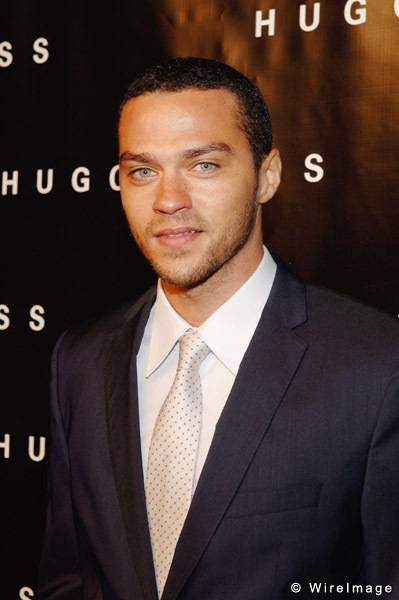
The new (biracial) guy on Grey’s Anatomy?  As soon as he first hit the screen I was like, “I think he’s one of us!”  But I wasn’t 100% sure until I saw Jesse Williams on the Bonnie Hunt Show.  He showed pictures of himself as a child with his (Black) dad.  So cute!  Then and now!!  My friend google led me to some more info about him….

Williams is the son of an African American father and a Swedish mother, and as a teenager, he moved from urban Chicago to ‘lily-white’ suburban Massachusetts.  His interest in acting was sparked, in part, when a film he was writing about this uneasy transition was chosen as a finalist in the Sundance Screenwriter’s Lab.  “It was a big part of my life.  I really rejected that move.  It was a complete cultural shock.”  Williams recalls, “It wasn’t good.  My friends were sh***y, the people were sh***y, the parents were sh***y.  A lot of parents closed the door in my face, so I was like, I don’t need to be here.  I’m not going to try and change you, which, I guess I did try for a while.”- via

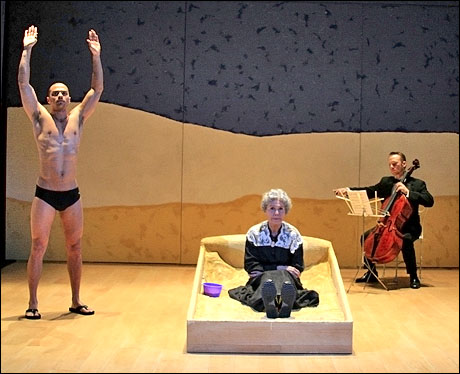
This is from an off-broadway play that Williams did last year.  So wish I had seen it.

Jesse Williams isn’t embarrassed to admit he wasn’t fully aware of who Edward Albee was when he auditioned for him to play the scantily-clad Angel of Death in the revival of The Sandbox that the 80-year-old playwright is now directing (in tandem with The American Dream) at The Cherry Lane. “Actually, I think it helped me, not being so intimidated,” says Williams. “He was so funny, cracking jokes with me even from the beginning. And I didn’t even fully process that he had offered me the job. But it’s all been an amazing experience, getting this immediate response from the audience, and working with this cast. And honestly, I don’t even really know what I look like on stage. I said I was going to go to the gym more often, but I end up just doing push-ups in the basement of the theater and trying to keep quiet.”

Williams’ enthusiasm is understandable, since he has only been acting professionally for a couple of years. While studying filmmaking at Philadelphia’s Temple University, he did some commercial and modeling work, with the occasional acting audition — even turning down a prime soap opera role. “I am a biracial man, and I was supposed to play this tragic mulatto character lusting after a white girl, and I didn’t want to leave school to do that kind of part.” Instead, after graduation, he took a job as a public school teacher in Philadelphia, and then a high-level law firm job in New York — “I was supervising 60 attorneys, even though I’m not a lawyer” — before deciding to focus on acting.- via

Oh, Jesse Williams.  I can’t wait to interview you!