if you look like one, you could be another

Brilliant!!! I love everything about this!  I’ll admit that I felt what I would have described back then as “weird” about my (mixed)race.  Looking back, I think “shame” fits the bill.  I’m so happy to hear that acknowledged, and even happier that feelings are changing to pride.  Mine included.

Danbury’s multi-racial students to star in film

Eileen FitzGerald

DANBURY — The three boys wore jeans and long-sleeve T-shirts. The two girls each wore a dozen bracelets and necklaces. They looked like typical students in the library media center at Broadview Middle School.

It was their differences, however, that brought them together Monday. They’re subjects in a documentary in which Western Connecticut State University professor Marsha Daria is examining the identity and social relationships of multiracial children.

Daria is interviewing elementary, middle and high school students to help educators and teacher training programs consider multiracial students in the curriculum and school issues.

The sixth-, seventh- and eighth-graders carry the roots of about a dozen ethnic heritages, including African American, Spanish, Italian, Scottish, Irish, Chinese and Portuguese.

“It’s cool to be two races, because you get to experience two different cultures and those countries,” sixth-grader Jonathan Garcia, 11, said.

Jonathan, who is half Chinese and half Puerto Rican, was a little nervous to be interviewed but glad to express his feelings about the issue for the movie.

“This gives me a chance to say that what race you are doesn’t matter. If you look like one, you could be another,” he said. “Sometimes they say I am Asian, but what bothers me is that I’m not all Asian. They say things about Asians that I don’t think are nice.”

Sometimes he points out people’s negative comments, and they acknowledge they were wrong. Other times he ignores what people say.

Eighth-grader Kiani Oliveira, 14, who is Portuguese, African American, Indian and Scottish, wanted people to know that multiracial people are unique.

“Like we look different. Our skin color is different, and our hair and eyes can be different — unique,” she said. “It’s not harder to be multiracial. My friends take me as I am and think I’m cool.”

A Western Connecticut State University Professor, Marsha Daria, is filming a documentary on multiracial children. Daria and the film crew where filming at Broadview Middle School in Danbury on Monday March 29, 2010. From left, cameraman Scott Volpe of WCSU media services, Broadview student Kiani Oliveira, 14, and Professor Marsha Best. Photo: Lisa Weir

Daria is doing this project during her sabbatical as an education professor at WestConn, where she has taught since 1995. Her film crew is from WestConn –Rebecca Woodward, Scott Volpe and Renato Ghio– and she consults Emmy award-winning producer and director Karyl Evans.

“It’s critical to examine the ways in which we talk about race and ethnicity. There is a change in how kids view themselves. They used to be ashamed, but now you see a lot of pride. They want people to know who they are,” Daria said.

“It used to be a marginalizing experience, but not anymore. They feel special.”

Daria will use the results of the 2010 Census in the documentary, which are likely to be more specific about race than the 2000 census, in which seven million people reported they were of mixed race.

“I want to educate. To bring awareness to kids who are mixed race. We do become a better country when we accept each other,” she said. “There are good and bad in every group. We should accept people for who they are.”

Seventh-grader Robert Best, 12, who is Italian, African American, Indian and Irish, hopes the film will help people understand that multiracial kids are just like other kids.

“People think African-American people steal and white people are laid back, and I’m supposed to be like both of them, but I don’t like that,” he said. But he wouldn’t want things to be different for children who are multiracial, because it would put them in a separate group.

Seventh-grader Marissa Segura, 12, who is Costa Rican and Italian, and Nasir Fleming, 13, an eighth-grader who is Puerto Rican, African American, Italian, Native American, and a little Irish were also questioned.

The students, all American born, said they mostly celebrate American holidays and eat all types of food, including traditional food from their dominant cultures. They usually talk about typical teen topics — things like school and music — with friends from all over.

Marissa has friends from all over and wishes people would stop guessing and ask what nationality she is.

“All my friends are from different places,” she said. “My sister said I never have a friend who is actually from America. I just get along with a lot of people and have a lot of friends.”

Nasir said he’s annoyed when people think he is only African American.

“When I was younger it made me feel sad, but now it’s just whatever,” he said. “Some friends aren’t cool about who they are, because society tries to make them feel they are nothing.”

It might be easier to stay quiet when you are classified a certain way, he said, “but if you want to keep your rights you should explain who you are.

“People who are diverse are like a little community, but we’re all different,” Nasir said. “If you had to find a similar thing about us, it’s that we don’t like being titled one thing. It’s not OK to be judgmental, to stereotype.”

SOURCE

the greatest negro?

I immediately thought of Obama while reading this article and am quite, quite certain that most agree that he is indeed a “Negro.”  That there was debate around Douglass’ negrocity ( I like to make up words sometimes) is of interest to me because I’m fascinated by the fact that mulatto was a valid and recognized identity in America before 1920.  Then it wasn’t anymore.  The ranking of Negroes from greatest to least strikes me as ludicrous.  That being said, the question, “Will Obama go down in history as the greatest Negro who ever lived?” popped into my head.  And then I thought that seeing as he isn’t one “in the full sense of the term,”  MLK probably outranks him.  How quickly I went from judging the system of rankings to ordering some myself!

Knoxville’s farewell to a civil-rights icon

By Robert Booker

SOURCE

A large crowd packed into Logan Temple A.M.E. Zion Church to honor the memory of the country’s best known civil-rights advocate. Among them were Knoxville’s black elite.

It was Feb. 25, 1895, and they had come to say farewell to Frederick Douglass, who had been born into slavery and died six days earlier.

Two days before the memorial, The Knoxville Tribune had its say about Douglass and wondered if he was a true Negro: “If we consider Douglass as a Negro, he was the brightest of his race in America. But he was not a Negro in the full sense of the term. Although born a slave, his father was a white man and his mother was a mulatto. Born a bastard and a slave, he rose to distinction and influences, and there were those among a class of white people who delighted to honor him.

“There are those who class him as the greatest Negro. This estimate of him is extravagant and unwarranted. In the first place he was not a Negro, and in the next place he is outranked by other Negroes. The greatest Negro who ever lived was Toussaint L’Ouverture the Haitian general, whose death was and will always be a dishonor to France. No Negro in this country ever approached L’Ouverture in intellect.”

L’Ouverture (1744-1803) was the Haitian independence leader who took part in the slave revolt in that country in 1790. He joined the Spaniards when they attacked the French in 1793, but fought for the French when they agreed to abolish slavery. By 1801 he had virtual control over Hispaniola, but was arrested and died in a French prison.

The blacks who spoke at the Douglass memorial took issue with the Tribunes’s assessment of him.

Attorney Samuel R. Maples said he wanted “to correct a statement in one of the local papers that Douglass boasted of his white blood and denied being a Negro. This was not true. Douglass never denied being a Negro. He was very proud of his race.”

Attorney William F. Yardley, who had introduced Douglass when he spoke here at Staub’s Opera House Nov. 21, 1881, said Douglass “Was the victim of the great American curse – slavery. He slept with dogs and ate the crumbs from his master’s table, but his great mind and energy lifted him to the loftiest heights of fame. He was not a creature of circumstance but of force. He was tireless and had been the greatest blessing to his race.”

Charles W. Cansler spoke of Douglass as “An anti-slavery agitator who represented a great moral principle and not a minister of malice. He was seventy-eight years old when he died and spent his life earnestly in the extension of freedom and in establishing justice among men. He was the Moses of his race, and it is hard to tell what his heath means to us.”

Rev. J.R. Riley, pastor of Shiloh Presbyterian Church, spoke of Douglass as a leader: “He was carved by the hand of deity to be a great leader, though cradled in the most iniquitous institution – American slavery – and schooled in dire adversity, his power of mind and greatness of spirit had surmounted all, and he stood out boldly as the greatest man of his race and the peer of all great men.”

It seems that Riley, who was pastor of Shiloh from 1891 to 1913, knew Douglass personally and they had many experiences together. He said his friend had “great personal magnetism. His quick wit and ability to read men made him irresistible in his influence among men.”

the cover of the sheet music for Frederick Douglass's funeral march

This image shows the front cover of “Frederick Douglass Funeral March.”  At each corner of his portrait are pen and ink drawings in circular frames that depict the slave trade, bondage, auction block, and freedom.

oh… but… jill…

I was pained by this headline, but upon reading the article wasn’t as offended as I’d prepared myself to be.  There’s a lot of history behind this pain, and I won’t ask anyone not to feel it or to ignore it.  That would be detrimental to our progress.  I’m glad Jill Scott has put this out there in this way.  I wonder, though, if her soul burns when she sees a not-so-successful black man with a white woman.  The history is the same and the choice sends the same message wealthy man or not, right?  Anyhow, I think we need to dialogue about this so that we’re clear on where these pains and hurts originate, so that eventually the love a person lives will speak to his soul’s credibility.  Not the color of the love a person lives.

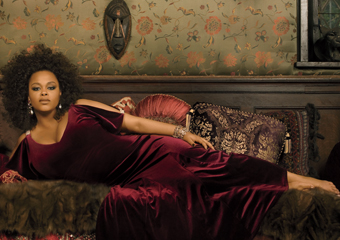
Jill Scott ‘pained by mixed-race couples’

By Marcell Minaya

Jill Scott has reportedly said that her “soul burns” every time she see a “successful black man with a white woman”.

In an interview with Essence magazine, the R&B-soul singer-songwriter said that she wished that a male, African-American friend was married to a black, rather than a Caucasian, woman.

Scott wrote: “My new friend is handsome, African-American, intelligent and seemingly wealthy. He is an athlete, loves his momma, and is happily married to a white woman. I admit when I saw his wedding ring, I privately hoped. But something in me just knew he didn’t marry a sister. Although my guess hit the mark, when my friend told me his wife was indeed Caucasian, I felt my spirit wince. I didn’t immediately understand it. My face read happy for you. My body showed no reaction to my inner pinch, but the sting was there, quiet like a mosquito under a summer dress.”

She continued: “Was I jealous? Did the reality of his relationship somehow diminish his soul’s credibility? The answer is not simple. One could easily dispel the wince as racist or separatist, but that’s not how I was brought up. I was reared in a Jehovah’s Witness household. I was taught that every man should be judged by his deeds and not his colour and I firmly stand where my grandmother left me. African people worldwide are known to be welcoming and open-minded. We share our culture sometimes to our own peril and most of us love the very notion of love. My position is that for women of colour, this very common “wince” has solely to do with the African story in America.”

Scott added: “Our minds do understand that people of all races find genuine love in many places. We dig that the world is full of amazing options. But underneath, there is a bite, no matter the ointment, that has yet to stop burning. Some may find these thoughts to be hurtful. That is not my intent. I’m just sayin’.”

SOURCE

speaking of isabella fowler…

So here’s what came from my search for more on Isabella Fowler.  In these paragraphs excerpted from Black Slaveowners: free Black slave masters in South Carolina, 1790-1860 by Larry Koger we see where the intraracial divide between mulattoes and “negroes”started.  I must admit that I am disappointed (to say the least) in the behavior of these privileged “biracials.”  I cannot defend the behavior.  Don’t want to.  On the other hand, it’s easy for me to sit in judgement in the year 2010 when my freedom and my opportunity for advancement are not on the line.  I would love to believe that back then, were I given the choice I would free my people.  That I would not see myself as separate from or better than, and that the only privilege I would take advantage of would be the one by which I could exercise my right to right some wrongs and provide an opportunity for others to be liberated and elevated alongside me.  I would love to believe that… but circumstances were different and I can’t possibly know how I would have behaved.  I do know that none of those attitudes/ideals have taken root in me, yet the accusations continue to be hurled and conclusions jumped to.  All of that being said, it’s 2010 and the time for ridding ourselves of these old paradigms of house slaves vs. field hands is long overdue. Maybe by 2012… according to Willie Lynch (perhaps a mythical “legend”) that’s when the stronghold of slave conditioning will lose it’s grip.

The mulatto children of slave masters, who were accepted as legitimate heirs, held a position in the household of their fathers which placed them in a superior status over the other slaves.  These children were accustomed to the master-slave relationship; however, they conceived of themselves not as slaves but slave masters.  In spite of the fact that they were of African descent, the white blood that ran through their veins separated them from their fellow black slaves on the estates of their fathers.  For example, the children of Michael Fowler, a white planter of Christ Church Parish, and his black companion named Sibb were raised in an environment which condoned slavery.  According to Calvin D. Wilson, in 1912, “there was a rich planter in Charleston named Fowler who took a woman of African descent and established her in his home…. There was a daughter born, who was called Isabella; the planter insisted that she should be known as Miss Fowler.”  Clearly Michael Fowler expected his slaves to serve and regard his mulatto children as thought they were white.  So the offspring of Fowler were treated as little masters and mistresses by the slaves of their father.

In fact, the process of cultural assimilation was so complete that the children of Michael Fowler, once reaching maturity and inheriting their father’s plantation and slaves, chose to align themselves with the values of white slaveowners rather than embracing the spirit of freedom and liberty espoused by the abolitionists.  In 1810, the estate of the deceased Michael Fowler was divided among his mulatto children….  When the descendants of Michael Fowler received their slaves, manumission was still the privilege of the slaveowners; however, none of the heirs chose to emancipate their slaves… Undoubtedly, the children of Michael Fowler considered slavery a viable labor system and chose to hold their slaves in bondage.

Mulatto children were not always acknowledged as the offspring of white slaveholders.  However, upon the death of their owners, they occasionally were manumitted and provided for once freed.  These children  probably were unaware of the bond of kinship to their owners.  Yet that bond allowed them to receive preferential treatment from their slave masters.  The unknowing mulatto offspring of white slaveowners often were trained as house servants or artisans.  Although they were not acknowledged as the children of slave masters, their encounter with the culture of their masters influenced them to become slaveowners.

In fact, the slaves of both mixed and unmixed racial heritage who served as house servants or artisans accepted certain aspects of the culture of white slaveowners.  Regrettably, the close interaction with the Southern culture influenced many slaves to identify with their owners.  For the house slaves, the contact with their masters and mistresses perpetuated the difference between themselves and the majority of the slaves who tilled the soil.  The house servants were taught to consider themselves superior to the common field hands.  Furthermore, the house slaves’ conception of superiority was reinforced by their dress, food, and housing, which was slightly better than that given to the field hands.  So it was that they separated themselves from the field slaves and occasionally accepted the values of their slaveowners and looked upon slavery as a justified institution.  As a consequence, they envied the life of splendor that their owners enjoyed and viewed slavery as a means of obtaining the luxuries possessed by their masters.

SOURCE

alice disrobed

More on the Rhinelander Trial.  I’d like to make a movie about this.

Leonard “Kip” Rhinelander Trial (1925)

The New Rochelle, New York annulment trial of Leonard “Kip” Rhinelander and his wife, Alice Jones Rhinelander, was a much-publicized issue in the 1920s which highlighted white America’s definitions of race, class, and marriage.

Alice Jones was the daughter of working-class English immigrants.  Her mother was known to be white, while her father’s ancestry was “mixed.”   Leonard “Kip” Rhinelander was descended from a wealthy, white New York family.

Rhinelander and Jones met in 1921, fell in love, and married in 1924.  Because of the Rhinelander family prestige, the union soon became public.  In the social atmosphere of the 1920s, it was scandalous that Rhinelander would marry a woman of lower socioeconomic class, or who possessed any “non-white” blood.  Rhinelander’s father pushed the annulment lawsuit brought by his son only weeks after the wedding, in which Rhinelander, Jr. charged Mrs. Rhinelander with deceiving him as to her race.  The prosecution argued that if Leonard had known she was “not white,” he would not have married Alice.  A leading issue in the trial thus became what Alice Rhinelander’s true race was, bringing into sharp focus the arbitrary nature of white America’s obsession with racial classification during that period.

Attorneys on each side attempted to answer this question using Alice Jones Rhinelander’s social network, her father’s ancestry, and even her language as evidence of her racial status.  The Rhinelander attorneys attempted to paint Leonard as a “dupe” victimized by a “vamp,” playing on sexualized stereotypes of African American women, while defense counsel resorted to desperate means to prove that Rhinelander must have known his bride was not “white” when they induced a stricken Alice to disrobe before the jury.

During the trial, the court required Alice to disrobe on the witness stand for examination of her skin. The court wanted the jury to inspect the color of her nipples.

The Rhinelander Trial held the public in its grip for the better part of 1925, with both black and white press weighing in with varying opinions.  Ultimately, on December 6, 1925, the jury ruled in Mrs. Rhinelander’s favor.  Playing on the notion that race can be visually established, the defense attorney successfully “showed” Mrs. Rhinelander to be “colored,”  argued that she could not have deceived her husband, and therefore his claims for annulment were invalid.

LATE IN 1929, Alice agreed to a divorce in exchange for a small monthly pension, and with the stroke of a pen a Nevada judge erased Kip Rhinelander’s social error. According to the terms of the settlement, Kip Jr. paid Jones a lump sum of $32,500 and $3,600 per year for life if she would disown their family name. Ironically, Jones would outlive her ex-husband by 50 years, passing away in 1989. On her gravestone read the name Alice J. Rhinelander.

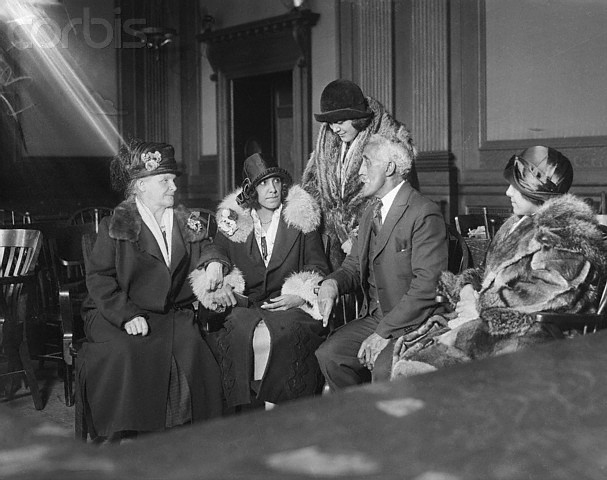
Original caption: Photo shows Mrs. Alice Rhinelander surrounded by relatives as jury decides case…Rhinelander jury locked for night; both sides anxiously await verdict. “Sentiment, passion, and prejudices should not interfere with your honest determination,” Justice Morschauser charged jury deciding Rhinelander case. Having failed to reach a verdict by 5:50 p.m. December 4th, they were ordered locked for the night. Left to right: Mrs. Jones, Alice, Grace, Jones, and Emily awaiting verdict.

SOURCE

passers

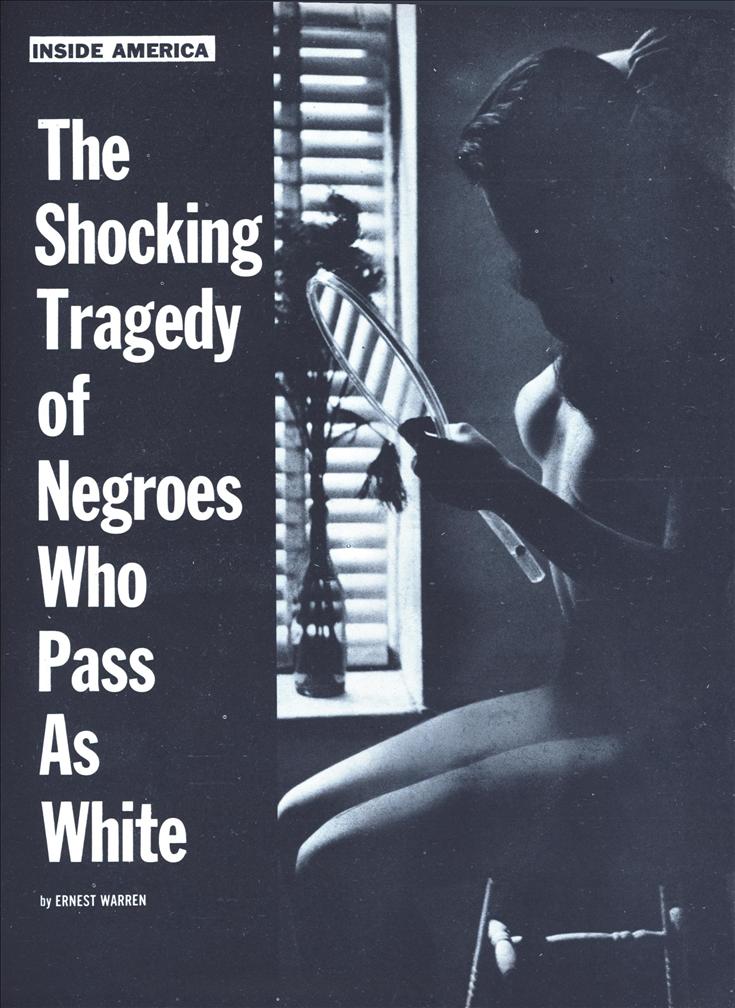
Thank you, Lee, for turning me on to this little “gem.”  Horrifying sums it up well.  I don’t know what content I find most horrifying.  I’m picking up lots of “tragic mulatto” and “jezebel” (the cover page photo!) innuendo though those specific terms aren’t used.  In fact, the passers don’t have to be mulatto at all.  As I’m constantly told, as a nation and a people we’re all mixed and there are plenty of “black” people that are lighter than some mulattoes such as myself.   I do like this notion of “one honest goal: the elimination of the invisible color boundary which for so many years unfairly kept him from his rightful place in the sun.”  We’re still workin’ on it.

ENTIRE ARTICLE

…it seems well-nigh incredible that some five million Negroes have turned their backs on their own race and are passing as white. For almost a quarter of a century, this fantastic lie has been lived by large groups of Negroes with no sign of abatement despite the strong gains that have been made by the champions of anti-segregation.

In the year 1960 alone more than 60,000 negroes are expected to “disappear”, cross the invisible color line into the world of whites. These are not just dreamed up figures. They are actual facts. Just as it is a fact that no one ever reports a Negro to the Missing Persons Bureau unless they are absolutely sure the missing human isn’t passing.

Many shocking incidents were brought to light some years back in a sensational book, ‘Black Metropolis’ by St. Clair Drake and Horace R. Cayton. The authors claim that many “white negroes” as passers are called— hold strong positions in the white world as physicians, scientists, and public administrators—despite the fact that many such jobs are also held by Negroes unashamed of their race.

The late Walter White, himself a Negro, and one of the prime movers in the National Association for the Advancement of Colored People, once attempted to clarify the problem of passing. He said: “Negroes naturally resent the loss of some of the brilliant minds which would be an asset to them in their grim struggle for survival. But if any Negro believes he will be happier living as a white and thereby escape the barbs and handicaps of prejudices, or if he believes he can use his ability and training to greater advantage on the other side of the racial line, most Negroes wish him well.”

When it comes to passing, although most Negroes today refuse to condone it, they will not tell on one another. Most seem to understand the reasoning that prompts lighter-hued members of their race wanting to cross over.

“We know there are stronger anti-discrimination laws than ever before,” they will tell you, “but when a negro has a white skin, he seems to have a compulsion to live the way of the people who have so long opposed him. He doesn’t seem to realize that scientists have proven that the very people who condemn him might not be in a position to do so.”

A scientist like those mentioned above is Dr. Caroline Day, of Atlanta University, who wrote in her famous Harvard African Studies: “The grim joke of the whole matter is that for 150 years and more the Negro has been absorbed and his descendants are constantly rubbing elbows with some of the very ones who are discussing them.”

Even the fact that people, who believe all passers are eventually found out because their children are sure to be black, are merely deluding themselves, hasn’t deterred the practise of passing. Science took the inherited color theory apart a long time ago, with the aid of such eminent savants as Amram Schienfeld, Dr. Ernest A. Hooten and the late Dr. Edward M. East, who theorized thus; “If one of the parents is pure white, the baby cannot he darker than the darker parent. If they both have Negro blood, the baby may be slightly darker than its parents hut the chances are against it.”

With the legalization of racial intermarriage approved in some 22 states, nobody has been able to upset their theory – though, obviously, chances to do so have been many.

Yet the “passers” themselves seldom worry about theories. The “permanent passer”, going over the line, never comes back. He prefers to end his days living a big white lie; and women passers who marry bear children and keep their secret for life.

Only under unusual circumstances, such as the one that befell the wife of a prominent socialite, does a sensational exposure ever occur. This was the Leonard Kip Rhinelander case, which rated lurid headlines when the socialite playboy sought to have his marriage to Alice Jones set aside. Rhinelander claimed his wife was colored and failed to tell him so. In her defense, Alice stripped to the waist and bared her breasts to the jury, thus providing the sensation-seeking New York Graphic with a classic composite-photo of this closed door session for its front page.

Besides the “permanent passer”, the “segmental passer” stands without guilt or censure. The “segmental passers” lead a dual life; whites by day, Negroes by night. You’ll often find them in jobs where opposition to Negroes is strong but secret-Some are telephone operators, receptionist, typists, clerks in large corporations and in department stores, where, though some Negroes are employed the unspoken policy is “Enough is enough.”

On Broadway, particularly, the Negro girl has a tough time getting a chorus or showgirl job. There is a story current of a Negro showgirl, allegedly passing as white, who was recognized by a popular Negro singer, but he refused to reveal her secret. He also reportedly wouldn’t talk to the girl, not because of her “passing” but because of her more than passing interest in a white socialite-playboy who met her nightly.

“Obviously she hasn’t learned yet that mixed marriages are no longer looked on with horror,” a Negro artist told INSIDE STORY, “so she’ll go on living her lie and, in the long run, probably find her heart broken because she feels she can’t reveal her secret to the man should he want to marry her. Life will never be easy for her. She not only sometimes has to listen to blasts against her race, but worry every moment about being exposed.”

While there’s no way of truly gauging the number of passers operating, some estimate is arrived at by studies of census reports, immigration records, vital statistics and information from other sources. Yet this does not take into account the ‘’segmental passer” or the passer who, in the past, was known as an “occasional” a reference to light-hued Negroes who occasionally went downtown to segregated areas and, as a lark, spent their money on white entertainment.

Actually, when it comes to “passing”, the shocked might as well face these facts: Passers not only go through life as white, they have children who look (and are) white. Any anthropologist will tell you that if a person has one-sixteenth or less of Negro blood—it is impossible to determine his or her ancestry.

Yet, the practice of passing still continues, much to the chagrin, not necessarily the shame, of the Negro who believes in living as he was born. To such a Negro, there can be only one honest goal: the elimination of the invisible color boundary which for so many years unfairly kept him from his rightful place in the sun. The passer, working in the movies, working as a white actress or a showgirl, or a model or a clerk, or a receptionist doesn’t think of this. He’s thinking of himself. Or herself. And that, to a good many Negroes, is a “shameful secret!


grateful for the choice

I mailed my Census form yesterday.  I must say that after all the hype, I was totally underwhelmed by the experience.  I checked the two boxes.  I can’t say it brought me any great feelings of validation.  I guess I thought they’d be asking some questions that went beyond race.  I also thought that “Negro” would be the only African American classification term offered since there was so much buzz about the word being used in 2010.  At any rate, I enjoyed this article.

More than black or white

By Annette John-Hall

Inquirer Columnist

SOURCE

For Kathrin P. Ivanovic, racial identity means a whole lot more than just black or white.

Her makeup runs the gamut.

“My mother is German and my birth father is African American with Cuban ancestry,” says Ivanovic, 29, director of development at the Nationalities Service Center, a Philadelphia nonprofit that services immigrants and refugees.

“Plus, my adopted dad is white, and I’m queer. Unfortunately, they don’t have a box for that.

“. . . I call myself a mixed chick.”

But when her 2010 U.S. Census form arrives in the mail this week (the 10-question form is being touted as the shortest in census history), Ivanovic will be satisfied to check black and white – which is really how she sees herself anyway.

Since the 2000 census, for millions of Americans like Ivanovic, “check one or more” will apply.

There is plenty to choose from, with the number of racial and ethnic categories at 63. In the 1990 census, there were only five designations offered.

It can be dizzying. If you’re, say, Asian, you can check any combination of Asian American, Chinese, Japanese, Filipino, Korean, Vietnamese, Hawaiian, Guamanian, or Chamorro, Samoan, as well as write-in categories for Other Asian or Other Pacific Islander.

In addition, you can also note if you’re of Hispanic, Latino, or Spanish origin. That’s because since 1970, Hispanic was no longer recognized as an overarching classification.

Still with me? (And here I thought having Negro on the same line as the black or African American box was confusing.)

But I’m all for it, especially if it paints a more genuine picture of who we are – all 300 million of us. Doesn’t matter if only 2 percent of Americans were identified as more than one race in 2000. Nowadays, we’ve got more multiracial and multiethnic couples and children than ever before, which means the percentage is sure to increase this year.

Which in turn enables the government to allocate funds more equitably. Census data are used in everything from determining the number of congressmen your region gets to the assessing the amount of funding for your town’s bridge project to supporting health centers.

Race data also have driven the nation’s civil rights laws (how many people were denied the right to vote, how many were discriminated against in housing, for example) and are still used to monitor inequalities in health and education.

But it wasn’t always that way.

Truth is, the U.S. Census was historically more of an oppressor than an advocate, especially when it came to African Americans.

Racial count

From the time census data were first collected in 1790, when enumerators listed categories of free men and slaves, whites used the census to diminish African Americans.

“You can see why they had a slave category,” says MIT professor Melissa Nobles, author of Shades of Citizenship: Race and the Census in Modern Politics. “Southern slave owners wanted the least amount of information, thinking it would help abolitionists. And abolitionists wanted the most amount of information [to make their case].”

Throughout the 19th century and until 1930, census counters used categories such as quadroon (one-quarter black), octoroon (one-eighth black), and mulatto (half black) to describe any person who had a discernible amount of African American blood.

Like they could tell just from looking.

Even after 1930, Southern laws imposed the “one-drop rule” to its census enumerating, meaning they were to count as mulattos anyone who even looked remotely black – a mandate loosely applied by census counters nationwide.

“They used it for racial social science,” Nobles says. For example, they used census data to prove skewed theories (arguing, for instance, that biracial people – “the tragic mulatto” – were somehow weaker and suffered from higher death rates), which in turn helped legislators make the case against interracial marriage.

But even as the categories have expanded, some today are pushing for a separate, generic multiracial designation.

Ralina L. Joseph, a professor of communications at the University of Washington, worries that even though the data will show us as more diverse and multihued, they could be misinterpreted once again.

“I don’t want people to read the numbers and think that racism is over, that this is a post-racial moment,” says Joseph, who is biracial. “We should hope that people who are disenfranchised through race, class, and poverty levels should be identified as such.”

Some sociologists even insist that racial designations have no place on a census form, if it is indeed as simple as an objective count.

But in a multiracial, multiethnic society where even the president is a self-described “mutt,” Kathrin Ivanovic is grateful for the choice.

“I am mixed. It’s how I view the world, and in some ways it’s how the world views me,” she says. “To not be able to identify that way is dishonest to me personally.”

“The Census Taker” (1870) Harper’s Weekly

mixed race barbies

I don’t think I would have been allowed to have one of these Barbies either.  Actually, I kind of don’t get this.  The designer doesn’t say that she made them so that little mixed girls will have a doll that more accurately represents their background.  She says it’s for African-American girls (which is weird because this is in the UK), so how are these different from the black barbies that have been around for years?  Is it that they’re wearing Rocawear, which we can assume white Barbie either knows nothing about, or wouldn’t be caught dead in?  Is it that African-American girls have career aspirations that include having Jay Z as their boss?   Ok, clearly I don’t just kind of not get it, I don’t get it at all.

First collection of mixed race Barbie dolls hits the UK

The ‘So In Style’ dolls designed by African American mum debut today in Selfridges

The So In Style dolls launched today at Selfridges

It seems Barbie has some new friends to add to her circle and they come in the shape of four mixed race girls named Jayla, Kara, Trichelle and Chandra. The first of their kind in a sea of fair skinned Barbie dolls, the four ‘So In Style’ girls were unveiled today as part of a cultural Barbie retrospective at the Wonder Room concept store within Selfridges.

Adding to the Wonder Room’s repertoire of all things contemporary and interesting, the mixed race dolls, designed by Barbie designer Stacey McBride-Irby, feature as part of an exhibition to celebrate 40 years of black Barbie history.

Unveiled by brand consultant and founder of WAH-Nails Sharmadean Reid, the authentic looking dolls stand alongside vintage black Barbies as well as 12 larger than life dolls.  The woman behind the creation of the ‘So In Style’ girls, who are decked out in Jay Z’s Rocawear clothing, says her inspiration behind the range was her daughter and her own heritage.

“As a Barbie doll designer for more than 10 years, I want African-American girls to know that dolls can represent their career aspirations, hobbies and ethnic backgrounds. Barbie inspired me to realise my dream of becoming a designer, and I want my dolls to inspire girls to play, create and live out their dreams,” explains Stacey.

The dolls are available in Selfridges (link) from today and cost £25.

SOURCE

a rare testament of harmony

This is a fascinating story of interracial marriage, institutional racism, blended families, and mixed race ideology.  I am inspired by the courage of conviction this woman maintained in the face of so much opposition.  Oh! And… um…. excuse me South Carolina… 1998!?!?  Yes, Michigan!

How one woman overcame the racial barriers that divide us

By DAVID LAUDERDALE

Laura Markovich came to Beaufort County in 1965 because it had one of the few places in the South where whites and blacks could gather.

She came from Michigan to attend a religious “summer school” of her Bahá’í World Faith at Penn Center on St. Helena Island.

What unfolded here became a rare testament of harmony in the messy struggle of race relations in America.

At the secluded Penn Center, on sandy soil where the first school for freed slaves was erected in 1862, the young white widow met a tall and striking black widower.

On the surface, the only thing they had in common were children underfoot. Laura had four children, all white, and Elting B. Smalls Sr. of St. Helena had six children, all black.

Three years later, they were married. They lived in the Tom Fripp community on St. Helena and together had four more children.

Laura and Elting Smalls, center, on St. Helena Island with two of her daughters, one of their sons, and two family friends.

It was a life so odd for that era in the Deep South that it demanded hard-to-reach courage, resolve and unity.

Those characteristics — and Laura Smalls’ devotion to her faith, early childhood education and family — were cited Tuesday when a standing-room-only crowd gathered back at that same Penn Center for her funeral. She died Feb. 27 at age 79.

Her children composed a eulogy that makes it sound like they were raised in the world of Ozzie and Harriet:

“Her greatest loves were arts and crafts, playing and teaching children, talking to everyone and anyone, and dancing. You can see this evidenced through her children’s passions….Can’t you yet see her sweet smile?”

‘WEDDED WIFE’

That smile was a triumph of the spirit over harrowing details.

To set the stage, their marriage took place days after Dr. Martin Luther King Jr. was assassinated and America’s streets erupted into racial violence. King himself had gathered his troops for retreats at the Penn Center for the same reason the Bahá’ís did. They believed in unity, and this was one place they could find it. Just months before he died, King stood at Penn Center to ring home a point to the antsy civil rights activists: “So I say to you tonight that I have taken a vow. I, Martin Luther King, take thee, nonviolence, to be my wedded wife.”

For Elting Smalls to take Laura Markovich to be his wedded wife was not much easier.

Her faith required written permission from her father, and he didn’t want to give it. It took her three years to get it. Her father never did agree to meet Smalls, a Penn School graduate and career civil service worker at Parris Island Marine Corps Recruit Depot.

And then there was the matter of the law. In June 1967, the U.S. Supreme Court overturned state laws, like South Carolina’s, that banned interracial marriage. But it took South Carolina until 1998 to officially amend the state Constitution to remove what had been ruled a violation of the 14th Amendment. The Smalls wedding was a quiet affair in the home of one of the bride’s closest friends — in Michigan.

Thus a family of whites from up North and a family of black Sea Island Gullahs became one. They lived united, years before integration was forced on the local schools, much less accepted in the home.

BLACK AND PROUD

Sometimes Laura Smalls would take her troupe of white, black and mixed-race children into the historically white waiting room at the doctor’s office, and sometimes into the historically black waiting room, and always let the odd stares fall where they may.

Family members say the white community in town had a stand-offish attitude, but the blacks of St. Helena welcomed them all, as family.

“She didn’t do it to make a statement,” said daughter Lynn Markovich Bryant of Lady’s Island. “She fell in love with Elting and she wasn’t going to let anything stand in her way.”

Bryant gives the world a look at race it rarely sees in her 2002 autobiography, ” ‘I’m Black and I’m Proud,’ Wished the White Girl.”

As a child she was stunned by the ingrained racism she saw in her little classmates. She struggled with white attitudes toward blacks because in her world, there was no racial divide. She chose to attend the predominately black St. Helena Elementary School, where she felt welcomed as a fifth-grader. Today, she has taught there for almost 30 years after finishing second in her class at Beaufort High School, earning a full scholarship to Clemson University, graduating with honors and earning a master’s degree with a 4.0 grade point average.

She sounds like a black person, and she married a black man, joking that she would have had to marry a white for it to have been considered an interracial marriage. Her husband, Wilbert Bryant, teaches at Battery Creek High School.

One day as an adolescent, Lynn Bryant blurted out, “Mama, I hate white people.”

In her book, Bryant writes: “Being a mother to such a multitude of children, this was hardly her first or last problematic situation to resolve. … She ever so warmly and calmly responded as only she could, ‘Well, Lynn don’t you love the Bahá’ís? There are white Bahá’ís.”

EMBRACED

…Smalls was embraced on St. Helena because she was not a white who ignored the natives or said, “My way is better than your way — move over.”

She saw racial progress, her daughter said, but not the level of social interaction that’s necessary for people of different races, cultures and beliefs to quit being so judgmental.

“She taught us that we have more commonality than differences,” Bryant said.

Together, Laura Smalls’ 13 surviving children and stepchildren of all colors wrote: “Our mother did not tell us how to sacrifice and serve others; instead she showed us how to walk the walk.”

SOURCE

yellow rose of texas

I’ve heard of this song (the first published edition of which was copyrighted by Firth, Pond and Company of New York on September 2, 1858.), but never actually heard the song itself.  I don’t get the feeling that this is the proudest moment in “mulatto history”, but if these are indeed the facts, it was a moment so…

Picture

Group will shed light on minorities’ role in the settling of the West

BY MITCH MITCHELL

Our ancestors kept secrets.

The secrets they kept, and the secrets their parents kept from them, left holes in our histories.

Minorities helped create Texas and the nation and helped tame the West, but they barely get a mention in most history books.

On Tuesday, a group of people who can shed light on that era will gather at the Palace Arts Theater in Grapevine. Author Liz Lawless, along with amateur historians and living-history storytellers Wendell Prince and Rosieleetta Lee Reed, will attempt to fill some of those historical gaps while dressed in period costumes.

Reed specializes in stories about frontier women, like stagecoach driver Mary Fields… But if you take Reed aside and ask, she may tell you a story about Emily D. West, perhaps a hero of the Battle of San Jacinto, who was made famous by a song that historians say had nothing to do with her:  The Yellow Rose of Texas.

Historians are almost certain that West was a free woman of mixed race who migrated from Connecticut to Texas. Documents place her in Galveston in the employ of Col. James Morgan in 1835, and later at the Battle of San Jacinto.

Beyond that, little is known for sure. Santa Anna’s account is that he was asleep when the Texian army attacked and could not rouse himself to stem the ensuing chaos and his army’s ultimate defeat, said Jeff Dunn, amateur historian and an expert on West. Some say they believe that Santa Anna was involved in a dalliance with West at the time of the attack and that she detained him long enough to ensure a Texas victory.

“Some argued that she was his concubine, and some argued that she was a white woman,” Reed said. “She was black. She was contraband.”

Mexican troops burned Morgan’s property in Galveston and captured West and several of Morgan’s servants days before the epic battle.

“The only reason we know this story exists is because William Bollaert wrote about it to a friend, and then tried to tell him to keep it quiet,” Dunn said. “Off to the left-hand margin he writes ‘private’ and he underlines it three times.”

Bollaert wrote the following, stating that this came from a letter written by Houston to a friend, Dunn said.

“The battle of San Jacinto was probably lost to the Mexicans, owing to the influence of a Mulatto girl [Emily] belonging to Col. Morgan who was closeted in the tent with g’l Santana, at the time the cry was made the Enemy! They come! They come! & detained Santana so long, that order could not be restored readily again.”

It was not until the 1950s, when Henderson Shuffler, another amateur historian and later a publicist for Texas A&M University, linked The Yellow Rose of Texas and West forever, according to the Handbook of Texas Online. However, historians believe that the song was written by an African-American man longing for his light-skinned sweetheart and was linked to West erroneously.

Frontier Texas was a very fluid place racially speaking, said Sam Haynes, University of Texas-Arlington history professor and the director of its Center for Southwestern Studies. Marriages between different racial groups are evident in the state’s early history, Haynes said.

SOURCE