British family have rainbow children
A mixed race couple have nicknamed their kids the Rainbow Children after a genetic quirk left them with a remarkable spectrum of skin colours
via Published: 6:48PM BST 06 Jul 2009


via Published: 6:48PM BST 06 Jul 2009
I came across this article on the birthplace of Dwight Eisenhower, Abilene, KS. This isn’t much of a news story, but it’s proof that we existed and were acknowledged once. The Hispanic=White is interesting to me too.
via The Abilene Reflector-Chronicle
Dave Bergmeier
Editor and Publisher
Tuesday, Jun 30, 2009
Cindy Harris, who has done extensive research on 19th and early 20th century Abilene gave an overview of civic, business, social and cultural life at the turn of the 20th century. She was among the speakers for the latest installment of Ike’s Abilene Saturday at the Eisenhower Visitors Center. Saturday’s edition was entitled “Life in the City, 1900: Political, Business and Social History.” The focus on the series is about Abilene during Dwight D. Eisenhower’s youth and when he grew to a young man who would later become the nation’s 34th president.
…Her studies indicated that Abilene had a diversified community. Census forms indicated only three races were available to check — white, black and mulatto (someone with a black parent and white parent). As a result, Hispanics, who worked in the railroad industry were listed as white.
David and Ida Eisenhower lived in the south part of Abilene, considered south of the tracks, where people of mixed races also lived, Harris said. However, there were other mixed race neighborhoods in other parts of Abilene.
Harris said Dwight Eisenhower was proud of his Abilene roots and what the people and community meant to him.
“Tricky Dick” wasn’t his only nickname (list), and since this confirms for me that he was an ass, I prefer to call him by his law school nickname, “Iron Butt.”
By Toby Harnden in Washington
Published: 7:49PM BST 24 Jun 2009
Commenting privately on the landmark 1973 Supreme Court ruling Roe vs Wade, which decriminalised abortion in the US, the then-president said he worried that access to a legal abortion could lead to “permissiveness” because “it breaks the family” but thought them justified in certain cases.
“There are times when an abortion is necessary,” he told his aide Chuck Colson. “I know that. When you have a black and a white.” Mr Colson offered that rape might also make an abortion legitimate, prompting Mr Nixon to respond: “Or a rape.”
The comments were revealed in more than 150 hours of tape and 30,000 pages of documents made public this week by the Nixon Presidential Library, part of the United State National Archives.
They were recorded by secret microphones in the Oval Office from January and February 1973 and provide fresh insights into Mr Nixon’s tumultuous presidency, which ended with his resignation in August 1974 over the Watergate scandal.
Mr Nixon was widely believed at the time to be privately opposed to abortion rights, though he declined to take a public stance on the issue.
The tapes capture mundane conversations about daily life in the White House but also offer new insight into changes in US society.
During a telephone conversation with George H. W. Bush, then Republican National Committee chairman and later elected president in 1988, Mr Nixon said that a visit to the South Carolina legislature had persuaded him of the value of female political candidates for his party.
“I noticed a couple of very attractive women, both of them Republicans, in the legislature. I want you to be sure to emphasize to our people, God, let’s look for some … Understand, I don’t do it because I’m for women, but I’m doing it because I think maybe a woman might win someplace where a man might not … So have you got that in mind?” Mr Bush replied: “I’ll certainly keep it in mind.”
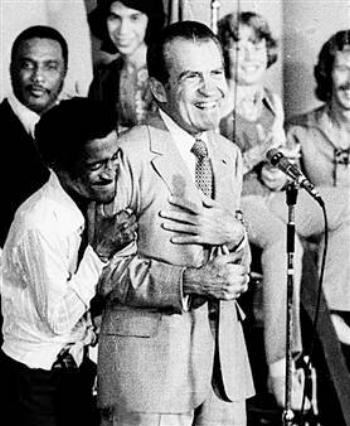
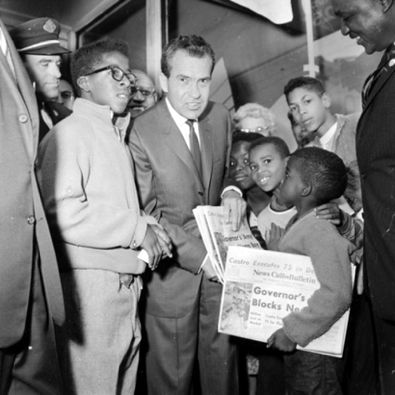

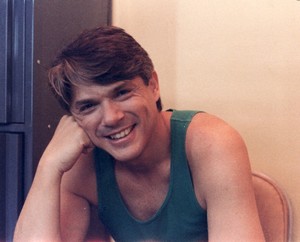
At the Mixed Roots Film & Literary Festival Elliott it was brought to my attention that on The Jeffersons a white male and a black female were cast as Tom and Helen’s children. I could hardly believe it. Then I kinda forgot about it. Well, I was flipping channels today and came across the Jeffersons and lo and behold there was Berlinda Tolbert playing Jenny Willis. She played the part well, don’t get me wrong, but….um…. well there’s just no way! Why was this the best casting choice? On the other hand, biracial actresses play “black” characters all the time, so what’s the difference. I’m not sure really. It just seemed silly to me. The son, Allan (played by Jay Hammer), was only on for one season and was written as “their overzealous college drop-out who abandoned the family, passed as a full-blood Caucasian and lived in Paris for two years.” Here are some recent(ish) photos of the brother and sister…

I wonder what Lenny Kravitz thinks of that. I wonder if he and his mother ever discussed it. I wonder if I’ll ever get to ask him.

I didn’t know that Slash was biracial until HBO’s The Black List. There was a brief period in middle school when I really tried to like Guns N’ Roses. I guess I’m just not that white. That’s meant to be a joke, btw. Anyway, I was pleasantly surprised to find out about his mixedness, and thought to myself, “I should have known. Look at that hair.” But back then I didn’t even know that I had that hair, so of course I was clueless.
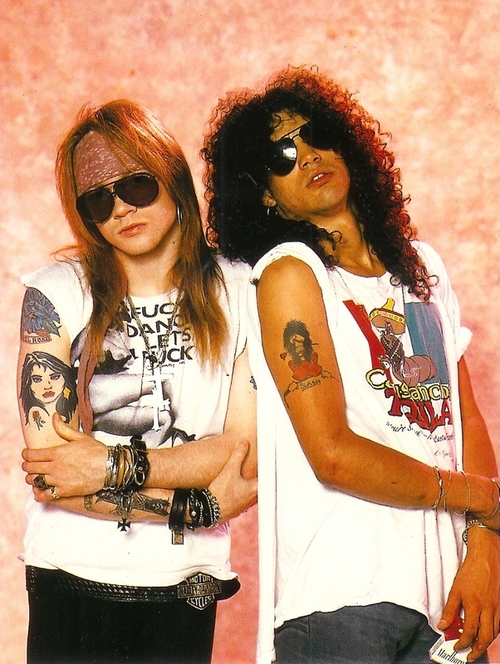
In Rip It Up: The Black Experience in Rock ‘N’ Roll edited by Kandia Crazy Horse Slash is asked if he defines himself as a black musician to which he replies that he defines himself as a rock musician if he defines himself as anything. He says he is very proud of his black heritage and sees this as being very cool. One thing he clears up is that he is NOT a Jewish musician. He says that is because his first name is Saul, but he is not Jewish. He talks about his racial background (biracial)…and how it was dealing with a white midwesterner in GNR.
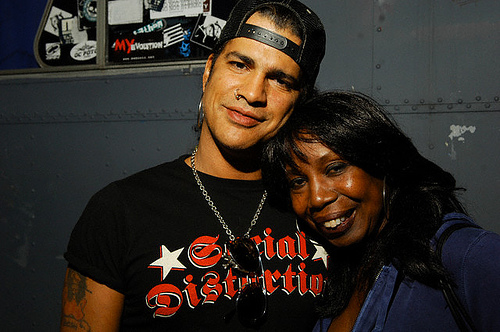
A recent article on the passing of Slash’s mother:
Rock guitarist Slash, the bi-racial son of a black mother and white father, is mourning the passing of his mother Ola Hudson, a woman he referred to recently as a “cool rock and roll mom.”
Hudson, a former costume designer for such musicians as Ringo Starr, John Lennon and Diana Ross died on the morning of May 6 after a battle with lung cancer. She was 62.
“This is a difficult time, but I have to share with you that she was the sweetest, warmest, most loving human being I’ve ever known (next to my grandmother on her side), as well as one of the most creative and talented,” Slash wrote on his MySpace page.
“She was also the coolest rock and roll mom, a rock junkie like myself could ever possibly want to have,” Slash continued. “She was responsible for exposing me to a lot of the music that would influence me as a musician growing up, as well as introducing me to ‘the life’ and priming me to survive this crazy business that I’m now in.
“But more importantly, she turned me on to all different forms of art and the importance of artistic self expression and creative communication thru music and dance from as early on as I can remember. She really was all things artistic and creative personified and the world is a lesser place without her.”
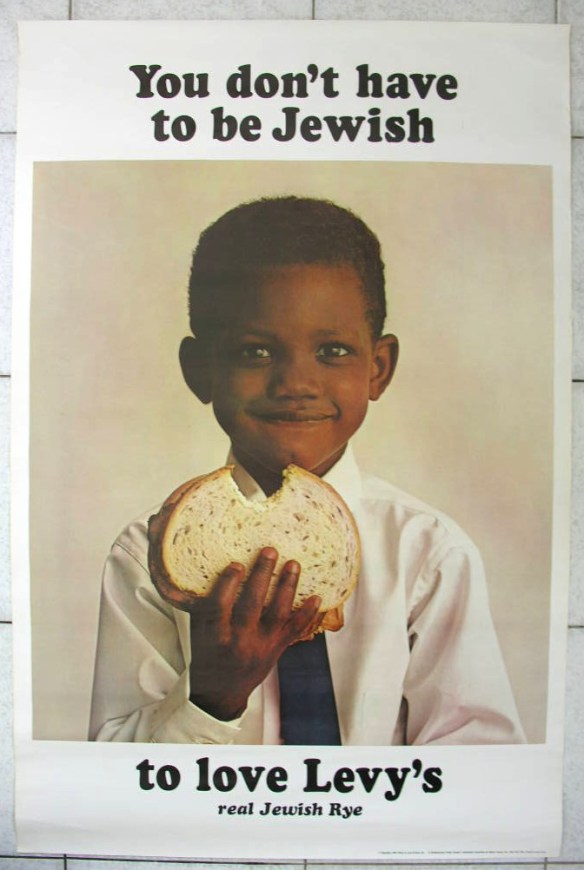
I was happy to come across this article (http://www.politicalarticles.net/blog/2009/06/17/are-you-black-black-enough-and-who-decides/) on the notion of “black enough.” I’m wondering today why, when I call attention to the absurd and potentially damaging rigid notions of blackness and whiteness, people feel the need to challenge me instead of challenging these notions. And the one that says that black and white cannot co-exist without the degradation of one, maybe even both, of them. I do not agree with Taylor’s assertion that “it may be too late in history as well as potentially dangerous to be tampering with the socio-cultural definition of blackness even though the definition is a product of slavery.” I think it dangerous not to tamper with it. I think the American consciousness is infected with racism (colorism at best). We trace the disease back to slavery. I don’t think we will heal and prosper and achieve the greatness intended for the nation until we rectify this situation. These definitions. I certainly do agree with his last statement though.
By Robert Taylor
In the wake of the claims of Tiger Woods and the election of a mixed race but Black President, a question has been raised in black internet chat rooms around the country as to whether there is a legal or biological definition of who is black.
Actually, there is no law operable today which defines what percentage of “black blood” makes one black. The oft-repeated notion that one drop of black blood makes one black is a cultural definition which has neither a legal nor biological foundation…It is basically a socio-cultural attitude based in major measure on how a person looks.
…Simply put, in America, if you “look” in anyway black, you “are” black. That is not law. That is not science. It just is – a practical reality. Thus Tiger Woods’ mother may be from Thailand and Tiger may object to being called black. But it does not make a practical difference.
Further, it may be too late in history as well as potentially dangerous to be tampering with the socio-cultural definition of blackness even though the definition is a product of slavery. When the Census Bureau decided a few years ago to include a category called “mixed race” in the census, many people rightfully saw it as potentially divisive, asking what practical good does the “mixed race” category serve, but to further divide people along largely artificial lines.
Finally, if one just has to ask the question, the real question should not be “who is black” but instead “who is white.” The scientific theories of Evolution and “Out of Africa” are very clear: There is only one “race” on the planet Earth and it had its origin in East Africa (around present-day Ethiopia) and then spread to all other parts of the world. Adapting to environmental conditions such as the degree of sunlight and developing in relative isolation, some groups evolved lighter skins and others evolved darker skins…Thus technically every person on the planet – from the darkest skinned person in the Congo to the lightest skinned person in Sweden – is of African ancestry.
Therefore the answer to the question above is YOU decide if you are Black enough and whether you realize it or not that gives you tremendous power.
via Politicalarticles.net
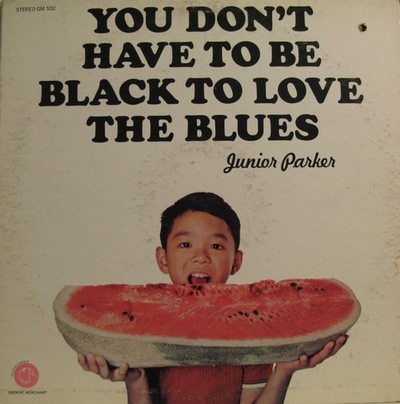
I just came across a bad review of Mulatto Diaries: The Movie on a blog http://www.losangelista.com/2009/06/black-biracial-mixed-white-other.html. Here’s an excerpt…
Her film is called the Mulatto Diaries, and sadly…Tiffany rubbed me the wrong way. She, and a few of the other biracial folks she interviewed in her film, came across like she believes on some level that being black means being ghetto, stupid, uneducated, lazy,uncultured, not being able to speak correct English and not having class or manners.
I am shocked that one could come away from the film with this impression. Yes, there are clips of me and the interviewees saying that at one time or another a black person/some black people have called us out for not being black enough. What does this mean if not that to some degree, which they find unsatisfactory, we do not ascribe to some stereotypical idea of being black? I’d really like to know. There is also a clip of me saying that for me the shame of this biracialness was heightened at the times when I was uncomfortable with my blackness. That discomfort was shameful. Not the blackness.
I think my point often is that I know firsthand that blackness indeed is not about donning the stereotypical garb of rap music and ebonics, but embracing the rich and difficult history that led to my being alive. Here in this country. Today. Blessed with so much. It is only because I am proud of my blackness and secure in my blackness, that I am able to say without shame and in a loud voice that I am also white. I am proud of who I am and who I am is equal parts both. It may seem like I go on and on about this. To an extreme. Beating a dead horse. Protesting too much this one drop rule. But I am trying to make up for hundreds of years of silence. This silence which I believe has contributed somehow to these negative depictions of blackness and to some illusory idea of the grandeur of whiteness. I may not always find the way to say exactly what I mean. I do not know what I am doing. I only know that I am doing. I am doing with good intentions. I am trying to free us all (black, white, mixed, whatever) from the boxes which I believe hold us back from reaching the great heights intended for us.


Last night TNT premiered “HawthoRNe” starring Jada Pinkett Smith. I especially like the show because they’re portraying biracial! Smith plays a recently widowed nurse who’s raising her biracial teenage daughter (Hannah Hodson). The (white)dead husband’s mother plays an antagonistic role. I don’t care what she does as long as she’s there and she’s white. Thank you TNT for this “unconventional” casting. I love seeing Joanna Cassidy as Hannah Hodson’s granny!
Even though I only got three hours of sleep, I couldn’t wait to get back to the festival Saturday morning. For me, the day started with two workshops: Mixed Race in Media Space: Tangible Ways to Voice Your Ideas and Concerns followed by Use It! Turning a Mixed Roots Experience into a Powerful Piece of Writing. I got a lot out of both sessions.
Next was the Mixed in Hollywood panel discussion moderated by the wonderful Elliott Lewis author of Fade. On the panel were Angel Nissel co-executive producer and writer for Scrubs/author of The Broke Diaries and Mixed, and Karyn Parsons of The Fresh Prince of Bel-Air and Sweet Blackberry Productions. I filmed some of it and will have it on youtube pretty soon.
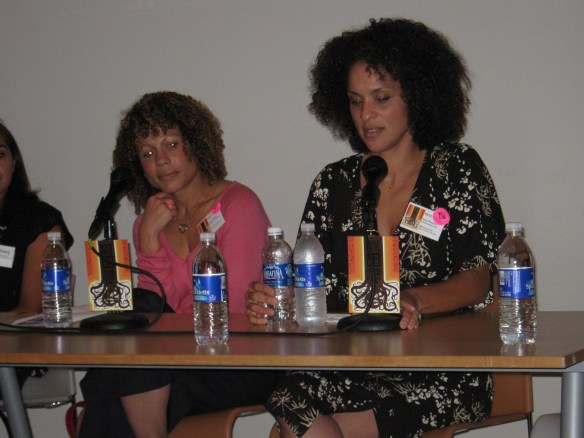
Another session of readings followed the panel discussion. Unfortunately, I missed most of them (a girl’s got to eat), but really enjoyed what I did hear from Liberty Hultberg.
Readings were followed by screenings of In the Name of the Son, Parallel Adele, and….

The other films were great and it didn’t kill me to have to watch my big face in a semi-large group of people. I liked listening to people watching it. And, from what I can tell, they liked it! Phew! There was a q&a afterwards, and seeing as I was the only director there, all of the questions were for me. Thank God people had some questions to ask! My mom filmed it and I intend to put that on youtube as well. Pretty soon 🙂
My best friend from college, Sophina, (who was also my first biracial friend) came with some friends, as did my (step)sister Megan, and of course my mom was there and it was really just wonderful.
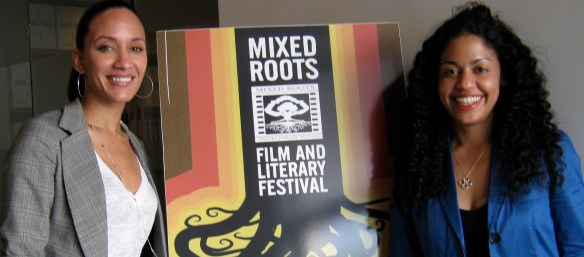
The event ended with Angela Nissel and Maria P.P. Root being award The Loving Prize for inspirational dedication to celebrating and illuminating the Mixed racial and cultural experience, followed by performances by the very talented Jordan Elgrably, Juliette Fairley, Kaypri, Jason Luckett, Lisa Marie Rollins, Jennifer Lisa Vest, Maija DiGiorgio, and Chris Williams.
Wow! What a line-up, what a weekend! It all went by so quickly! It was like a whole week of stuff packed into 2 days. Heidi and Fanshen, I don’t know how you did it! But I’m so grateful that you did! Thank you for including me.

The weekend left me with lots of thoughts. Some old, some new. I’m still trying to process and incorporate and figure out what to do with it all. But if I had to sum it up in one sentence, (today) it would be…

I never would have guessed Utah!

By Christopher Smart
The Salt Lake Tribune
http://www.sltrib.com/ci_12530272
Utah’s mixed-race population grew at the fastest rate in the nation from 2007 to 2008 — a trend some say could show Utahns are increasingly comfortable identifying themselves as multiracial.
“People are more willing to take a stand and say, ‘This is what I am,’ ” said Betty Sawyer, who works closely with students of various ethnic backgrounds and is president of Ogden’s NAACP.
New census data show multiracial Americans make up the nation’s fastest-growing demographic group. Between 2007 and 2008 the number of people identifying themselves as being of mixed race grew 3.4 percent; in Utah, the number jumped 5.9 percent.
But before 2000, the U.S. Census Bureau didn’t even provide a way for people to identify themselves as multiracial.
…Still, the new Census Bureau option doesn’t mean the country has moved beyond racism, said Darron Smith, an adjunct professor of sociology at Utah Valley University in Orem.
Smith, a black man who is married to a white woman, studies census trends.
In Utah Valley, people often make note of the black-and-white couple who have two girls, he explained.
“I always tell my kids they are biracial,” Smith said. “But the world will consider them black.”
While more people are identifying themselves as being of mixed race, those numbers don’t necessarily reflect a more racially progressive society, according to Smith. The percentage of biracial marriages and their mixed-race offspring is still very small — 3 to 5 percent.
“It’s a [statistical] outlier,” he said of interracial marriage. “It’s still not accepted.”
 mulatto diaries