
Reply

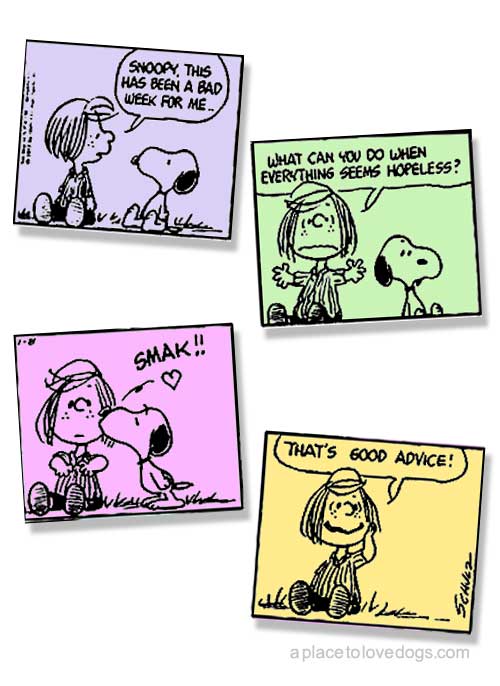

“Dogs are our link to paradise. They don’t know evil or jealousy or discontent. To sit with a dog on a hillside on a glorious afternoon is to be back in Eden, where doing nothing was not boring—it was peace.”-Milan Kundera

“I think we are drawn to dogs because they are the uninhibited creatures we might be if we weren’t certain we knew better. They fight for honor at the first challenge, make love with no moral restraint, and they do not for all their marvelous instincts appear to know about death. Being such wonderfully uncomplicated beings, they need us to do their worrying.”-George Bird Evans



Oscar! My new dog!
This is a fascinating story of interracial marriage, institutional racism, blended families, and mixed race ideology. I am inspired by the courage of conviction this woman maintained in the face of so much opposition. Oh! And… um…. excuse me South Carolina… 1998!?!? Yes, Michigan!
By DAVID LAUDERDALE
Laura Markovich came to Beaufort County in 1965 because it had one of the few places in the South where whites and blacks could gather.
She came from Michigan to attend a religious “summer school” of her Bahá’í World Faith at Penn Center on St. Helena Island.
What unfolded here became a rare testament of harmony in the messy struggle of race relations in America.
At the secluded Penn Center, on sandy soil where the first school for freed slaves was erected in 1862, the young white widow met a tall and striking black widower.
On the surface, the only thing they had in common were children underfoot. Laura had four children, all white, and Elting B. Smalls Sr. of St. Helena had six children, all black.
Three years later, they were married. They lived in the Tom Fripp community on St. Helena and together had four more children.
 Laura and Elting Smalls, center, on St. Helena Island with two of her daughters, one of their sons, and two family friends.
It was a life so odd for that era in the Deep South that it demanded hard-to-reach courage, resolve and unity.
Those characteristics — and Laura Smalls’ devotion to her faith, early childhood education and family — were cited Tuesday when a standing-room-only crowd gathered back at that same Penn Center for her funeral. She died Feb. 27 at age 79.
Her children composed a eulogy that makes it sound like they were raised in the world of Ozzie and Harriet:
“Her greatest loves were arts and crafts, playing and teaching children, talking to everyone and anyone, and dancing. You can see this evidenced through her children’s passions….Can’t you yet see her sweet smile?”
‘WEDDED WIFE’
That smile was a triumph of the spirit over harrowing details.
To set the stage, their marriage took place days after Dr. Martin Luther King Jr. was assassinated and America’s streets erupted into racial violence. King himself had gathered his troops for retreats at the Penn Center for the same reason the Bahá’ís did. They believed in unity, and this was one place they could find it. Just months before he died, King stood at Penn Center to ring home a point to the antsy civil rights activists: “So I say to you tonight that I have taken a vow. I, Martin Luther King, take thee, nonviolence, to be my wedded wife.”
For Elting Smalls to take Laura Markovich to be his wedded wife was not much easier.
Her faith required written permission from her father, and he didn’t want to give it. It took her three years to get it. Her father never did agree to meet Smalls, a Penn School graduate and career civil service worker at Parris Island Marine Corps Recruit Depot.
And then there was the matter of the law. In June 1967, the U.S. Supreme Court overturned state laws, like South Carolina’s, that banned interracial marriage. But it took South Carolina until 1998 to officially amend the state Constitution to remove what had been ruled a violation of the 14th Amendment. The Smalls wedding was a quiet affair in the home of one of the bride’s closest friends — in Michigan.
Thus a family of whites from up North and a family of black Sea Island Gullahs became one. They lived united, years before integration was forced on the local schools, much less accepted in the home.
BLACK AND PROUD
Sometimes Laura Smalls would take her troupe of white, black and mixed-race children into the historically white waiting room at the doctor’s office, and sometimes into the historically black waiting room, and always let the odd stares fall where they may.
Family members say the white community in town had a stand-offish attitude, but the blacks of St. Helena welcomed them all, as family.
“She didn’t do it to make a statement,” said daughter Lynn Markovich Bryant of Lady’s Island. “She fell in love with Elting and she wasn’t going to let anything stand in her way.”
Bryant gives the world a look at race it rarely sees in her 2002 autobiography, ” ‘I’m Black and I’m Proud,’ Wished the White Girl.”
As a child she was stunned by the ingrained racism she saw in her little classmates. She struggled with white attitudes toward blacks because in her world, there was no racial divide. She chose to attend the predominately black St. Helena Elementary School, where she felt welcomed as a fifth-grader. Today, she has taught there for almost 30 years after finishing second in her class at Beaufort High School, earning a full scholarship to Clemson University, graduating with honors and earning a master’s degree with a 4.0 grade point average.
She sounds like a black person, and she married a black man, joking that she would have had to marry a white for it to have been considered an interracial marriage. Her husband, Wilbert Bryant, teaches at Battery Creek High School.
One day as an adolescent, Lynn Bryant blurted out, “Mama, I hate white people.”
In her book, Bryant writes: “Being a mother to such a multitude of children, this was hardly her first or last problematic situation to resolve. … She ever so warmly and calmly responded as only she could, ‘Well, Lynn don’t you love the Bahá’ís? There are white Bahá’ís.”
EMBRACED
…Smalls was embraced on St. Helena because she was not a white who ignored the natives or said, “My way is better than your way — move over.”
She saw racial progress, her daughter said, but not the level of social interaction that’s necessary for people of different races, cultures and beliefs to quit being so judgmental.
“She taught us that we have more commonality than differences,” Bryant said.
Together, Laura Smalls’ 13 surviving children and stepchildren of all colors wrote: “Our mother did not tell us how to sacrifice and serve others; instead she showed us how to walk the walk.”


I love, love, love this op-ed piece on gayness, marriage, family, laws, human rights, and injustice in the good old USA.

When does a society decide to rectify an obvious longstanding injustice? The U.S. has a long history of allowing states to legislate unconstitutional laws such as miscegenation, segregation, slavery, women’s rights, reproductive rights, and LBGT equality based on an imposed religious morality.
Until 1967, the issue of interracial marriage was left up to the state. Opponents of interracial marriage felt that the mixing of races was unnatural, was against their religious ideals, and would lead to the death of the institution of marriage. Anti-miscegenation laws were enforced to protect mixed-race offspring from such an unnatural union.
Women’s rights opponents argued that women should’t be allowed to vote as they are mentally deficient, weak and neurotic by nature. It was argued that freeing the slaves was a disastrous concept and would lead to society’s downfall.
Some religious people believe that homosexuality is a choice or mental illness, advocating faith-based healing or sexual aversion therapies including electroshock or the administration of a corrective rape. No credible evidence shows these treatments to be effective. Rather, they end with suicide or-even worse-the subjects being expelled from their social groups. Am I mistaken assuming sexuality is innate?
The fact is this occurs in nature. Of the approximate 1,500 animal species we have extensively studied, nearly 450 exhibit homosexual behavior, engaging in same-sex relationships.
The belief that same-sex households lead to dangerous environments for children is absurd, since convicted drug dealers, neo-nazis, murders, rapists and convicted pedophiles are allowed to marry and raise children. Who poses a danger?
Coretta Scott King, civil rights leader, and Martin Luther King, Jr.’s widow spoke at Richard Stockton College about gay rights: “Gay and lesbian people have families, and their families should have legal protection. A constitutional amendment banning same-sex marriages is a form of gay bashing, and it would do nothing at all to protect traditional marriages.” This is of the most respected and active people in the civil and women’s rights movements.
Some feel that gay marriage and homosexuality simply go against the established traditions of America. Is American marriage purely for procreation? What about infertile couples, couples who choose not to have children, and the elderly who have long been allowed to marry and are allowed the full benefits and legal protections of the union? American marriage is about mutual love and commitment, not primarily about procreation.
How can such a great society tolerate such a liberal definition of freedom of speech while limiting its definition of equality? Do we really want a society that enables Liberty to rob Justice blind?


Perhaps even more influential than John Powell was Walter Plecker. Plecker dedicated his life to making sure that people like me could not exist. And though the notion predated him, I believe that he further ingrained into the consciousness of the nation the myth of the “tragic mulatto.” But even worse than that, he stripped the Native Americans of Virginia of their rights and identity. In my opinion Powell, Plecker, and the Eugenics movement in general are major pieces of this race in America puzzle.

John Powell, the renowned Richmond-born composer and pianist, clutches an American flag in this news service photograph from 1920. Wealthy Virginians and powerful newspaper editors supported the white-supremacist sentiments espoused by Powell. Fear of racial mixing was particularly pronounced among genealogy-obsessed Virginians who wanted to maintain a “pure” bloodline.
Disdaining the Ku Klux Klan’s violent white supremacist policies and tactics, elite white Virginians embraced the scientific racism espoused by the Anglo-Saxon Clubs of America. Founded in Richmond in September 1922 by internationally renowned pianist John Powell, self-styled ethnologist Earnest Sevier Cox, and Walter Plecker, the ASCOA committed itself to preserving white “racial purity.” Powell provided the movement’s star power and publicity; Cox’s book White America (1923) provided the pseudoscientific, eugenic justifications; and Plecker backed the other two with the state’s police power. The ASCOA demanded legislation prohibiting interracial marriage and defining anyone with any non-white heritage—even one drop—as black.
Passed at the height of the eugenics movement, the Racial Integrity Act proclaimed the existence of only two racial categories in Virginia—”colored” and white. The law stripped Native Americans, and members of other groups with dark skin, of their land, voting rights, and legal identity.
Walter Ashby Plecker was the first registrar of Virginia’s Bureau of Vital Statistics, which records births, marriages and deaths. He accepted the job in 1912. For the next 34 years, he led the effort to purify the white race in Virginia by forcing Indians and other nonwhites to classify themselves as blacks. It amounted to bureaucratic genocide.
He worked with a vengeance.
Plecker was a white supremacist and a zealous advocate of—a now discredited movement to preserve the integrity of white blood by preventing interracial breeding. “Unless this can be done,” he once wrote, “we have little to hope for, but may expect in the future decline or complete destruction of our civilization.”
Plecker would recall his early days in a letter to a magazine editor expressing his abhorrence of interracial breeding. He remembered “being largely under the control” of a “faithful” slave named Delia. When the war ended, she stayed on as a servant. The Pleckers were so fond of her that they let her get married in their house. When Plecker’s mother died in 1915, it was Delia “who closed her eyes,” he wrote.
Then Plecker got to his point. “As much as we held in esteem individual negroes this esteem was not of a character that would tolerate marriage with them, though as we know now to our sorrow much illegitimate mixture has occurred.” Plecker added, “If you desire to do the correct thing for the negro race … inspire (them) with the thought that the birth of mulatto children is a standing disgrace.”

Walter Plecker sits at his desk in 1935 at the Bureau of Vital Statistics
Plecker was a devout Presbyterian. He helped establish churches around the state and supported fundamentalist missionaries. Plecker belonged to a conservative Southern branch of the church that believed the Bible was infallible and condoned segregation. Members of Plecker’s branch maintained that God flooded the earth and destroyed Sodom to express his anger at racial interbreeding.
“Let us turn a deaf ear to those who would interpret Christian brotherhood as racial equality,” Plecker wrote in a 1925 essay.
Plecker saw everything in black and white. There were no other races. There was no such thing as a Virginia Indian. The tribes, he said, had become a “mongrel” mixture of black and American Indian blood.
Their existence greatly disturbed Plecker. He was convinced that mulatto offspring would slowly seep into the white race. “Like rats when you’re not watching,” they “have been sneaking in their birth certificates through their own midwives, giving either Indian or white racial classification,” Plecker wrote.

Many who came into Plecker’s cross hairs were acting with pure intentions. They registered as white or Indian because that’s how their parents identified themselves. Plecker seemed to delight in informing them they were “colored,” citing genealogical records dating back to the early 1800s that he said his office possessed. His tone was cold and final.
In one letter, Plecker informed a Pennsylvania woman that the Virginia man about to become her son-in-law had black blood. “You have to set the thing straight now and we hope your daughter can see the seriousness of the whole matter and dismiss this young man without any more ado,” he wrote.
In another missive, he rejected a Lynchburg woman’s claim that her newborn was white. The father, he told her in a letter, had traces of “negro” blood.
“This is to inform you that this is a mulatto child and you cannot pass it off as white,” he wrote.
“You will have to do something about this matter and see that this child is not allowed to mix with white children. It cannot go to white schools and can never marry a white person in Virginia.
“It is a horrible thing.”
Plecker demanded the removal of bodies from white cemeteries. He tried to evict a set of twins from a Presbyterian orphanage because they were illegitimate and, therefore, the “chances are 10-1 they are of negro blood.”
Plecker maintained that all of his racial designations were based on impeccable records. There was, however, a secret Plecker revealed to only a few trusted allies: A lot of the time he was just guessing.
He acknowledged the sham when a Richmond attorney questioned his authority to change the birth certificate of a woman classified as an Indian before 1924. Plecker quietly admitted he had no such power and rescinded his designation of the woman as “colored.”
Plecker fretted that he would lose his hold on Indians if word of his retreat got out. “In reality I have been doing a good deal of bluffing, knowing all the while that it could never be legally sustained,” he wrote to his cohort, John Powell. “This is the first time that my hand has been absolutely called.”
The setback was temporary, however. The attorney kept quiet.
Plecker’s racial records were largely ignored after 1959, when his handpicked successor retired. Virginia schools were fully integrated in 1963 and, four years later, the state’s ban on interracial marriage was ruled unconstitutional. In 1975, the General Assembly repealed the rest of the Racial Integrity Act.
Virginia has tried to erase Plecker’s legacy. It has established councils on Indian affairs and has conferred official state recognition on eight tribes, a designation that provides no privileges. But Indian leaders say recognition equals respect.
The approach to healing for mixed-race Indians must be holistic, inclusive of their bi-racial and tri-racial and Indian identity.


 mulatto diaries