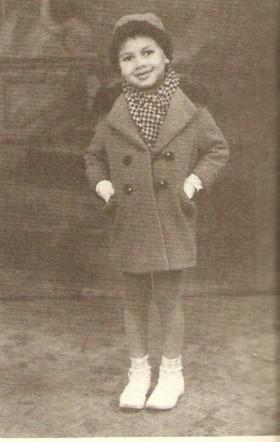
brown babies

I’ve been meaning to post more about these AfroGerman children since blogging about  the holocaust memorial last month.  This post is mostly a reblog from MochaJuden.com.  As someone who has a hard time embracing my German heritage (none of which is “afro”), I find myself fascinated by this piece of our history.  I would love to track down some of these “brown babies” and interview them about their experiences in Germany and in the U.S.  The Black German Cultural Society website is definitely worth checking out.  So many resources, so much information.  I have a feeling I’ll be touching on this topic again…. and again.

Germany’s Brown Babies

Many of our constituents are children who were born to German mothers who were abandoned by African American soldiers during the U. S. Occupation following World War II. While some remained in Germany, many were raised in orphanages or with foster families; a few remained with their natural mothers. Many were offered for International Adoption to African American Families and accepted into the US under the Displaced Persons Act of 1948 (amended June 16, 1950) , where it was assumed that they would “more easily assimilate into the culture.”

This result is a generation of culturally displaced persons who remain disconnected and alienated from the mainstream of the societies in which they lived and from both ethnic communities to which they belong.

Adoption is a wonderful concept and is generally accepted as an ideal social mechanism for improving lives and circumstances for abandoned or orphaned children. However, recent psychological and sociological research has determined that these children often suffer significant lifelong emotional and social problems such as identity deficits, separation and attachment disorders, and chronic depression, as well as other problems as a result of separation trauma and what has been identified as “the primal wound.”

The issue is magnified and the outlook becomes ever more complicated when we explore the international adoption and abandonment of interracial children who were created by opposing forces following a major global war. For the most part, there was no professional follow up in terms of the physical, social and emotional well being of these children once they were placed.

Historians in the last decade have begun to study and write publications about the Brown Baby Plan and the cooperative attempt between the two governments to place and provide for these unwanted and displaced children. Autobiographical Interviews and publications have given voice to the trauma and lifelong suffering stemming from the dramatic loss of identity and heritage and the cultural alienation that these children faced, particularly while growing up both in post war Germany and in the US during the Civil Rights era, a period when intense racism and discrimination was under scrutiny and identified as a major problem in both societies.

“We struggled through childhoods filled with confusion, fear, anger, and feelings of inferior self-esteem. Navigated adolescence in extreme conformity to perceived structures of authority, in order to redeem our existence, or in defiance to them in utter rebellion. Adulthood was either accomplished successfully by integrating the powerful nuances of our diversified selves, or postponed until safety could be found in the distanced wisdom of experience. Some of us didn’t make it. Some of us are just now coming of age.” ~ Rebecca, Black German Cultural Society.

American Homes For Germany’s Brown Babies Are Scarce – Jet Mag, May 15, 1952

Tan Tots Attend German Schools – Jet Magazine, July 24, 1952

Brotherly Love – Jet Magazine, December 18, 1952

2607979643_5a07458832_o

German Brown Babies Arrive in US – Jet Magazine, January 29, 1953

Brown Babies Become Americanized – Jet Magazine, May 21, 1953

Brown Babies Find New Homes In America – Jet Mag, Oct 8, 1953

all photos found atVieilles_annonces of Flickr

the gains to be realized from black-white intermarriage

What a life! From the seemingly extreme “Take that eugenics!”attitude of her parents, to the prodiginous achievements of her childhood, on to the “passing” years Philippa Schuyler’s story encompasses so many fascinating facets of the “biracial” experience of old.

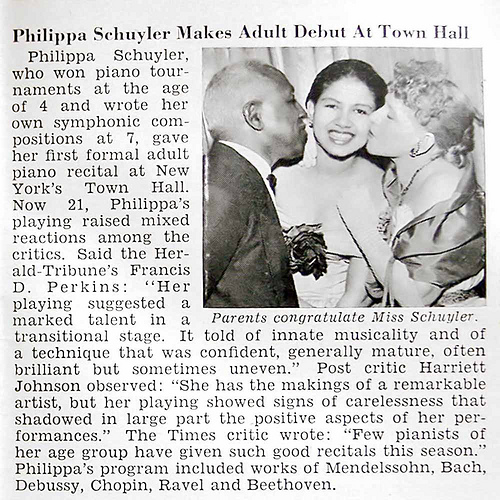
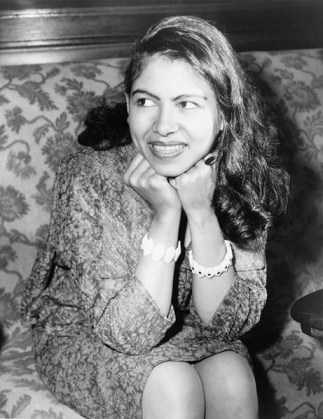
Philippa Schuyler

1931-1967

Classical pianist, writer

One of the most unusual and perhaps most tragic figures in American cultural history, Philippa Schuyler gained national acclaim as a child prodigy on the piano. Her picture graced the covers of weekly news magazines, and she was hailed as a young American Mozart. Schuyler’s life during adulthood, however, was a difficult one. She struggled with racial discrimination and with issues related to her mixed-race background, traveling the world in an attempt to find not only musical success but also an identity and a place in the world. She turned to writing in the early 1960s, visiting war zones as a newspaper correspondent, and she was killed in a helicopter crash in Vietnam in 1967. After her death she was mostly forgotten for several decades, but her life story was told in a 1995 biography.

Philippa Duke Schuyler was born on August 2, 1931, in New York and brought up in Harlem at the height of the area’s cultural flowering. The complexities of her life began with her background, for she had two singular parents. Her father George Schuyler was a journalist who wrote for one of the leading black newspapers of the day, the Pittsburgh Courier, and he was well acquainted with numerous writers in both black and white journalistic circles. He was not a civil rights crusader like many of his Harlem contemporaries, but rather a conservative satirist who rejected the idea of a distinctive black culture and later in life joined the ultra-right-wing John Birch Society. Philippa Schuyler’s mother, Josephine Cogdell Schuyler, was a white Southern belle from a Texas ranch who had married George Schuyler after coming to New York to escape a wealthy family of unreconstructed racists. They all refused to attend concerts Philippa Schuyler gave in Texas at the height of her fame.

Schuyler’s parents were in the grip of several novel theories and fads, some of which they devised themselves. They fed Philippa raw vegetables, brains, and liver, believing that cooking leached vital nutrients out of food. And, in contrast to the now-discredited but at the time widely held belief in eugenics, which formed the basis for Nazi ideas of racial purity, they claimed that racial mixing could produce a superior “hybrid” sort of human. That notion had strong effects on Philippa Schuyler’s life, for the Schuylers planned to make their daughter into Exhibit A for the gains that could be realized from black-white intermarriage.

And, indeed, the plan seemed to work. Schuyler walked before she was a year old, was said to be reading the Rubaiyat poems of Omar Khayyam at two and a half, and playing the piano and writing stories at three. When she was five, Schuyler underwent an IQ test at Columbia University; it yielded the genius-level figure of 185. She made rapid progress on the piano, and due to Mr. Schuyler’s connections it wasn’t long before stories about Philippa began to appear in New York newspapers.


Schuyler’s mother, described by the New York Times as “the stage mother from hell, blending a frustrated artist’s ambition with an activist’s self-righteousness,” started to enter her in musical competitions. Schuyler did spectacularly well and was a regular concert attraction by the time she was eight. Just short of her ninth birthday, New York mayor Fiorello LaGuardia named a day after her at the New York World’s Fair. But her childhood was an isolated one; she was taught mostly by private tutors and had no friends her own age. Her mother, who fired her piano teachers whenever she began to get close to one emotionally, beat her regularly.

For a period of time during World War II, Schuyler was a national child star. She wrote a symphony at age 13, and leading composer and critic Virgil Thomson pronounced it the equal of works that Mozart had written at that age after the New York Philharmonic performed it in 1945. A concert Schuyler performed with the Philharmonic soon after that was attended by a crowd of 12,000, and profiles of the attractive teen appeared in Time, Look, and The New Yorker. Schuyler was promoted by the black press in general, not just in her father’s Pittsburgh Courier, as a role model, and she certainly inspired a generation of black parents to sign their kids up for piano lessons.

But there were pitfalls ahead for the talented youngster. When she was 13, she discovered a scrapbook her mother had kept of her accomplishments, and more and more she began to feel like an exotic flower on display. On tour, especially in the South, she began to experience racial prejudice, something of which she had been mostly unaware during her sheltered upbringing. Bookings began to dry up, except in black-organized concert series. Observers have offered various explanations as to why. Schuyler herself and many others pointed to discrimination; the world of classical music has never been a nurturing one for African-American performers, and in the 1940s very few blacks indeed had access to major concert stages. Some felt that Schuyler’s playing, although technically flawless, suffered from an emotionless quality brought on by the strictures of her demanding life. And Schuyler faced a problem she had in common with other teenage sensations—the tendency of the spotlight to seek out the next young phenomenon.

Though Schuyler briefly fascinated the nation as a mulatto child prodigy, white America lost interest in her as she aged.

Schuyler and her mother reacted by once again calling in George Schuyler’s connections; he had friends in Latin American countries, and Schuyler began to give concerts there. In 1952 she visited Europe for the first time. Schuyler enjoyed travel, and, like other black performers, found a measure of unprejudiced acceptance among European audiences. Over the next 15 years she would appear in 80 countries and would master four new languages, becoming proficient enough in French, Portuguese, and Italian that she could write for periodicals published in those languages. She traveled to Africa as well as Europe, performing for independence leaders such as Kwame Nkrumah in Ghana and Haile Selassie in Ethiopia—but also passing for white in apartheid-era South Africa. Schuyler began to resist the pressure that still came from her parents, but she remained close to them, writing to her mother almost daily and becoming their chief means of financial support.

Her income came not only from music but also from lectures she gave to groups such as the virulently anti-internationalist John Birch Society, for Schuyler had come to share her father’s conservative politics. Despite her performances in newly independent African capitals, she came to adopt a positive outlook on European colonialism.

Confused and fearful about the future, Schuyler took steps in two new directions. First, since her ethnic identity seemed uncertain to those who had never encountered her, she began in 1962 to bill herself as Felipa Monterro or Felipa Monterro y Schuyler. She even obtained a new passport in that name. Her motivation seems to have been split between a desire to have audiences judge her without knowing of her African-American background, and a broader renunciation of her black identity. The ruse convinced audiences for a time, but the reviews of her concerts were mixed, and she soon abandoned the effort.

Second, Schuyler began to write. Traveling the globe, she filed stories from political hot spots for United Press International and later for the ultraconservative Manchester Union Leader newspaper in New Hampshire.  She wrote several books and magazine articles as well, and at her death she left several unpublished novels in various stages of completion. One of them evolved into an autobiography, Adventures in Black and White, which was published in 1960.

She traveled to Vietnam to do lay missionary work, supporting U.S. military action there and writing a posthumously published book about American soldiers, Good Men Die. She founded an organization devoted to the aid of children fathered by U.S. servicemen, and on several occasions she assisted Catholic organizations in evacuating children and convent residents from areas of what was then the nation of South Vietnam as pro-North Vietnamese guerrillas advanced. It was on one of those evacuation missions, on May 9, 1967, that Schuyler’s helicopter crashed into Da Nang Bay. She drowned, for she was unable to swim. Shortly before her death, she had written a letter that seemed to suggest a political change of heart, expressing sympathy with black activist leader Stokely Carmichael.

Schuyler’s funeral was held at New York’s St. Patrick’s Cathedral, and in death she was once again in the headlines. Two years after her death, Schuyler’s mother hanged herself in her Harlem apartment. A New York City school was named after Schuyler, but her name dropped into temporary obscurity. She became better known with the publication in 1995 of Composition in Black and White: The Life of Philippa Schuyler, a biography by Kathryn Talalay. In 2004, star vocalist Alicia Keys was signed to portray Schuyler in a film co-produced by actress Halle Berry. “This story is so much about finding your place in the world,” Keys told Japan’s Daily Yomiuri newspaper. “Where do we really fit in, in a world so full of boxes and categories?”

SOURCE

people don’t know how to treat you

This article is from 2005.  I wonder if the family has noticed a shift in attitudes over the last five years.  And of course I’d love to hear from little Toni.  The bridge between them.  I like that part a lot.

HOW DARE THEY TREAT US LIKE THIS?

by DIANA APPLEYARD

JAN LLOYD, 45, has been married to Tony, 48, for ten years. The couple have a four-year-old daughter, Toni. They run a successful martial arts business, Fighting Fit, with gyms around South London, where they live.

photo by Jenny Goodall

Jan says:

PEOPLE have spat at me in the street, stared at me, jostled me and shouted at me — all because I fell in love with a black man. But unless you have experienced it, you are unlikely to have any idea of the racism in British society.

It’s terrifying, but it’s something I am aware of every day of my life. We were taking our daughter Toni to see the GP when she was only two years old, when I was spat at in the street. It was completely random — a white man in his 40s looked us up and down and then spat at me.

It was so disgusting — I couldn’t believe it was happening. I looked for support, but everyone looked away. They were embarrassed and probably disgusted too, but no one wanted to get involved. I was shaking and tearful, but angry as well — how could someone behave like that in a civilised society?

As I walk down the street, go to the pictures, eat out in restaurants or go to the theatre, I am frequently aware of a kind of coldness and embarrassment around me. The only way I can describe it is that it’s like being disabled — people don’t know how to treat you.

They don’t know what to say to me. You can see the thought running through people’s minds: ‘Why is she with a black man?’
When I got together with Tony, a lot of my friends melted away. They’d invite me to a party with my new boyfriend, but then, mysteriously, they’d never invite us again. Once, early in our relationship, I’d booked a table at a nice restaurant. When we arrived, there were lots of empty tables — but they put us at the back, next to the toilets. I was going to complain, but Tony told me just to leave it. He’s used to it. Our backgrounds could not be more different. I was brought up in a well-off family in Sussex and was privately educated. I met Tony when I took up aerobics and he was my instructor.  I thought he was nice, but our relationship didn’t progress until I was in a horrid road-rage incident, when a man hit my car and then bashed on my window. It made me realise I ought to learn self-defence and Tony also taught martial arts. Before I fell for him, I’d been out with City types, public-school educated white men, so Tony was a real change. I thought he was intelligent and interesting — I was fascinated by the fact that his life was so different from mine.

He was born in Yorkshire, but his family moved to London when he was three. He had traditional values and an old-fashioned approach to relationships. There was also a lovely warmth about him. He was successful and welloff through his business and he was a real self-made man.

We started going out and six months later I met his family. He’s one of six and it was so different from my middle-class home — they were so loud, so welcoming, pressing food on me and firing questions at me.

Tony told me he’d been badly beaten up as a child by racist bullies and that nearly every day he faced some kind of prejudice or abuse — it hurt him so much.

But it wasn’t long before I started to experience the kind of hostility he’d faced most of his life. Suddenly, being with him, I was made to feel like a freak, a secondclass citizen. It was bizarre. There was so much disapproval in people’s glances. There seems to be this attitude like ‘Aren’t white men good enough?’ when all I had done was fall in love.

We had been together only six months when we decided to get married and it came as a shock to my parents, who asked me if I was sure it was going to work given our cultural backgrounds. But they have since mellowed and little Toni is the bridge between us.

My parents are very traditional, and all they could see were problems in a mixed marriage.

We married on a beach in St Lucia. Both sets of parents came and it made such a difference being there — we were surrounded by welcoming black people, and my parents felt less uneasy.  Now they are very supportive of Tony and can see what a good man he is. Before, they — like so many others — had only seen the stereotypes.

After our wedding I joined Tony in his business, and Fighting Fit is now very successful. We live in a lovely four-bedroom house, we enjoy great holidays, scuba dive, ride horses and have a happy, middle-class life. Now when I get the looks, I ignore them and carry on. They can’t harm our life or family.

I did worry a little about our daughter and whether she’d face any prejudice at school being mixed race, but she’s totally accepted — she’s just Toni, with a big personality for a little girl, so sunny and confident. Everyone loves her.

SOURCE

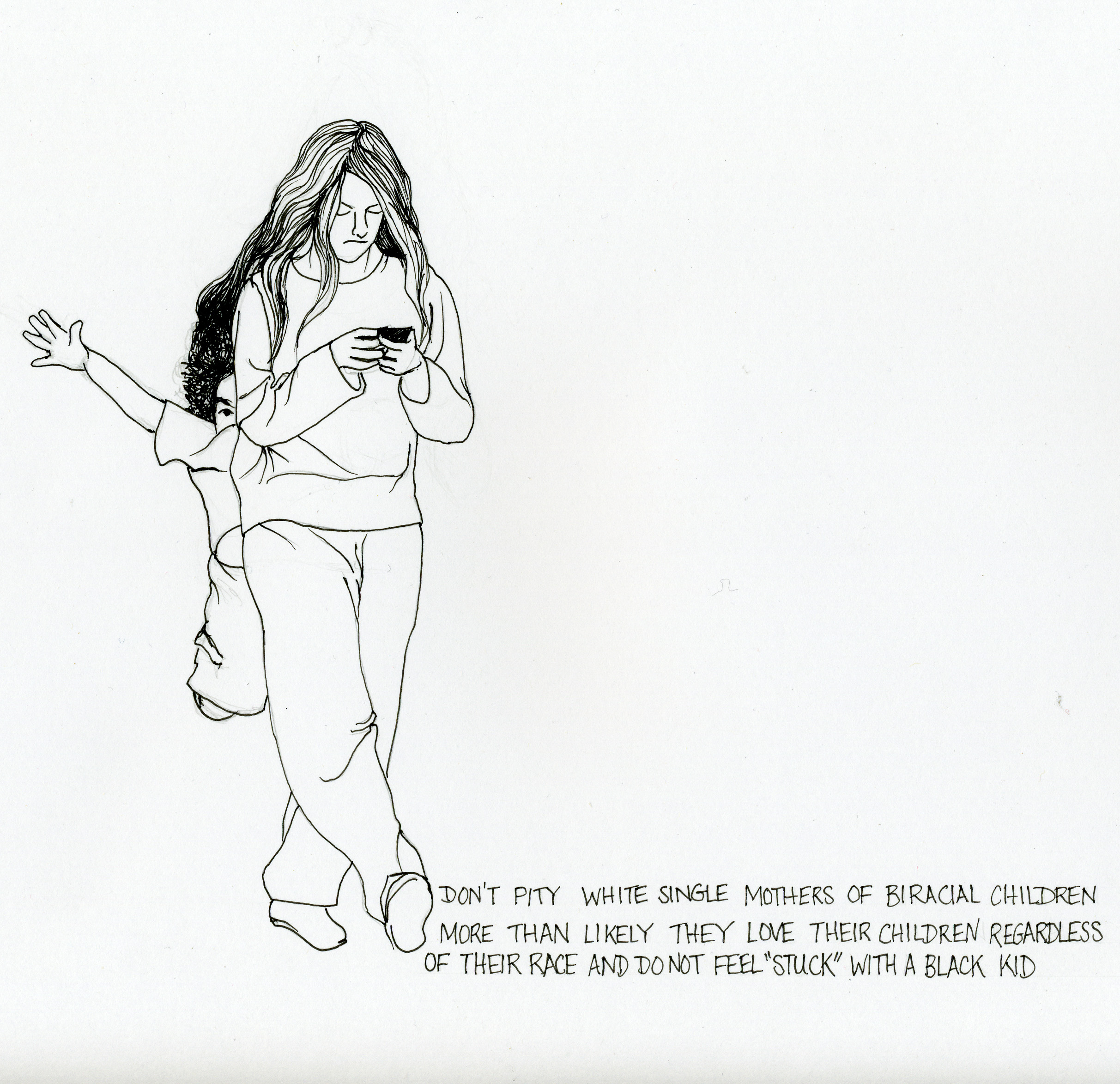
white mothers of mixed-race children

I want to be a part of this research!  I’ve long been fascinated by the “white mom having” vs. “black mom having” biracial experience.  One similarity I can glean from my own “black mom having” experience and what is written in this article about that of the white mothers is the scrutiny.  I vividly remember my mother’s parenting being scrutinized by the mothers of my white classmates and some of the school faculty as well.

Do Racist Attitudes Hinder Mothers Of Mixed-Race Children?

via, Adapted from materials provided by University of Royal Holloway London, via AlphaGalileo.

Professor Ravinder Barn and Dr Vicki Harman from the Centre for Criminology and Sociology at Royal Holloway, University of London are carrying out research into white mothers of mixed-race children. It is part of a wider study of mixed-race children and young people that has spanned more than two decades.

Parenting as an activity has become the focus for much concern at a policy and academic level, and the experiences of white women mothering mixed-race children is also receiving considerable attention.

Globalisation and migration are playing key roles in determining the social and familial landscape of contemporary western societies. Government statistics in the UK, Canada and the USA point to the increasing racial and cultural heterogeneity and the growth of the mixed-race population. Although many of these families lead relatively trouble-free lives, there is evidence of vulnerability and disadvantage for others in a number of areas including education, health, social care and the criminal justice system.

New and ongoing research was presented at a one day inter-disciplinary research conference, organised by Professor Barn and Dr Harman to disseminate the findings to those working with inter-racial families and to determine the research agenda of the future.


“In the academic and popular discourse, there is now a concern that ‘mixed families’ have become problematised. White mothers in these settings are often subjected to a racialised critical social gaze in a way that their parenting is placed under scrutiny,” said Professor Barn.

Dr Harman added, “Although the growing number of mixed relationships have been suggested to be evidence of a more tolerant society, social significance continues to be attached to relationships involving people from different ethnic backgrounds. White mothers of mixed-parentage children can find themselves dealing with racism directed at their children as well as facing social disapproval themselves”.

The six papers presented at the event explored a range of areas including: the mixed-race landscape in the Canadian context, common themes amongst families experiencing social service involvement, the need to understand the social networks utilized by white mothers in mixed families and historical research looking at government archives to understand the ways in which white women’s role in nation building had been marginalized.

racial identity shaped by social experience, or white mulattoes

This entire post is reblogged from Renegade South: histories of unconventional southerners.  I find it to be a fascinating piece of American history.  It’s one of those stories in which “american” history and “african-american” history are so intertwined that a distinction between the two can hardly be made.  That’s just how it always should be, in my opinion.  This country has just one history.  It’s black and white and everything in between.  The story is long and may be hard to follow, but I think it’s worth the effort.

The Family Origins of Vernon Dahmer, Civil Rights Activist

by renegadesouth

Vernon F. Dahmer, a well known Mississippi civil rights worker, was murdered in 1966 by white supremacists connected to the Ku Klux Klan. Before the night of January 10, 1966, when the Dahmer grocery store and home were firebombed, Vernon had been leading voter registration drives in his community. To facilitate that effort, he had recently placed a voter registration book in the grocery store he owned.

Dahmer Grocery Store

Vernon Dahmer’s grocery store, located on Monroe Road, 3.5 miles from the Jones County line. Photo courtesy of Vernon Dahmer, Jr.

Vernon Dahmer, Western Union Telegram

It took many years and five court trials to convict KKK Imperial Wizard Sam Bowers in 1998 of having ordered the murder of Vernon Dahmer. Today, Dahmer is revered for his courageous work on behalf of black civil rights. In honor of his memory, both a street and memorial park in Hattiesburg bear his name.

In the essay that follows, Dahmer’s grandniece, Wilmer Watts Backstrom, and Yvonne Bivins, a member of his extended family, enrich our understanding by telling the story of his family roots in southern Mississippi. Dahmer’s multiracial heritage included white, black, and Indian ancestors. The narrative begins with the story of his grandmother, Laura Barnes.

The Family Origins of Vernon F. Dahmer, Mississippi Civil Rights Activist

By Wilmer Watts Backstrom and Yvonne Bivins

Laura Barnes was born in Jones County, MS in October 1854. According to her daughter, Roxanne Craft, “she was given to a black family to raise because she was born out of wedlock to a white girl.”

The 1870 census for Twp 9 in NE Jones County, Mississippi, shows that fifteen-year-old Laura was living in the household of Ann Barnes, a 55-year-old mulatto woman born in Mississippi whose occupation was housekeeper. A young mulatto boy, Augustus, age 12, also lived in the home.  Living next door to the Barnes family were Andrew and Annice (Brumfield) Dahmer.

Laura Barnes

Laura Barnes, grandmother of Vernon Dahmer, Sr., courtesy of Vernon Dahmer, Jr.

After the Civil War, Andrew Dahmer and his brothers became traveling salesmen who peddled their wares in Wayne, Jones, and Perry Counties in Mississippi. Andrew soon met and married Annice Brumfield, whose mother, Altamarah Knight Brumfield, was the daughter aunt of Newt Knight and Serena Knight.

Andrew and Annice’s neighbor, Laura Barnes, met Andrew’s brother, Peter Dahmer, in the early 1870s. They began a relationship that resulted in the birth of a baby boy in 1872, who Laura named George Washington Dahmer. Peter apparently did not acknowledge his child, and soon moved to Chickasaw County with several brothers, where they farmed and built a mercantile business.

For giving birth out of wedlock, Laura became a “marked woman.” During this period in her life, she operated a boarding house for the railroad and sawmill workers in northeast Covington County and near “Sullivan’s Hollow” in Smith County. The “Hollow” was notorious for its lawlessness and racial bigotry.  Blacks were not welcome there.  Black families that did live there were descendants of Craft and Sullivan slaves.

Laura hired a black man from the hollow named Charlie Craft. Working closely together on her place, they soon fell in love and developed a relationship. This would bring trouble, because although Laura was raised by a mulatto woman and listed as mulatto on census records, whites still considered her off limits to a black man.

Charlie and Laura Barnes Craft

Charlie and Laura Barnes Craft, grandparents of Vernon Dahmer. Photo courtesy of Vernon Dahmer, Jr.

Charlie Craft was born in Smith County, MS, around 1853.  According to family history, he was part Creek Indian and part African, with piercing eyes and coal black straight hair. A former slave of Bryant Craft, Charlie was known as a man who had never run from a fight. Story has it that after a shootout with the infamous Sullivans, he left Smith County, but doubled back to spirit away his siblings. Because newly freed slaves were not welcome in Smith County, they moved to Covington County, where they settled on a ridge south of the Hollow in the Oakohay area. Here, they established a prosperous community called Hopewell.

By 1880, thirty-year-old Charlie and twenty-eight-year old Laura lived in the Oakohay District.  Four children lived with them: George (Laura’s son by Peter Dahmer), age 10; [Roxanne] Viola, age 7; Bettie, age 5; and Elnathan, age 2. All, including Laura and her son George, were listed as “mulattos” on the 1880 federal manuscript census for Covington County.  Living nearby were Charlie Craft’s mother, Melvina, and several siblings.

One night a local white mob filled with home brew surrounded and attacked their home.  Both Laura and Charlie were excellent shots. Laura shot and killed one of attackers as they tried to protect their children from the mob and, in so doing, the couple had to flee “the ridge.” Laura’s son, George Dahmer, helped them escape.  Upon arriving in the Kelly Settlement, they moved off in the swamps on the Leaf River on the old “William Jenkins Place.”

George Washington Dahmer

George Washington Dahmer, father of Vernon Dahmer, son of Laura Barnes Craft and Peter Dahmer, stepson of Charlie Craft. Photo courtesy of Vernon Dahmer, Jr

The area commonly known as Kelly Settlement was settled by John Kelly, a white man born in North Carolina about 1750.  John and his wife, Amelia, left Hancock County, GA, and arrived in Mississippi in late 1819, settling in Perry County.  By 1820, the Kelly household included John, Amelia, sons Green, 16, and Osborne, 18, Osborne’s wife Joene, and nine slaves. Among these slaves were the parents of Sarah, whose descendants later formed Kelly Settlement. Although the 1820 federal manuscript census for Perry County listed no free blacks living in the household of John and Amelia Kelly, descendants claim that Sarah’s folks were not slaves, but free people who accompanied the Kelly family to Mississippi.

After the Civil War, Sarah’s children began to homestead land, marry, and raise children.  Working together as they had down on John Kelly’s place, they cleared the land to raise crops, cut timber, and hauled it to the Leaf River by oxen to float it down to the Gulf Coast.

Laura Barnes Craft’s son, George Dahmer, moved to the Kelly community ahead of the rest of the Crafts. In 1895, George married Ellen Louvenia Kelly, the daughter of Warren Kelly and Henrietta McComb.  Like his own mother, Laura, Ellen’s mother, Henrietta, was a white child born out of wedlock and given to a black family, the McCombs, to raise.  The McCombs were living on the William Jenkins place when the Crafts arrived in Perry County.  Ellen Kelly’s father, Warren Kelly, was the mulatto son of Green H. Kelly and the grandson of John Kelly, the original white settler of the area. Warren Kelly’s mother was Sarah, the daughter of John Kelly’s slaves (or perhaps free black servants).

Warren Kelly

Warren Kelly, son of Green Kelly and Sarah Kelly, father of Ellen Kelly Dahmer, grandfather of Vernon Dahmer. Photo courtesy of Vernon Dahmer, Jr.

It was to this community that Charlie and Laura Barnes Craft fled with the aid of Laura’s son, George Dahmer. According to Wilmer Watts Backstrom (their great granddaughter), Charlie and Laura’s family lived in isolation for many years after being forced out of Covington County; they were prone to violent disagreements and exhibited heated tempers. This family drank heavily with much cursing.  They lived down in the swamps isolated from the community until the children were all grown.  As the children became adults, they gradually moved out of the swamps, married and had families of their own.

Charlie was employed by Green Kelly as a night watchman on the Leaf River. He died before 1910 in Forrest County, MS.  By that year, several of his and Laura’s children were married and living in Kelly Settlement, MS. Although Laura’s name does not appear on the 1910 Census, she was still alive that year. In 1920, she lived with her oldest child, daughter Roxanne Craft Watts, on the Dixie Highway, Forrest County, MS.  Laura died on 5 June 1922.

Ellen Louvenia Kelly

Ellen Louvenia Kelly, wife of George Dahmer, mother of Vernon Dahmer, daughter of Warren and Henrietta McComb Kelly. Photo courtesy of Vernon Dahmer, Jr.

Laura’s son and Charlie’s stepson, George Dahmer, identified as a black man even though his mother and biological father were white, demonstrating how strongly one’s racial identity is shaped by social experience.

George and Ellen Kelly Dahmer were the parents of Vernon Dahmer. George was known as an honest, hardworking man of outstanding integrity, rich in character rather than worldly goods. Like his father, Vernon worked hard and became a successful storekeeper and commercial farmer. Before his tragic death, he served as music director and Sunday school teacher at the Shady Grove Baptist Church, as well as president of the Forrest County Chapter of the NAACP. He and his wife, Ellie Jewell Davis, were the parents of seven sons and one daughter.

Vernon F. Dahmer, Sr.

Vernon F. Dahmer, Sr. Photo courtesy of Vernon Dahmer, Jr.

Vernon and Ellie Dahmer Family

Vernon Dahmer’s wife and children: seated left to right, George Weldon, Ellie J., Alvin; standing, left to right, Vernon Jr., Betty Ellen, Harold. Photo courtesy of Vernon Dahmer, Jr.

you’re not adopted

Wow, what a story!  While I think that Mrs. Brannigan’s choice to feign adoption in order to keep her own son is a sad commentary on black/white race relations, I honestly admire her commitment to her child and think her solution was clever.  This certainly is a unique story of “transracial” “adoption”.

Torment of the child from a mixed- race affair

By Ronan Lang

Tim Brannigan likes to say that he was born on May 10, 1966, and that he died the same day too. Minutes after his birth, Tim was ferried away from his mother Peggy, who subsequently told her own parents, siblings and her three other children that her baby had died in childbirth.

For the next five days in Templemore Hospital in Belfast, Peggy Brannigan had one ashen-faced visitor after another express their deepest condolences for her loss while, just a few doors down, her baby gurgled and cooed away like any healthy newborn.

The reason for the deception was that Peggy was a white woman married to a white man, and her new son was black. During a difficult period in her relationship with her husband Tom, Peggy had met and had a brief affair with a Ghanaian doctor named Michael Euke.

When she became pregnant, Peggy panicked and told her husband that she had been raped.

When the baby was born, Tom went along with the charade. Somehow, Peggy also convinced the hospital staff to assist in her scheme. The plan was for Tim to be smuggled to an orphanage under strict instructions that he was not to be adopted.

Peggy needed time and headspace to figure out what to do, but the plan was eventually to ‘adopt’ her own son. To her credit, by the time of Tim’s first birthday, he was living with his family deep in the heart of the Falls Road.

EastEnders scriptwriters would throw out that idea for being too far-fetched, but it’s all true, and laid out in honest, mind-boggling detail in Tim’s new book, Where Are You Really From?

Speaking to Weekend on a recent visit to Dublin, Tim recalls the night that his mother finally confessed the truth to him.

“I was 19, and I remember it was the night before Live Aid,” he says. “We were at a family function, and we’d both had a few drinks. She was saying how she wanted me to travel and see the world. Then, out of the blue, she said, ‘Timothy love,I’ve something to tell you. I’m your real mum and you are my son. You’re not adopted’.”

It’s a bombshell by anyone’s standards, but Tim, astoundingly, managed to take the news in his stride. He remembers crying, but from happiness.

“Honestly, I found it relatively easy to process,” he explains. “At that stage, my relationship with her was already quite established. I viewed her naturally as my mother. I didn’t call her by her first name, I called her mum, and I was closer to her than most of my other brothers. It all just seemed right to me.”

Having had years to absorb the story, and the chance to revisit his origins through writing the book, Tim says that he understands his mother’s desperate motivations after he was born. “I think she was very proud, and was part of a culture of looking out the net curtains and judging others,” he says.

“Because her family were close to the Catholic Church, and they had a little bit of money, she couldn’t bring herself to tell her parents and it became this massive burden. I think mentally she let this secret get out of all proportions. Even after she told me in 1985, I wasn’t allowed to tell my two eldest brothers the truth. They only found out in the last decade.”

Peggy went on to tell Tim about his real father, who had refused to support Peggy and had only ever seen his son once as a toddler. Nevertheless, Peggy seemed to want Tim to find out more about his father.

“She wanted me to be excited about having this father all of a sudden, but I had no initial desire to meet him,” Tim says.

It would be almost 20 years before Tim finally did meet him. In the meantime, Tim completed a degree in politics at Liverpool Polytechnic, but it was the explosive politics in his native town that were to define his 20s and 30s.

…Surprisingly, Tim reveals that the most sustained racism he ever encountered in his life didn’t come from his neighbours on the Falls Road, schoolmates, Republican comrades or Loyalist foes, but rather from the British Army — even its black members.

“I think I escaped the worst aspects of any racism because Belfast was so conflicted,” he says. “The last thing the British Army were expecting to see was a black kid, so they’d be shouting things like ‘black bastard’, ‘nigger’ and ‘go back to the jungle’. But people on the street would then say, ‘Don’t listen to them Tim, ignore them’, and so I became ‘one of us’ and the soldiers were ‘them’.”

… Sadly, his mum’s health took a turn for the worse in October 2002 and, for the best part of two years, Tim nursed her until she died from a brain tumour in March 2004. With his mother’s wishes in mind, Tim decided to track down his father three years ago as part of a BBC Radio documentary.

“Even after all his messing around, my mum held him in high esteem,” Tim says of his father. “Whereas I was more cynical about him. I was like, ‘Why would I want to track him down? He knows where I am, and he’s never bothered. He’s clearly made his decision.’

“My mum wanted me to do well, and I think she wanted to say to him, ‘Look what I did with our son on my own’. So I started with a view to saying, ‘I’ve been through a lot, but I’m still standing; this is who I am; this is what’s happened to me’.”

It’s a journey that brought Tim as far as Ghana to eventually meet his birth father. Along the way, Tim discovered that he had five brothers and sisters on his father’s side, many of whom live in London. After showing initial enthusiasm towards Tim, they have since cut off contact. They’re likely taking the cue from their father.

“He’s a very successful, quite wealthy guy in Africa,” Tim explains. “Money doesn’t motivate me, but they might think I’m after something.”

Tim met with his father a few times during the documentary trip to Ghana. “It was pretty awkward and stilted,” he recalls. “He’s a man who seems to be able to compartmentalise his life. His wife, as far as I know, to this day doesn’t know about me. We met a few times for a drink, but it was clear he didn’t want me around. He was determined to keep me away from his house and the rest of the family.”

The last time they spoke, or had any contact, was by text and an argumentative phone call over Christmas 2008. Now that his story is out in print, there could be a chance of reconnecting, but Tim isn’t going to hold his breath.

“I think a couple of them are on Facebook so I probably will message them to say, ‘Brace yourselves’,” he says with a smile.

So has Tim dealt with what must be deep disappointment, and made peace with the fact that any kind of relationship with his father and half-siblings looks unlikely?

Tim smiles and pauses before replying: “There are issues … in my quiet moments. I find myself thinking, ‘What if?’, or, ‘Will I try again?’

“It’s still a bit of an emotional maelstrom, but what can I do? Maybe they’ll read this and change their opinions.” He pauses again before continuing: “I guess it comes back to what a social worker warned me when I first started looking for my father. She said, ‘If you don’t want to hurt anyone, then turn around now and don’t do it. Someone always gets hurt’.”

Where Are You Really From? by Tim Brannigan is out now, published by Blackstaff Press, €13

– Ronan Lang

read the rest @ Irish Independent

re: little. black. sambo.

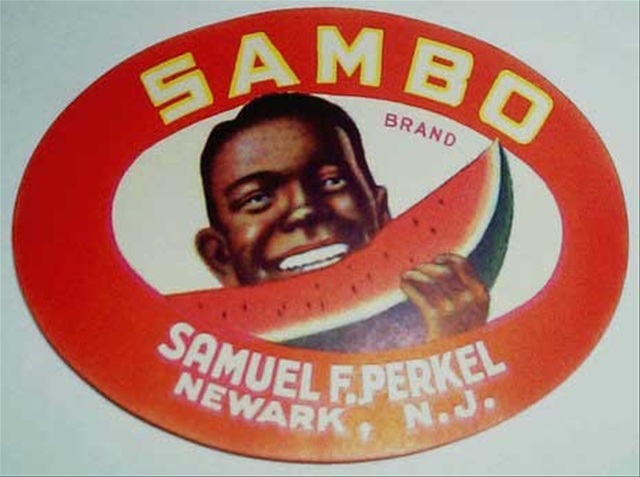
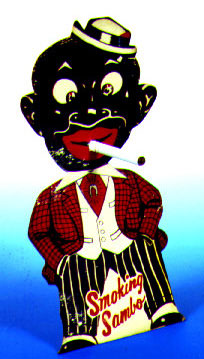
I just wanted to post a bit more about the history of Little Black Sambo.  I think the most important aspect of this history is the way the character/story has made people feel about themselves.  White privilege protects a majority of people from the hurts that can be evoked by “harmless” depictions in story books and advertisements.  The price for that protection can come in the form indifferent ignorance.

  • “The cultural understanding of ‘Little Black Sambo’ is a negative,” says Professor Frank Gilliam of UCLA. “It’s meant to suggest that people of African descent are childlike, that they’re irresponsible, that they’re not fully developed human beings.”
  • Langston Hughes pointed out that Little Black Sambo was “amusing undoubtedly to the white child, but like an unkind word to one who has known too many hurts to enjoy the additional pain of being laughed at.”

The following is excerpted from an essay found at the Jim Crow Museum of Racist Memorabilia:

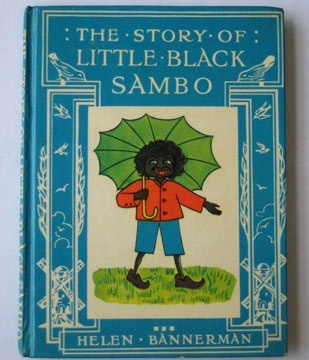
Arguably, the most controversial picaninny image is the one created by Helen Bannerman…The book appeared in England in 1899 and was an immediate success. The next year it was published in the United States by Frederick A. Stokes, a mainstream publisher. It was even more successful than it had been in England. The book’s success led to many imitators — and controversies.

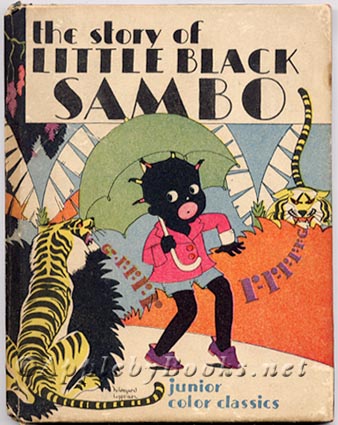
Was Bannerman’s Little Black Sambo racist? The major characters: Little Black Sambo, his mother (Black Mumbo) and his father (Black Jumbo) used standard English, not the bastardized English then associated with Blacks. Stereotypical anti-Black traits — for example, laziness, stupidity, and immorality — were absent from the book. Little Black Sambo, the character, was bright and resourceful unlike most portrayals of Black children. Nevertheless, the book does have anti-Black overtones, most notably the illustrations. Sambo is crudely drawn, an obvious caricature… The names Mumbo and Jumbo also make the characters seem nonsensical at a time when Blacks were routinely thought to be inherently dumb.

The illustrations were racially offensive, and so was the name Sambo. At the time that the book was originally published Sambo was an established anti-Black epithet, a generic degrading reference. It symbolized the lazy, grinning, docile, childlike, good-for-little servant. Maybe Bannerman was unfamiliar with Sambo’s American meaning. For many African Americans Little Black Sambo was an entertaining story ruined by racist pictures and racist names. Julius Lester, who has recently co-authored Sam and the Tigers, an updated Afrocentric version of Little Black Sambo, wrote:

When I read Little Black Sambo as a child, I had no choice but to identify with him because I am black and so was he. Even as I sit here and write the feelings of shame, embarrassment and hurt come back. And there was a bit of confusion because I liked the story and I especially liked all those pancakes, but the illustrations exaggerated the racial features society had made it clear to me represented my racial inferiority — the black, black skin, the eyes shining white, the red protruding lips. I did not feel good about myself as a black child looking at those pictures.

Little Black Sambo served as the boiler plate for a spate of other versions, many of which used mean-spirited racist drawings and dialogue. The vulgar reprint versions were symbolic of Black-White relations. Little Black Sambo’s popularity coincided with the crystallization of Jim Crow laws and etiquette. Blacks were denied basic human and civil rights, discriminated against in the labor market, barred from many public schools and libraries, harassed at voting booths, subjected to physical violence, and generally treated as second class citizens. The year that Little Black Sambo came to America a Whites-initiated race riot occurred in New Orleans. It was effectively a pogrom — Blacks were beaten, their schools and homes destroyed. Little Black Sambo did not, of course, cause riots, but it entered America during a period of strained and harsh race relations. It was, simply, another insult in the daily lives of African Americans.

The anti-Little Black Sambo movement started in the 1930s and continued into the 1970s. Black educators and civil rights leaders organized numerous campaigns to get the book banned from public libraries, especially in elementary schools. In the 1940s and 1950s the book was dropped from many lists of “Recommended Books.” By the 1960s the book was seen as a remnant of a racist past.

Little Black Sambo was again popular by the mid-1990s. Its recent popularity is a result of many factors, including a white backlash against perceived political correctness. This is evident in internet discussions. Americans, Black and White, are rereading the original book (and some of the unauthorized reprints). There is agreement that Bannerman’s book is entertaining. However, there is little agreement regarding whether it is racist. White readers tend to focus on Bannerman’s non-racist intentions and the unfairness of judging yesterday’s “classics” by today’s standards of racial equality. Blacks find the book’s title and the illustrations offensive. Most of the debate centers on Bannerman’s version; there is no debating the racism explicit in later editions of the book produced by other writers and publishers.

© Dr. David Pilgrim, Professor of Sociology
Ferris State University
Oct., 2000

SOURCE

little. black. sambo.

For someone who has a romanticized view of Japan as a near-perfect country/society, this is quite disappointing.  It’s not the first I’ve heard of Japanese insensitivity to stereotypes of African-Americans, and I hope that’s all it is.  Insensitivity.  Oh, Japan.

Little Black Sambo Comes to A Japanese Kindergarten

By Geoff Dean

The end of the last year of kindergarten and/or nursery school in Japan usually features a school play. My elder daughter played Toto in a very loosely arranged “Wizard of Oz” (there were two other Toto`s and all the boys were flying monkeys, meaning there was no scarecrow or tin man) while my younger one recently took a shot at “Alice in Wonderland” in a form probably unrecognizable to Lewis Carroll.

So when a nursery school in Saitama ran a school play, it was nothing out of the ordinary. There were songs, cute costumes, dancing, and kids who cried when the couldn`t remember their lines. Pretty much par for the course. Except that the school play was “Little Black Sambo”.

The Midori (Green) Nursery School of Tokorozawa, Saitama Prefecture (about an hour northwest of Tokyo) might have escaped notice if one concerned parent of a biracial child who attended the school, had not posted the play`s contents to Facebook. On questioning, a teacher at the school admitted reading the controversial book to the kids in her charge and arranging the school play based on the book. She said the kids “all” loved the book and found it very “cute”. The children even sang a ditty she wrote that was translated as “Little Black Sambo, Sambo, Sambo. His face and hands are completely black. Even his butt is completely black.”

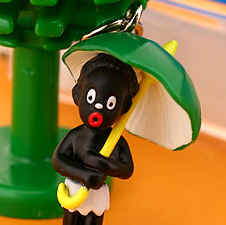
This is not the first time that the racial insenstivity of Japan has gotten them in trouble. A few years back, a toothpaste brand called “Darkey” featured a grotesque picture of a person of color with hugely oversized lips and glowing teeth, the implication apparently being that this toothpaste would make your teeth as shiny as those of a “darkey”. It was ultimately pulled from the shelves but not without much consternation. Many Japanese friends asked me what all the fuss was about.

Another involved the drink Calpis which is sold as Calpico is the states. The carton of the drink featured a “minstrel Al Jolson-style” black faced person with a top hat and the proverbial oversized lips. It was also eventually withdrawn.

I am especially concerned that “Little Black Sambo” was performed in a school where a biracial child was in attendance. How was he/she expected to feel? Did the teacher even consider that? I rather doubt it.

Still, the problem in my view ultimately stems from the lack of exposure and contact (deep, not superficial) that Japanese people have with the outside world. Traveling to and shopping in Guam and Hawaii does not equal “cultural sensitivity.” Especially in rural areas like Saitama, the idea that some might find “Sambo” offensive has never sunk in. But then again, when we have a governor of Tokyo like Shintaro Ishihara who constantly blames the rise of crime on foreigners and especially the Chinese, despite reams of data to the contrary, what can be expected?

Now, as for homphobia, ageism, sexism and glorification of the abuse of women in Japanese media….OK, don`t get me started already!

SOURCE

The facts that the story is read at the school and that this “play” was performed are disheartening, but it gets worse!  The parents of the biracial child complained.  Big time.  And yet the school refuses to remove the book from the classroom, or to stop the children from singing the offensive ditty.  I found this letter detailing the fallout after the performance on BlackTokyo.com.

Dear Black Tokyo,

I would like to bring the following matter to your attention.

A daycare center named Midori Hoikuen (みどり保育園), or Green Daycare Center, in Tokorozawa City in Saitama Prefecture, located just 30 minutes by train from Ikebukuro station in Tokyo, has been teaching hate speech to three-year old children daily, despite the protests of the parents of at least one biracial child in the class.

http://tinyurl.com/yz8ht6m

Although technically a private institution, the parents were originally instructed by the city of Tokorozawa that their child would have attend daycare there.

During the two years that the child has attended the daycare center, the parents had never once voiced a single concern about the operation of the daycare center until much to the their shock, the daycare center based a play / musical to be performed on Saturday, February 27th, 2010, on the book Little Black Sambo:

http://tinyurl.com/2xgvg8

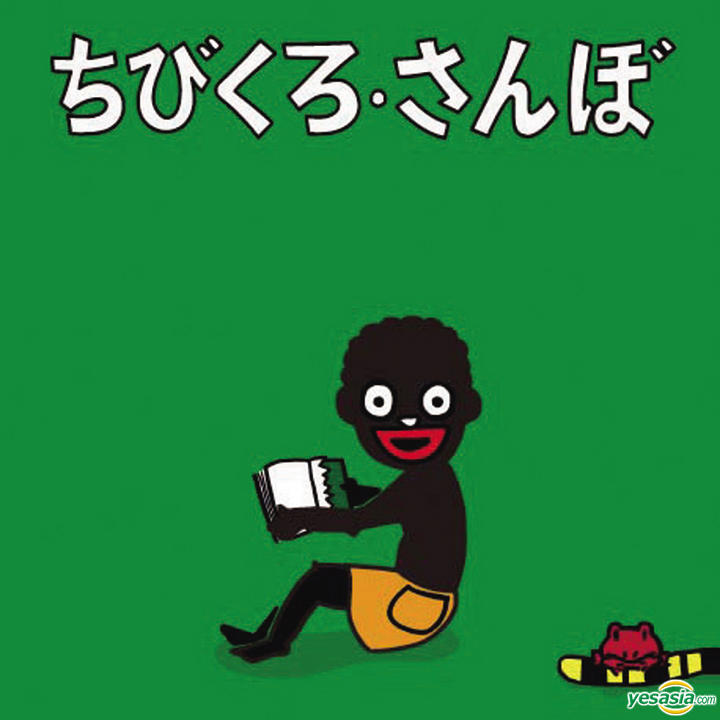
This is the very same book that several Japanese publishing companies had stopped printing due to public outrage in 1988. When the book was reprinted by one rogue publisher in 2005, many residents of Japan–foreign and Japanese–signed a petition encouraging the publishing company to use a different title and illustrations for the book due to their offensive nature:

http://www.debito.org/chibikurosanbo.html

Unfortunately, now that the book Little Black Sambo has been republished and widely distributed in Japan, it is apparent that the book is now being taught at Japanese daycare centers and quite possibly preschools and elementary schools across the country as well. At least two additional volumes of the book have also been printed by the same rogue Japanese publishing company.

…Here is a quick translation of some of the frightening lyrics from the song the children are being taught to enjoy singing daily at the daycare center in Tokorozawa:

“Little Black Sambo, sambo, sambo
His face and hands are completely black
Even his butt is completely black”

Obviously, that kind of speech should never be taught to children by teachers at a daycare center. Those words are more akin to what might be taught by a white supremacist group.

Apparently, the book they daycare center is using even comes complete with demeaning pickaninny images.

Now every time the 3-year old biracial child sees a black person he starts using the racial slur and mentions their black skin. The parents now fear taking their own child out in public or overseas. As the child is of such a young age, it also is not effective for the parents to tell the child not to use those derogatory words outside of daycare, as the child will only use them more.

In an attempt to be as understanding of cultural differences, as it was possible that perhaps the daycare center teachers were just not aware of the problems with the book, the parents of the biracial child both wrote letters in Japanese explaining the history of the book, why the title was discriminatory, and mentioning that they thought that illustrations showing demeaning racial stereotypes were not appropriate for young children.

The parents even showed the teachers that the term “sambo” was offensive and derogatory, both in English and in Japanese.

Beside being used as a disparaging reference to black people, the English dictionary makes it clear that the word is also used to refer to people of “mulatto ancestry,” in other words, the offspring of parents of different racial origin.

After doing a little research, the parents soon found that the term had been in use and deemed derogatory as far back as 1748, 150 years before the book Little Black Sambo was even written. In addition, the derogatory word “sambo” has been prohibited from being broadcasted on TV or radio in Japan, which was also explained to the daycare center.

This fact that the book contains offensive slurs shouldn’t even be considered news to anyone in Japan, when when Little Black Sambo was republished in Japan in 2005, the website of the Asahi News reported that the book was said to “discriminate against black people” and the article can still be found online:

http://book.asahi.com/news/TKY200504190160.html

In an attempt to help the daycare center out of a sticky situation, the parents of the biracial child even had the two following books sent by express mail and took them to the daycare center:

The Japanese translations of “Sam and the Tigers” and “The Story of Little Babaji.”

Both books above are modern, politically-correct retellings of Little Black Sambo that would not cause offense.

However, the daycare center said that they were not only already aware of the politically correct versions of the book, but has also refused to use them.

The daycare center’s excuse is that since all of the children have already learned the title Little Black Sambo, there will be no change in the title whatsoever. The staff have continued to teach the use of the discriminatory word “sambo” and encourage the children to enjoy using it.

In addition, at a meeting with one of the parents of the biracial child, the daycare center said that although they could not make any promises, they would “try” to change the lyrics of the song. However, it seems that additional lyrics were never actually taught and the biracial child and others in the school continue to use the hate speech filled one.

It appears that nothing has been done at all and that the daycare center is just trying to avoid the problem. Despite the parents’ protests, the daycare center still continues to use the racial slur in the presence of their biracial child and encourages the child’s classmates to enjoy singing the song which clearly contains hate speech.

Despite the daycare center’s claims, the fact is that there is no good excuse for racial discrimination.

It is shocking that a daycare center of all places, located just 30 minutes by train from downtown Tokyo, where the population includes a fair number of black people and numerous African Embassies, is teaching hate speech to small children.

As can be imagined, this has caused quite a lot of stress for the family with the biracial child. While understanding that this matter needs to be brought to the attention of the public, one of the parents of the biracial child has expressed concern for their family’s safety, and so wishes that the family not be further identified publicly.

Japanese society is based on shame and often slow to change. As a culture is appears that may Japanese people prefer to try to ignore problems and just hope they go away. Only by shaming organizations that discriminate and drawing the public’s attention to the problem of racial discrimination in Japan, will real change eventually come about.

Please take the time to contact the daycare center yourself, either in English or Japanese, and raise your concerns about the daycare center’s teaching of hate speech to young children. It will only take a minute of your time and contact information is provided below.

Midori Hoikuen (みどり保育園)

Tel: 04-2948-2613 (Monday to Saturday, 9 AM – 5 PM)
Fax: 04-2947-3924
E-mail: qqew85hd@world.ocn.ne.jp

Address:

Sayamagaoka 1-3003-52
Tokorozawa, Saitama 359-1161

Please also make your voice heard, by sending a carbon copy to Tokorozawa City Hall, Department of Daycare Services, which has been informed of this issue:

EMAIL: a9126@city.tokorozawa.saitama.jp

Thank you very much for your time. Your assistance would be greatly appreciated.

Sincerely,

Mark Thompson

This message can be freely copied, distributed or published online. Please help raise awareness of racial discrimination.