a terrific struggle for supremacy!?

oct 7 11

Savannah Tribune, October 7, 1911. Seems like the phenomenon of albinism was not as widely understood as one might think circa 1911.

oct 7 11 2

oct 7 11 3
I assume that said “recreation pier” was a place of cheap amusement–a midway of some sort. Nobody wasted any time capitalizing on the cash value of these infants. The bit about race supremacy being the crux of their antagonism certainly is nuts. It’s like baby Sallie is getting an exemption from the one-drop rule.

oct 7 11 4

“thick, super-sensual, sagging lips.” Eek!
oct 7 11 5

Gee, that’s arguably kinda racist. Though it’s mighty white on the part of the reporter to allow that baby Marie is “just as clean and equally bright as her sister.” I bet she grew up to be “articulate.”
oct 7 11 6
I wonder what happened to these kids.

reblogged from The Hope Chest

fair and good features….on the dark half

Good Lord!!

Ebony & Ivory

San Jose Mercury Evening News, November 30, 1887. Here’s the “tragic mulatto” principle taken to extremes by cruel Nature. Or then again, maybe circus life would have offered more to this kid than whatever hardscrabble misery awaited him in post-Redemption Florida. If only we had a name other than “it” for the child in question, I might be able to find out what happened to him.

Ebony & Ivory2

reblogged from The Hope Chest

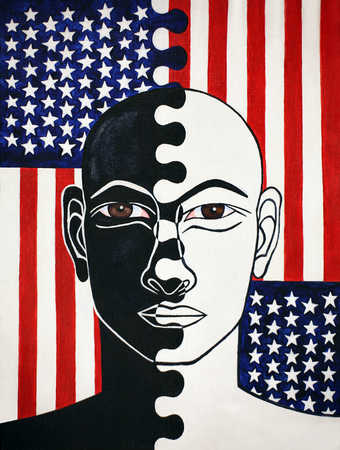
art by Kaadaa

don’t call me george

The Society for the Prevention of Calling Sleeping Car Porters “George” was a lighthearted association with a useful, if incidental, cause. Most railway porters were black, and many passengers called them all George, following the racist custom of naming slaves after their masters. (George Pullman ran the company that made the cars, so the porters were regarded as his servants.) Strangely, the prevention society was founded not by the black porters, but by white railway employees who were actually named George. Apparently they were either annoyed by the tradition or thought that such a society would be a good joke. People did think it was funny, or at least inoffensive. At its peak, the society had 31,000 members, including King George V of the United Kingdom, Babe Ruth (whose given name was George), and French politician Georges Clemenceau. source

The Society for the Prevention of Calling Sleeping Car Porters “George” was a lighthearted association with a useful, if incidental, cause. Most railway porters were black, and many passengers called them all George, following the racist custom of naming slaves after their masters. (George Pullman ran the company that made the cars, so the porters were regarded as his servants.)

Strangely, the prevention society was founded not by the black porters, but by white railway employees who were actually named George. Apparently they were either annoyed by the tradition or thought that such a society would be a good joke.

People did think it was funny, or at least inoffensive. At its peak, the society had 31,000 members, including King George V of the United Kingdom, Babe Ruth (whose given name was George), and French politician Georges Clemenceau.

via

I found some letters from 1937 to Time magazine in reference to an article they ran on the aforementioned Society.  I wonder whatever happened to John from Detroit.

TIME.com

Letters, Jan. 11, 1937

Double Interest Sirs:

Your article, TIME, Dec. 7, under People interests me doubly.

Whether porters become “Porter” or merely cease being “George,” I remain

GEORGE PORTER

Wallingford, Conn. Georges v. Electromaster

Sirs: Your issue of Dec. 7 failed to mention that the S. P. C. P. G.* is a trifle more than a “joke,” that it does everything in its power to help “George,” that its last known public appearance was in the U. S. Patent Office in July 1930. Electromaster, Inc., manufacturing cleaning and scouring powder, intended to market the product under the trade-mark of “Let George Do It” and for that purpose filed a trade-mark application. Opposition #10833 was filed by the Society. The Notice of Opposition recites that the society is “unincorporated under the laws of all States and having an office and place of business at in West Monroe St., Chicago, Illinois, not to mention the B. & O., the D. L. & W., the Santa Fe and points west.” Four grounds for opposition are set forth; the second goes as follows: “The mark which we are opposing comprises the hateful admonition, ‘Let George Do It’.

Now it is doubtless true that the Georges have performed most of the useful work of the world since the memory of man runneth not to the contrary, but the facile and facetious manner in which responsibility is delegated to us by Tom, Dick and Harry and others too lazy and too incompetent to assume it themselves is decidedly irksome to us Georges. . . . Besides, why should George do it?” . . .

Respondent denies that the trade-mark ‘Let George Do It’ is a hateful admonition; and further denies that the Georges have performed most of the work of the world, or any material part thereof, or that any of it has been of any value to humanity, and demands strict proof thereof. Further answering, Respondent is not concerned, or in any manner interested, excited, pleased or horrified regarding the responsibilities delegated to the Georges by Tom, Dick and Harry, or any others, or that such responsibilities are decidedly irksome to the said Georges, because they have a way of avoiding the seriousness thereof. Besides, why shouldn’t George do it? …

HENRY GOLDHOR

Newark, N. J.

Sirs: Your issue of TIME dated Dec. 7, p. 80, re The Society for the Prevention of Calling Sleeping Car Porters “George.” I wonder how many of your readers know of an organization whose purpose it is to discourage the use of a distinguished Christian name to designate an endroit which invites not even the slightest thought of anything distinguished; I have reference to “The Society for the Prevention of Calling Lavatories John.” The Society is of Detroit origin and confine, but it may be that mention of its existence in TIME will prompt the organization of companion chapters in other centers—perhaps even a national unit.

JOHN W. MACNEV

President

“Society for the Prevention of Calling Lavatories John” Detroit, Mich.

Read more:http://www.time.com/time/magazine/article/0,9171,757243-3,00.html#ixzz0YRZS3SJZ

right after the soup

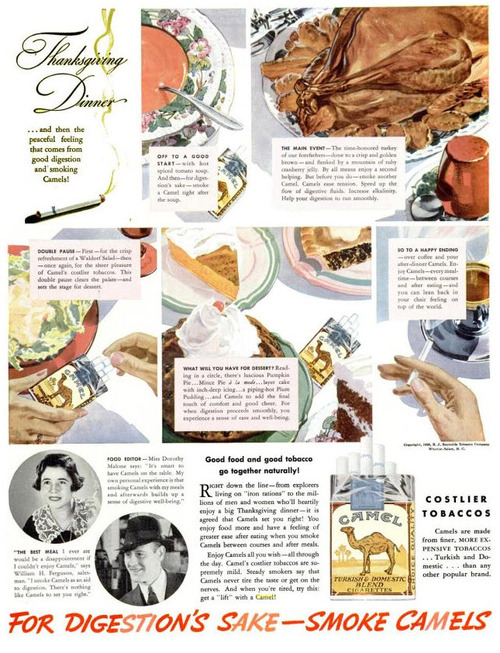
This ad for Camel cigarettes appeared in the November 23, 1936 edition of LIFE magazine. It earnestly demands that you smoke a Camel after each course of Thanksgiving dinner — “for digestion’s sake.”

Some quotes  include, “smoke a camel right after the soup,” “By all means enjoy a second helping, but before you do — smoke another Camel,” and “My own personal experience is that smoking Camels with my meals and afterwards builds up a sense of digestive well-being.”- via

source

hipster speak


Peel your ears (1) and get this, nickel rats (2). Some nighthawk (3)has been using his noggin (4) so much that rather than hittin’ the hop(5) they’ve compiled a collection of the best US slang from the 1920s to the 1960s. So grab a flop (6), chill your chat (7) and learn how to talk like a real hipster. Or something.

BARBECUE

A hot-looking lady.

CHICAGO OVERCOAT

Coffin.

CHICAGO LIGHTNING

Gunfire.

DEAD SOLDIERS

Empty beer bottles.

DIME DROPPER

An informer (someone who drops a dime in payphone to call the cops).

FACE LIKE A RUSSIAN FLAG

Embarrassed, ie red.

FREE TO RUN FOR PRESIDENT

Out of work, unemployed.

HAEMOPHILIA OF THE LARYNX

A blabbermouth.

HARLEM SUNSET

Knife wounds.

HAVE ONE ON THE CITY

Drink some water.

KNOW YOUR GROCERIES

Be hip, aware, alert to the situation.

OLD ENOUGH TO VOTE

Vintage liquor or wine.

PREPARING BAIT

Putting on makeup.

ROUNDHEELS

Party girl (deriving from a supposed natural ability to regularly fall over backwards).

SINHOUND

A priest.

SNIFFING ARIZONA PERFUME

Going to the gas chamber.

STRAIGHT FROM THE FRIDGE

Cool. Obviously.

TAKEN OFF THE PAYROLL

Killed/assassinated.

THAT VIBRATES ME

I’m impressed, I really like it.

VOMIT ON THE TABLE

Speak up.

YOUR ROOF IS LEAKING

You’re a bit crazy.

Intro footnotes…

1 Listen up 2 You cheap crooks 3 Late-night person

4 Brain 5 Doing drugs 6 Have a sit down 7 Shut up

The third edition of Straight From The Fridge, Dad by Max Décharné is out now (No Exit Press)

SOURCE

worse ads

The products are/were the real problem, I suppose.

Offensive & Politically incorrect advertising and propaganda:No fuss, to the point racist packaging. What you see here is an old Norwegian brand of tar/varnish used on wood burning ovens. It’s been out of production for a good while now, but boxes like this can still be found tucked away in old dusty closets in Norway. more examples of mindblowing advertising here

Offensive & Politically incorrect advertising and propaganda:

No fuss, to the point racist packaging. What you see here is an old Norwegian brand of tar/varnish used on wood burning ovens. It’s been out of production for a good while now, but boxes like this can still be found tucked away in old dusty closets in Norway.

via

here

kimball

1900sc_Nigger_Head_Oysters_Can

negro head oysters

In the US and the UK, the word nigger featured in branding and packaging consumer products, e.g. “Nigger Hair Tobacco” and “Niggerhead Oysters”, Brazil nuts were called nigger toes, et cetera. As racism became unacceptable in mainstream culture, the tobacco brand became “Bigger Hare” and the canned goods brand became “Negro Head”.