Unknown's avatar

About Tiffany

I am "biracial", but I'm mostly lots of other things

recently on the interweb

I’ve come across some interesting stories, commentary, and subsequent comments all dealing with… Biracialness! Big shocker, right?  I love reading the comments.  So many different opinions, which simply reinforce my will to stay with my self and stand confident in my personal ideology.

The Seattle Times

Via

Rant and Rave Rant to the women on the bus who, when asked to quell their use of expletives around my young children, disparaged me for having a biracial family and insulted my daughters’ hair. Rave to the man who told them my request concerning their language was valid and that they had no reason to insult me and my family. Thank you, sir.

Answer.com

JUST ASK AND LET THE OTHER TO ANSWER IT FOR YOU

Via

Pregnancy & Parenting

How do I tell my mum I’m having a mixed race baby?

the baby is going to be half black but i don’t think my mum or my family would be too happy about it.. I want my family to accept the baby but what can do I to make them accept my unborn baby…

5 Responses to “How do I tell my mum im having a mixed race baby?”

blessed says:

all you can really do is explain to them as much as you can to get them to understand, but even at that it might not change their minds, but if it doesn’t then just say it’s my baby and no matter what it is going to be family and they’ll just have to get over it.

Charles J says:

You don’t. I would recommend getting an abortion. No one likes a half-breed.

VincentL says:

just tell them straight up…they probably be very mad at first but sooner or later they will adjust to i

Due 12.3.10 says:

just tell her its ur child..

R.I.P Michael Jackson says:

u don’t have to they will c it when u have it………….
Run, Racists, Run! Biracials Are Everywhere!

By Sam Watson

Via

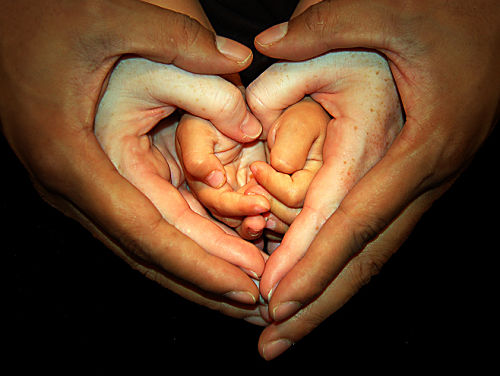
Gone are the days where the majority of people will shout racist remarks at those of color on the streets. It still happens, but nowhere near as much as in the past. Racists are kind of afraid to spew their hatred in public, and I feel us biracials are to blame. We represent an abomination to racists. An old, white guy- a complete stranger- once saw my mom (white, Ukrainian) with my sister and I, when we were very young children, and he shouted, “Slut!” at her. We’re mixed – half white and half black. We represent an absolute breakdown of a racist’s hateful beliefs.

…Racists don’t know whether or not the “white” person next to them is either mixed or married to someone of a different race. Racists better up their paranoia levels, and warn the town sheriff in Bigotville.  During the World Cup, I turned to my seemingly white co-worker, and started ragging on the Mexican team. She instantly scowled at me in return. I forgot! She’s half white and half Mexican! Even I- a biracial- was fooled! We’re everywhere, now, and this is a racist’s worst nightmare.

Comments

-You are right. When it comes to black people, they now hate themselves much more. All of us are mixed up with something. We are one human race. Our race is different from that of the animals, not each other.
-A study I heard cited recently encouraged parents to discuss race and racism with their kids. Several families dropped out because they were so uncomfortable with this requirement of the study.

The study discovered that racism is not discussed at all in many progressive, liberal households. The idea is that if we’re all supposed to be colorblind, discussing race, or any difference for that matter, is taboo. Of course, that’s the best way to make it a dark, secretive thing- precisely the problem. People who desperately want their kids to be not just tolerant, but accepting, are practically guaranteeing their kids get no exposure to the subject by pretending it’s not there.

Racism and bigotry is a vampire- it can’t stand the light. If we want it to die out, we have to do the uncomfortable, inconvenient thing and talk about it even when it’s not a major in-your-face problem.

-I am half German (white) and Puerto Rican (brown) and I always baffle people. I think it’s interesting that we assume that racism is disappearing when I feel like it is only growing. In an all colorful nation I still feel like I need to watch what I say when I am naming a race ~ whether it’s politically “correct” or not because I never know who is going to be offended.

-You better believe we are everywhere. Though I know I’m not the only unique biracial person out there, I do admit that people are surprise when they hear that my mom is from Dominican Republic and my father is from Afghanistan. Talk about fusing two totally different cultures.

I also understand when you talk about racism being a private thing. My step mother is racist, even though she’s married to my father. It makes me mad when she makes stupid comments regaurding race. She also tries to inplant her ideas on my half brother. I try my best to counter these thoughts though… my diverse background has raised me to be open to new ideas, cultures, and people. The more people who are biracial, the more tolerance we have of one another.

-Racism is still alive but it’s a endangered species. I say this because the current generation doesn’t hold race as important as the previous ones. Most of my friends (I, myself included) have bi-racial children. At times I wonder when these kids grow up will that look at their peers and ask in shock “You’re not mixed?” I think it’s a great thing, however as parents we still need to pour our cultures into the children, letting them know they have and even more extended set of roots and the beauty contained within both.

-Racism is part of human nature. Embrace it!

-I’m old enough to have seen overt racism, as well as the more prevalent covert racism. Sometimes I feel that the only hope we have to eradicate racism is the gradual blending of all races into an “everyman.”

-I was recently showing off pictures of my friends in New York to some people here. They nodded politely at all of them, but paused at a picture of two my best friends.

“What race are they?” I was asked.

I couldn’t believe it mattered. A lot of my previous pictures had been of people who were black or Asian or of some non-white race, but these two mixed-race girls came into question?

“Er, she’s Romanian and Jamaican, and she’s Indian, Portuguese and Italian.”

“Oh, okay.” The guy replied. “I just couldn’t figure it out.”

Why should you have to?
startling

Perhaps “startling” would be a bit of an exaggeration today, but a production like this would still be considered mildly innovative indicating that we haven’t evolved much out of our old traditions…

March 1970: Student teachers, Dereck Tapper and Scilla Nicholls in a rehearsal for a production of ‘Romeo and Juliet’ at St Luke’s Teacher Training College in Exeter. The mixed-race casting was considered a startling innovation at the time. (Photo by Keystone/Getty Images)

race is a shenpa

Excerpted from “Getting Unstuck” by Pema Chodron, from teachings on Shenpa that she attributes to her current teacher Dzigar Kongtrul Rinpoche

So this is a teaching on a Tibetan word – Shenpa. S-H-E-N-P-A, Shenpa.

And actually its taught about a lot in Buddhism but not quite in the style that Dzigar Kongtrul has been presenting it.

The usual translation of the work Shenpa is “attachment”. If you were to look it up in a Tibetan dictionary, you would find that the definition is attachment. But the word attachment absolutely doesn’t get at what it is, and so Dzigar Kongtrul said lets just not use that translation, its incomplete and it doesn’t touch the magnitude of shenpa and the effect that it has on us.

So, if I were translating Shenpa it would be very hard to find a word, but I am going to give you a few. One word might be “hooked”. How we get hooked. We get hooked, and then we get “stuck”. Everyone likes to hear teachings on getting stuck and how to get unstuck because it is so common to feel stuck.

Guess what: you can meditate for a long, long time, and you can still get stuck.

In terms of [the example previously described of] having scabies and the itch that goes along with that, and scratching it, shenpa is the itch and its the urge to scratch. So “urge” is another word. The urge to smoke that cigarette, the urge to overeat, have one more drink, or whatever your addiction is.

And it gets into everyday experience. Somebody says a mean word to you… and then something in you tightens. That’s the shenpa. And then it starts to spiral into low self-esteem or blaming them or anger at them or denigrating yourself, and then words or actions, maybe if you have strong addictions you just go right for your addiction to cover over that bad feeling that arose when someone said this mean word to you. This is a mean word that gets you. Hooks you. Another word might not affect you, but we’re talking about when it touches that sore place. That’s a shenpa.

The fundamental root shenpa is what in buddhism is called ego, or ego-clinging. And we experience it as this tightening and self-absorption that gets very strong at that point. So the fundamental root shenpa is ego-clinging, or self-absorption, or “cocoon”*, and then the branch shenpas are all the different styles of scratching and so forth, like that.

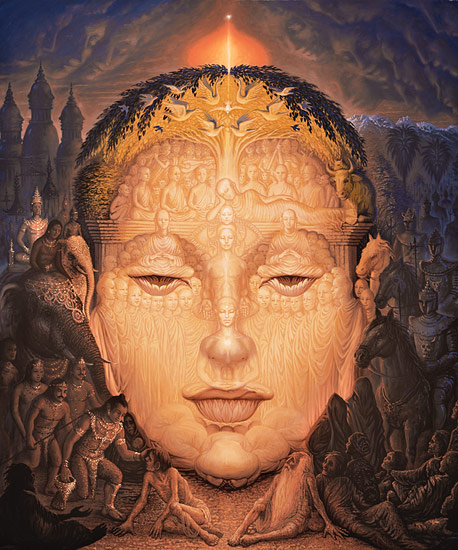
Buddha by Octavio Ocampo

So someone criticizes you, they criticize your work, they criticize your appearance, they criticize your child and – shenpa – almost co-arising. As soon as those words have registered – boom, its there, and its like a tightening.

Shenpa is not the thoughts. Dzigar Kongtrul made a big thing about it’s closer to an emotion, it’s pre-verbal and then it breeds thoughts really quickly, but shenpa is not the thoughts. He said it’s more like an emotion, but I think its even pre-emotion in a way, its kind of that (makes gasping sound)… so that you can feel it happening, which often, people just starting with this can – you feel it happening sometimes.

Say like at the monastery, at Gampo Abbey, people were finding someone would come sit next to them, and of course you have a kind of intimate relationship with everyone there living in community, and they can feel the shenpa just because this person sat down next to them, because they have some kind of thing going about this person, and they’re hooked.

Now if you catch it at that level, its very workable and then you have the possibility to have this enormous curiosity about this urge to do the habitual thing, to strengthen the habituation. You can feel it.

One thing about shenpa is it’s never new, it always has a familiar taste in the mouth. It has a familiar smell. It’s like when you begin to get the hang of it, you feel like this has been happening forever.

It causes you to feel the fundamental underlying insecurity of the human experience that is inherent in a changing shifting impermanent illusory world as long as we are habituated to want to have ground under our feet.

whiteness defined

This one is so good that I don’t have perspective to add or anything witty to say about it.  However that could just be because I’ve only had three hours of sleep and just can’t do any better.  Either way, this excerpt of a transcript of an NPR interview is definitely worth reading and pondering.  You could also listen to it in it’s entirety HERE.

Author Examines ‘The History Of White People’

Once upon a time, notorious laws in this country defined as black anyone with as much as one drop of black blood. Similar laws struggled with the rights of people of mixed race, octoroons, for example. But nowhere can you find a definition of white people, and as a practical matter, that non-definition has changed. Ethnic groups now regarded as white Irish, Jews, Italians – were once very much on the outside.

These points (are) from Nell Irvin Painter’s new book, “The History of White People,” which traces ideas about color and race from antiquity to the Obama administration.

This is TALK OF THE NATION. I’m Neal Conan in Washington. Nell Irvin Painter is our guest…

CONAN: …you conclude at the end of your book, you say the fundamental black-white binary endures even though the category of whiteness or we might say more precisely a category of non-blackness effectively expands. That non-blackness, is that by lack of a definition of whiteness?

Ms. PAINTER: Yeah, that’s about how it goes. There as you noted, there have not been legal definitions of whiteness. It’s kind of what’s leftover from blackness.

CONAN: What isn’t.

Ms. PAINTER: And blackness, there’s the idea of a one-drop rule is an idea. What the states did was say one-fourth, one-eighth, that kind of thing, one grandparent, one great-grandparent. That’s how they decided what one drop was.

I suppose people use the word one drop because actually color disappears very quickly in people. And so you can look functionally white with one black grandparent, which in most places would make you legally black. So what makes you black has been defined and redefined and re-re-redefined. What makes you white is what’s leftover.

CONAN: And in fact, you say that has been, well, ill-defined but redefined and redefined over the years, too.

Ms. PAINTER: Yeah…  The whole point of defining races is mostly to put people down, and so those needs change over time. Who do you want to put down? Well, you want to put down, say, Jews and Italians and Slavs 100 years ago, but 150 years ago, you wanted to put down the Irish.

…We think of race as something physical, biological and permanent, but the way people used race in the 19th and 20th centuries and probably still today is that it has to do with temperament, racial temperament. So how people look on the outside is a key to what they’re like on the inside, their temperament. So that had to do with Protestantism, too.

…CONAN: It’s interesting, Nell Irvin Painter, you describe how, in fact, racial laws made a transition in the late part of the 20th century from being used to exclude persons of color to define injustices against persons of color.

Ms. PAINTER: Not persons of color, Negroes, to be exact. The laws were against Negroes. But you’re absolutely right that before desegregation, before the Civil Rights Act of 1964, all those laws, exclusionary laws, were meant to keep Negroes out. And the counting up was to keep Negroes out.

And after that, particularly after the 1970s, the need to rectify the injustices meant that we had to count people in order to straighten things out. So now we count up racial categories, say, to track mortgage lending, where there’s still a good deal of racial discrimination.

So in the census, the census keeps counting us by race for purposes of undoing racial harm in the past.

Read more (or listen) HERE