
Reply

I wanted to know more about this “colored slave owner” after reading that small bit about him in the gullah tour article. There is more information out there than I’d expected. I wish I could see a photograph of his Caucasian and Indian (American) parents. The New York Times article truly fascinates me. First of all, I’d love to know who wrote it! Secondly, it’s nice to hear (although there’s nothing nice about the sick and twisted system) that there were legitimate and acknowledged mulatto children. But that nice feeling quickly disappeared when I searched for more information on Isabella. I’ll include that in a separate post.
![[Richard DeReef]](https://i0.wp.com/www.gullahtours.com/_derived/dereef.jpg)

IMAGE: ON RIGHT — Richard Edward Dereef (1798-1876), a free black wood factor and real estate investor, built this small two story frame single house sometime after he purchased the site in April, 1838. The site was part of a large lot, extending to Calhoun Street, on which Dereef erected several buildings, of which only this house remains. Dereef, a native Charlestonian, was one of the wealthiest men of the free black community. He and his son, Richard, Jr., had a wood factorage business on Dereef’s Wharf at the foot of Chapel Street, and lived nearby on Washington street. By 1867 Dereef had conveyed this property, apparently built for rental purposes, to Margaret Walker, a black woman.
(Stockton, unpub. MS.) SOURCE
May 26, 1907, Sunday
To the Editor of the New York Times:
Truth is stranger than fiction, and had not the information of the ownership of slaves by colored citizens of Charleston, and elsewhere, been sent forth by such an authority as The News and Courier, the statement would have been regarded as incredible. But The News and Courier has not stated nearly all the truth which is, according to your confession, surprising to you, and, according to your belief, surprising to many others in the North.
The prevalent views, State documents, Congressional debates, and lecture courses bearing upon the general subject render it difficult of belief that the proclamation of emancipation by Mr. Lincoln reduced many colored people of the South, and especially in the City of Charleston, from a state of affluence and competence to a condition of need, if not of poverty.
But such was the case.
Those slave owners were not called “negroes,” but “colored people,” as they were generally of mixed blood- sometimes of Caucasian and African; sometimes of Caucasian and Indian; (American.) Many of the colored people of Charleston had no African blood whatever. The question you ask, and The News and Courier failed to answer, is: How did those people come into possession of their slaves- by inheritance, gift, or purchase? The answer is, By all these ways. They were generally the children of rich planters who, in the early days of the coast settlements, established themselves in lower South Carolina, with Charleston as the centre of operation. These children were regarded as such, and not as illegitimate of slaves. They bore the name of the father with recognition and as by right. They were also educated.
Upon the death of the father these children would come, by inheritance, into possession of the estate, including beasts of burden, slaves, etc. There was a very large number of free colored people in Charleston in the eighteenth century.
An interesting article on this subject may be found in the January issue of The Southern Workman. Some of those who owned slaves in years before the war were by name De Reefs, McKinlays, Westons, Hollaways, Thornes, and Howards. There are descendants of some of those people in New York and Brooklyn to-day. There is information enough at hand on this subject to fill a book, but let me relate you one story which may prove interesting.
There was a rich planter in Charleston of the name of Fowler. He took a woman of African descent and established her in his home. Whether there were a pledge of relationship or form of ceremony is not of record, but it was known that he had no other family. There was a daughter born in that home to whom was given the name of Isabella. But the planter insisted upon it that all persons should know her as Miss Fowler. She grew to womanhood, and was married to Richard De Reef, a young man of Caucasian-Indian blood. At the time of her marriage her father presented to her as a wedding gift a plantation and a sufficient number of slaves to work it.
The News and Courier says that two colored Charlestonians had each fourteen slaves, but the records of the family showed that at emanicpation Mrs. Isabella De Reef liverated forty instead of fourteen.
In another thing the News and Courier is wrong- that is, in saying those free persons of color had no political privileges. The De Reef brothers- Richard and Joseph- born, respectively, in 1798 and in 1802, voted on reaching their majority, and ever after. Some others may have enjoyed the same privilege, but there are colored men in Charleston to-day, and some now living elsewhere, who could claim the right to vote on the “grandfather clause”; these were never enfranchised by an amendment to the Constitution of the United States.
A former Charlestonian.
New York, May 23, 1907.
click HERE for a link to a copy of the original NYTimes article

I wasn’t familiar with the Stono Rebellion before yesterday. Nat Turner, yes. Stono, no. So I “looked” it up. Here’s what BlackPast.org had to offer…
On Sunday, September 9th, 1739 the British colony of South Carolina was shaken by a slave uprising that culminated with the death of sixty people. Led by an Angolan named Jemmy, a band of twenty slaves organized a rebellion on the banks of the Stono River. After breaking into Hutchinson’s store the band, now armed with guns, called for their liberty. As they marched, overseers were killed and reluctant slaves were forced to join the company. The band reached the Edisto River where white colonists descended upon them, killing most of the rebels. The survivors were sold off to the West Indies.
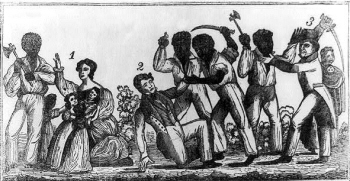
The immediate factors that sparked the uprising remain in doubt. A malaria epidemic in Charlestown, which caused general confusion throughout Carolina, may have influenced the timing of the Rebellion. The recent (August 1739) passage of the Security Act by the South Carolina Colonial Assembly may also have played a role. The act required all white men to carry firearms to church on Sunday. Thus the enslaved leaders of the rebellion knew their best chance for success would be during the time of the church services when armed white males were away from the plantations.
After the Stono Rebellion South Carolina authorities moved to reduce provocations for rebellion. Masters, for example, were penalized for imposing excessive work or brutal punishments of slaves and a school was started so that slaves could learn Christian doctrine. In a colony that already had more blacks than whites, the Assembly also imposed a prohibitive duty on the importation of new slaves from Africa and the West Indies. Authorities also tightened control over the enslaved. The Assembly enacted a new law requiring a ratio of one white for every ten blacks on any plantation and passed the Negro Act of 1740 which prohibited enslaved people from growing their own food, assembling in groups, earning money they, rather than their owners, could retain or learning to read.
I read a few more accounts of the Rebellion. While most of the websites relayed the story in identical fashion, I was slightly disturbed by this one that I found on teachingushistory.org. I think this 4th grade textbook account is clearly biased in favor of the “white families.” It’s almost subtle, but not really. No other recounting mentioned drunk (on stolen goods) slaves, nor started the tale with “while the white families were in church.” I can imagine my 4th grade self wanting to disappear during this lesson…

The Stono Rebellion occurred during the early morning hours of Sunday, September 9, 1739. While white families were in church, a slave called Jemmy led a group of about 20 slaves who broke into a store, killed the store owner, and armed themselves with a supply of guns and ammunition. From there the slaves moved southward from one plantation to another slaughtering whites and burning houses as they went. Men, women, and children were killed. Some were beheaded and their heads were left for display. At one tavern, the insurgents spared the life of the innkeeper because he was known to be good to his slaves. At another, a slave hid his master and distracted the insurgents. (Smith 18) As the slaves moved southward more slaves from the plantations joined the rebel force, which continued in military fashion displaying a flag and beating a drum.
Lt. Gov. William Bull, who was traveling on horseback with four companions, happened upon the rebels about eleven o’clock in the morning. Bull and his companions quickly fled for their own safety. They alerted the militia and local planters, who then organized men to pursue the insurgents. At about four o’clock in the afternoon they came upon the group of slaves about ten miles to the south. Some slaves were resting. Others were drunk on whiskey they had stolen in the raid. The slaves fought hard, but the militia won the fight and ended the Stono Rebellion killing many of the slaves. Slaves who escaped the scene were tracked down for months, and most were apprehended. Those responsible for the revolt were executed. One slave, July, who had saved the lives of his owner and the owner’s family was given his freedom. Forty-four blacks and twenty-one whites lost their lives as a result of the Stono Rebellion.
I would love to take this tour. So many fascinating (albeit horrifying) pieces of our nation’s history are highlighted. Underground railroad, black slave owners, paved over cemeteries, middle passage “reception,” color hierarchy. I’m elated by the notion of forsaking shame and guilt in favor of honest discussion to ensure that this never happens again. I’d like to think that “it” happening again is an impossibility, and that now our ultimate goal is to get rid of the vestiges of slavery. Clearly we’re making progress.
The biggest hint that Charleston is a very different breed of Southern Belle — and that I’m on no ordinary city tour — comes as our air-conditioned mini-bus reaches the mainly African-American east side, a warren of economically deprived streets framing what was once an important stop on the Underground Railroad.
I look up to see a most unusual Star Spangled Banner flying bold African colors of red, black and green from a worn-looking flagpole. It’s an expression of indomitable Gullah pride, explains tour guide Alphonso Brown.
Like many living in the east side, Brown himself is Gullah: a descendant of slaves who endured the brutal “middle passage” from West Africa and the Caribbean during the 18th century, landing at Charleston’s bustling port before being sent to toil on plantations across the South.
Brown’s popular Gullah Tour, which marks its 25th anniversary this year, brims with atypical landmarks like this flag, as it excavates vestiges of an uglier time hidden amid the exquisite cobblestone streets and pastel-painted Georgian home fronts.
A multi-million-dollar waterfront estate, for example, looks impressive — until it is revealed to have been built by a rich slave ship proprietor who added slave quarters and a threatening-looking spiked gate to pen in human chattel. Later, we stop and stretch our legs in a parking lot owned by a Catholic church. It turns out to conceal the paved-over graves of freed slaves, for it was once their cemetery.
And the bus rolls on.
It’s potentially uncomfortable subject matter for his mixed-race audience, but Brown manages to keep the atmosphere light, sprinkling his commentary with anecdotes and jokes, and slipping in and out of the sing-songy Creole of his forefathers. “I-eh hab disshuh dreem,” he recites in Gullah. “We hol’ dees trut’ fuh be sef-ebbuhdent, dat all man duh mek equal.”
Plumped with West-African and Elizabethan English influences, Gullah was initially spoken in secret and spread wherever slaves were taken, along the coast and barrier islands as far as Georgia, and down to around Jacksonville, Fla.
SULLIVAN’S ISLAND
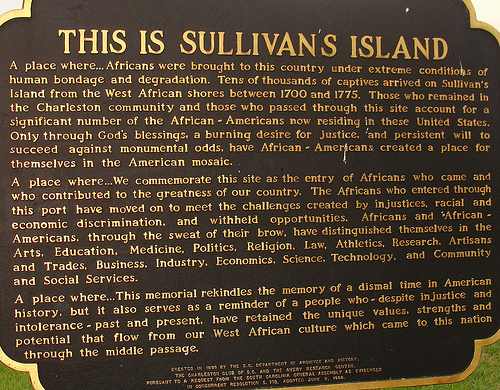
Sullivan’s Island, opposite Charleston, became the macabre version of Ellis: a processing station where newly arrived slaves were kept in preventive isolation before their auction at The Old Slave Mart downtown, which today is a museum.
When the Civil War ended, emancipated blacks stayed on the barrier islands, renting rooms from former masters or squatting on abandoned plantations. In their isolation — bridges were few — they incubated the distinctive Gullah body of traditions for cooking, planting, fishing, praying and burying that are subtly evident throughout Charleston and the Lowcountry today.
Front porches in the city, we learn, often face southeast for shade, as per the African custom. Charlestonians were early, enthusiastic practitioners of root medicine and witchcraft. In literature, the tales of Brer Rabbit and Brer Fox derive from West African oral storytelling. And characteristic dishes, from spicy stone ground grits and shrimp to slippery-smooth okra gumbo, are Gullah to the core.
The inside of Brown’s mini-bus is ringed with pictures of inspiring Gullah throughout history and modern times. Among them is Clarence Thomas, second black appointee to the U.S. Supreme Court, and Philip Simmons, lauded by the Smithsonian Institution as a National Folk Treasure for his ornamental iron gates, which dress many of the city’s architectural landmarks.
CIVIC ACTIVISM
Politically, we learn, the Gullah have been determined organizers of abolitionist and Civil Rights movements. Dr. Martin Luther King, Jr. often retreated to St. Helena Island’s Penn Center — where one of America’s first schools for freed slaves was established — and may have begun drafting his 1963 I have a dream speech there.
More recently, in the run-up to the last presidential election, the Gullahs’ organized support for Barack Obama helped him clinch the crucial South Carolina primary.
Brown, who grew up in nearby Rantowles — not far from the site of the failed Stono River Rebellion of 1739, in which runaway slaves killed 20 whites before they were themselves slain — is justifiably proud of his ancestors’ achievements and defiant will.
He doesn’t deliver history in monochrome. Brown’s choice of material portrays a complex view of race relations in Charleston, which even during slavery was never officially segregated. We’re told, for example, that one of the richest freed black families was the DeReefs, whose patriarch, Richard Edward DeReef, owned multiple businesses — and at least 16 slaves.
Color was such a delineator of social status that freed “octoroons,” who had one-eighth black blood, judged themselves superior to “quadroons” with one-quarter slave ancestry. They, in turn, held themselves above mulattos, the children of white fathers who were often referred to, in delicate conversation, as “friends.” The divisions were physically embodied in the city’s many integrated churches, where slaves worshipped from the balconies while freed blacks sat behind whites in the lower pews.
A SENSE OF PRIDE
Two hours speed by on this tour. Brown makes it clear that Gullah traditions thriving in secrecy and isolation for centuries have more recently become a source of civic pride. Efforts to preserve and celebrate the culture are being stepped up, he says. And events, such as the Gullah Festival in Beaufort each May, or the Penn Center Heritage Days Celebration every second weekend in November, draw ever-growing crowds.
“Slavery was always a taboo subject: blacks were ashamed and whites felt guilty,” says Chuma Nwokike, owner of Gallery Chuma, which hosts works depicting traditional activities like crabbing and sweetgrass basket-sewing. The gallery doubles as rendezvous point for Brown’s tour.
“Now, the younger generation wants to acknowledge what went on, so we’re better able to come together and say, ‘how can we make sure it never happens again?’ ”


are cool





 mulatto diaries
