“biracial”

I’ve noticed in my latest research that in the ’50s and ’60s “biracial” described committees, boards, commissions, councils, governments, mediation teams, towns, schools, and groups. Not people. People were “mulatto” and things were biracial. Actually groups of black and white people were biracial. Now we’d say interracial, I guess. It is interesting to notice the shift in the language. I think the definitions are ever-changing. That’s why I have a love-hate relationship with words. I love them, but they can be fickle and misleading.

Kinda like, I know that when I say “monoracial” all the time that the proper term is “uniracial.” But to me uniracial is the big prize. It’s the word we get to use when the illusion of race has been globally recognized for the fallacy that it is and we’re uniracial. Belonging to the human race. We have various cultures and all, but basically we’re people and there’s only one race of us. So I’m saving uniracial. We don’t get to use it yet.

I totally did not intend to bring that up in this post.

Anyway, the first instance I found of a person being labeled biracial was in The New York Times on March 1, 1987- “LIVING IN TWO WORLDS. By Maxine B. Rosenberg. Photographs by George Ancona. A low-key and affecting photo essay about the fewer than two percent of children in the United States who are biracial.”

Biracial shows up thrice more in 1987 in reference to foster/adopted children. Through the early ’90s “biracial” is used mostly for the aforementioned groups with a noted increase in the use of the word as a racial categorization as the articles become more recent. 

This brings me back to my defense of my use of the word “mulatto.” Most of my childhood was spent in the 1980’s when people were still referred to as mulatto and “things” as biracial. But “mulatto” was a bad word not to be spoken, so I was either nothing, “other”, or black.  Everyone like me was. As I see it, this validated and perpetuated the one-drop rule. And threw shadows of shame onto my true identity. It gave me no chance and no choice to form an identity from a foundation of wholeness. I think this word “mulatto” is a larger piece of this race puzzle than most people think.

mulatto book coverI mean, I definitely don’t want to be associated with that and if that‘s what people think of as “mulatto” I’d rather deny my whole self and be black which is exactly what “they” wanted when “they” created the system because the system will crash if too many people come to know that there is no great divide between the two races and that a person can actually be both black and white simultaneously.

The system is crashing.
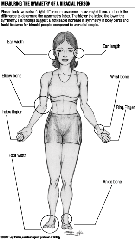
symmetry

I came across this article a while ago and have been thinking about it a lot since that “Plight of Mixed-Race Children” post a few days ago. I am generally still offended by that Freakonomics blog article, but maybe it’s a harsh reality that I don’t want to acknowledge. The study Levitt spoke of did have just over 90,000 participants. The “more attractive” thing really stuck out to me as being inappropriate.  Then I remembered reading about this UCLA study…

scbiracialgfxsmall_t135


11-05-2002

(Daily Bruin) (U-WIRE) LOS ANGELES — A recent study by University of California — Los Angeles Assistant Adjunct Professor of Biology Jay Phelan concluded that biracial people are perceived as more attractive than “uniracial” people because they have more symmetric features. 

Symmetry, according to Phelan, reflects an organism’s developmental stability and is strongly associated with longevity, health and fitness….

Symmetry, he found, was greater in heterozygous organisms. In other words, organisms are more symmetrical – and therefore potentially more “fit” – when their genes have two different alleles (for instance, one dominant allele and one recessive allele rather than two dominant or two recessive alleles). 

Crossing organisms from different populations, he believed, would result in “hybrid vigor.” The theory was that their heterozygosity was making them stronger and healthier. 

Genes produce enzymes that assist in bodily processes. When two slightly different enzymes are produced by heterozygous genes, the organism is “covered under a wider range of conditions,” he said. 

Most humans are heterozygous in about 20 percent of their genes. 

Assuming that biracial people are more heterozygous since they come from different populations (despite the debate surrounding the relative amounts of genetic variation within and among populations), Phelan started by measuring the symmetry of 99 UCLA student volunteers who were either biracial or uniracial. 

Biracial people were defined as those whose mother and father were of different races, but each of their parents were uniracial. Both parents of the uniracial subjects were of the same race. 

Phelan’s study concluded that biracial people were significantly more symmetrical than “uniracial” people. All 25 of the least symmetrical subjects were from uniracial groups, which were either Asian, black, Hispanic or white. Seven of the eight most symmetrical subjects were from biracial groups (Hispanic-white, Asian-white, black-white or Asian-Hispanic). 

In addition, Phelan found that symmetry was about the same for all uniracial people no matter which group they were in, and about the same foall biracial people, regardless of racial background. 

Phelan, however, did not want to stop merely with symmetry. He hypothesized that those who were more symmetrical would also be perceived as more attractive. 

To determine attractiveness, 30 people then rated photos of the subjects who had been measured for symmetry on attractiveness, ranking them from one to seven (seven being the highest). 

The results: Biracial people were perceived as significantly more attractive than “uniracial” people. 

Emily Shin, a third-year psychology student and president of the UCLA Hapa Club, appreciates Phelan’s work. 

“I think that it’s really great that people are doing research on hapa people, generally a group that’s marginalized,” Shin said. 

She added, however, that there is some dissent in the hapa community about research like Phelan’s, which perpetuates the stereotype that hapas are on average, more attractive people. 

“It makes hapa people, especially hapa girls, feel very objectified,” Shin added…..

David Zisser. “Study indicates mixed race, physical symmetry correlate.” University Wire. 2002.

I don’t know what I think of all this just yet. Right now I’m thinking, “If a majority of mixed-race children are struggling as Levitt’s article (which i initially brushed off as ridiculous mostly because of the attractiveness issue) suggests, then we need to help them because it doesn’t have to be that way.”

sunday comics

I have always loved Sunday comics. The first thing I ever read all by myself was a comic strip called “Henry.” I think. From what I recall, Henry usually didn’t speak. It was a “silent” comic strip. But on occasion there were words. And on one such occasion, I was “reading” (i.e. looking at the pictures) the comics by myself at the dining room table and I surprised myself by reading what Henry said that day. It was awesome. All of that to say, this popped up on my yahoo homepage today and I couldn’t resist sharing it. I can totally relate.

 
sbo090125gif


I notice it’s a little fuzzy. It says, “(sigh) _  I hate humidity.” And, yes, I read that all by myself 🙂