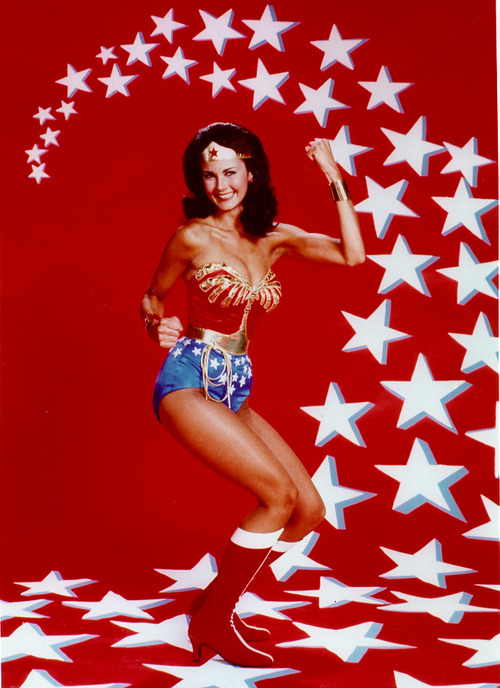
no wonder i loved wonder woman

7hu2U4T6Cd5e0b5iM71yN163_500

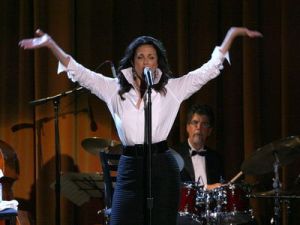
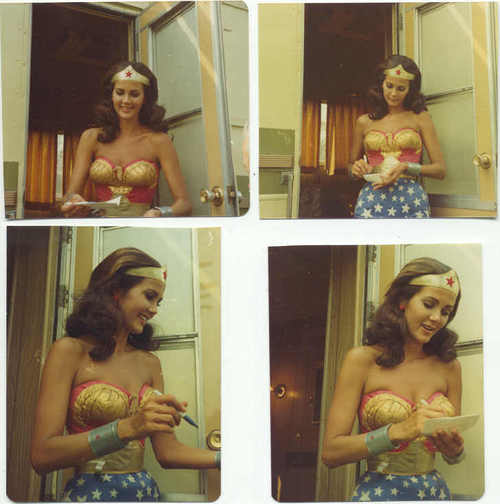
Legend has it that I became the youngest fan of Wonder Woman when at the age of 24 hours my eyes were glued to the tv in the hospital room whenever Diana, Princess of the Amazon appeared.  I must have known she was a kindred biracial spirit.  Only I didn’t know she was biracial until my 31st birthday when I was taken to see Lynda Carter’s cabaret show at Feinstein’s at the Regency in NYC.  It was great!  She talked about her Mexican mom.  She sang.  Really well.  I loved it! Cornel West was there. He loved it too.
6a00e55392afe18833011168b196b5970c-400wi

Carter was born Linda Jean Córdova Carter in Phoenix, Arizona. Her father, Colby Carter is an Irish American, and her mother, Juana Córdova, is of Mexican ancestry.

wonder woman in mirrors

wonder woman

HOLLYWOOD (By Sandra Marquez) August 23, 2007 — 

Born to a Mexican-American mother and an Anglo father in Miami, Arizona, Linda Jean Córdova Carter grew up to become one of America’s most iconic figures: Wonder Woman. In many ways, the actress who became known as Lynda Carter on the hit 1970s entertainment series was a mirror. To young Latinas in the know—such as Constance Marie of The George López Show — she was a role model. Many others had no idea that Carter was Mexican American. But she became a universal figure for her portrayal of Wonder Woman as an everyday woman with superhuman powers….

Tell me about your family history.

My mother grew up in a place called Globe, Arizona. My grandmother came to Arizona when she was a baby. They emigrated from Chihuahua, Mexico. Probably my best memories of childhood were in Globe. My grandmother would make her big stack of tortillas and we’d make menudo and it was all about eating.

Did you grow up hearing Spanish?

My father did not speak Spanish, so we didn’t grow up with it on a daily basis, but around my mother’s family I pretty much understood everything.

Raquel Welch has spoken about how, growing up, her Bolivian father would not speak Spanish in the home because he was afraid that she would be discriminated against. Did you ever experience that growing up?

No, but my mother I think did. If anything, I experienced a reverse discrimination in that I am not really Hispanic because my last name is Carter, and because I don’t look it. That I am not really Hispanic because I don’t talk about it 24/7 and my skin is not dark enough.

In your lifetime and career, have you seen a change in how Hispanics are regarded and the roles that are available?

People are surprised when they learn that I am half Latina even though all through my career from the very, very first, I spoke of it. And I speak of it proudly.

Constance Marie of The George López Show keeps a poster of you in her dressing room. She says you are her hero.

I know, I signed a poster for her. She was doing Good Morning America and they surprised her by having me call her. It was just wonderful to have had a positive effect on a person who has gone on to do such wonderful things. And she is so sweet. The one thing about Latinas, there is passion in our lives. We love passionately.

http://latina.ms/linda_jean_cordova_carter.htm

Celeb.lynda


3301740251_3d48566be4


when insults had class

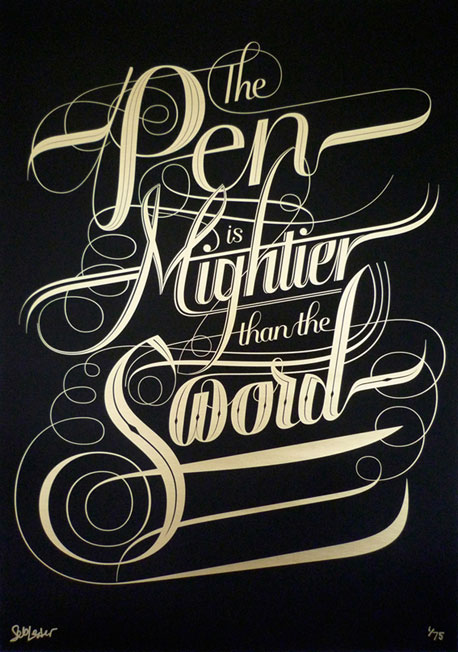
the pen is mightier

“I have never killed a man, but I have read many obituaries with great pleasure.”
— Clarence Darrow

“He has never been known to use a word that might send a reader to the dictionary.”
— William Faulkner (about Ernest Hemingway)

“Poor Faulkner. Does he really think big emotions come from big words?”
— Ernest Hemingway (about William Faulkner)

“He can compress the most words into the smallest idea of any man I know.”
— Abraham Lincoln

“I’ve had a perfectly wonderful evening. But this wasn’t it.”
— Groucho Marx

“I am enclosing two tickets to the first night of my new play; bring a friend…. if you have one.”
— George Bernard Shaw to Winston Churchill

“Cannot possibly attend first night, will attend second… if there is one.”
— Winston Churchill, in response

“He is a self-made man and worships his creator.”
— John Bright

“I’ve just learned about his illness. Let’s hope it’s nothing trivial.”
— Irvin S. Cobb

“There’s nothing wrong with you that reincarnation won’t cure.”
— Jack E. Leonard

“They never open their mouths without subtracting from the sum of human knowledge.”
— Thomas Brackett Reed

“He loves nature in spite of what it did to him.”
— Forrest Tucker

“His mother should have thrown him away and kept the stork.”
— Mae West

list via http://scumblr.tumblr.com

christia adair

Christia Adair (1920)

3395503109_2335fcbbc0

In 1920, Christia Adair took some schoolchildren to meet the train when Republican Warren G. Harding was campaigning for the presidency. After seeing him shake hands only with the white children, she became a Democrat.
***************************************
[b.1893 – d.1989]

Christia Adair was a teacher, a community leader, and a tireless activist for the rights of women and African-Americans. Born in Victoria on October 22, 1893, Adair spent her early years in Edna, then moved to Austin with her family in 1910. She attended college first at Samuel Huston (now Huston-Tillotson University) and then at Prairie View Normal and Industrial College (now Prairie View A&M.) After graduation she moved back to Edna, where she taught elementary school.

She married Elbert Adair in 1918, and they moved to Kingsville. There she opened a Sunday school, and also began her community activism. She joined a multiracial group opposed to gambling, and then became involved in the suffrage movement. At that time neither blacks nor women could vote, and anyone who knows her feminist history knows that there was some racism in the suffrage movement. Indeed, after the 19th Amendment was ratified in 1920, blacks were still turned away from the polls because of racist whites’ tactic to deter them: the white primary. Since the South was wholly Democratic at that point, the primary basically decided the election. Thus excluding African-Americans from the primary effectively disenfranchised them. Adair had this to say:

“Back in 1918 Negroes could not vote and women could not vote either. The white women were trying to help get a bill passed in the legislature where women could vote. I said to the Negro women, “I don’t know if we can use it now or not, but if there’s a chance, I want to say we helped make it. 

“We went to the polls at the white primary but could not vote…We kept after them until they finally said ‘You cannot vote because you are a Negro.'”

This was a smart strategy, because that gave them grounds to sue. And sue they did. The Adairs had moved to Houston in 1925, and Christia had become very active in the Houston chapter of the NAACP. As executive secretary, she was a driving force behind the landmark lawsuit, Smith v. Allwright, which overturned the white primary – and helped set the stage for Brown v. Board of Education.

In the Jim Crow South, these activities made Adair and her colleagues targets for racist whites. The chapter received bomb threats with alarming regularity. The Houston police were not helpful. In fact, they were a hindrance. According to Adair’s entry at the Handbook of Texas Online:

In 1957 Houston police attempted for three weeks to locate the chapter’s membership list. While the official charge was battery – the illegal solicitation of clients by attorneys – Adair believed the real purpose was to destroy the organization and its advocacy of civil rights. She testified for five hours in a three-week trial over the attempted seizure of NAACP records. Two years later, on appeal to the Supreme Court, Thurgood Marshall again won a decision for the organization. Adair never admitted having membership lists or having member’s names. In 1959 the chapter disbanded and she resigned as executive secretary, though she later helped rebuild the group’s rolls to 10,000 members.

Now that’s a hardcore sister. And she didn’t stop there. She was a lifelong leader in the Methodist Episcopal Church and a precinct judge for more than 25 years. She also helped to…

* desegregate Houston’s public buildings, city buses, and department stores
* win Blacks the right to serve on juries and be considered for county jobs
* convince newspapers to refer to blacks with the same courtesy titles used for 
whites
* desegregate the Democratic Party in Texas

Any one of her achievements is impressive. Taken together, they’re downright amazing. And folks noticed. Adair was recognized by many for her brave and principled activism. Zeta Phi Beta sorority named her Woman of the Year in 1952. In 1974 Houston NOW honored her for suffrage activism. In 1977 she was selected as one of four participants in the Black Women Oral History Project, sponsored by the Schlesinger Library at Radcliffe College. That same year the city of Houston named a park for her. And in 1984, she was named to the Texas Women’s Hall of Fame. Adair died just a few years later at the age of 96, on New Year’s Eve 1989, leaving behind her an indelible legacy of justice and equality.

Above bio from: NOW National Organization for Women
Photo and paragraph directly below photo from: 
‘The Face of Our Past: Images of Black Women from Colonial America to the Present’ edited by Kathleen Thompson and Hilary Mac Austin 

http://www.flickr.com/photos/22067139@N05/3395503109/

WOW!!!  Such an important woman.  How had I not heard of her before?  Thank you, Omega!