
Reply


I’ve heard of this song (the first published edition of which was copyrighted by Firth, Pond and Company of New York on September 2, 1858.), but never actually heard the song itself. I don’t get the feeling that this is the proudest moment in “mulatto history”, but if these are indeed the facts, it was a moment so…

BY MITCH MITCHELL
Our ancestors kept secrets.
The secrets they kept, and the secrets their parents kept from them, left holes in our histories.
Minorities helped create Texas and the nation and helped tame the West, but they barely get a mention in most history books.
On Tuesday, a group of people who can shed light on that era will gather at the Palace Arts Theater in Grapevine. Author Liz Lawless, along with amateur historians and living-history storytellers Wendell Prince and Rosieleetta Lee Reed, will attempt to fill some of those historical gaps while dressed in period costumes.
Reed specializes in stories about frontier women, like stagecoach driver Mary Fields… But if you take Reed aside and ask, she may tell you a story about Emily D. West, perhaps a hero of the Battle of San Jacinto, who was made famous by a song that historians say had nothing to do with her: The Yellow Rose of Texas.
Historians are almost certain that West was a free woman of mixed race who migrated from Connecticut to Texas. Documents place her in Galveston in the employ of Col. James Morgan in 1835, and later at the Battle of San Jacinto.
Beyond that, little is known for sure. Santa Anna’s account is that he was asleep when the Texian army attacked and could not rouse himself to stem the ensuing chaos and his army’s ultimate defeat, said Jeff Dunn, amateur historian and an expert on West. Some say they believe that Santa Anna was involved in a dalliance with West at the time of the attack and that she detained him long enough to ensure a Texas victory.
“Some argued that she was his concubine, and some argued that she was a white woman,” Reed said. “She was black. She was contraband.”
Mexican troops burned Morgan’s property in Galveston and captured West and several of Morgan’s servants days before the epic battle.
“The only reason we know this story exists is because William Bollaert wrote about it to a friend, and then tried to tell him to keep it quiet,” Dunn said. “Off to the left-hand margin he writes ‘private’ and he underlines it three times.”
Bollaert wrote the following, stating that this came from a letter written by Houston to a friend, Dunn said.
“The battle of San Jacinto was probably lost to the Mexicans, owing to the influence of a Mulatto girl [Emily] belonging to Col. Morgan who was closeted in the tent with g’l Santana, at the time the cry was made the Enemy! They come! They come! & detained Santana so long, that order could not be restored readily again.”
It was not until the 1950s, when Henderson Shuffler, another amateur historian and later a publicist for Texas A&M University, linked The Yellow Rose of Texas and West forever, according to the Handbook of Texas Online. However, historians believe that the song was written by an African-American man longing for his light-skinned sweetheart and was linked to West erroneously.
Frontier Texas was a very fluid place racially speaking, said Sam Haynes, University of Texas-Arlington history professor and the director of its Center for Southwestern Studies. Marriages between different racial groups are evident in the state’s early history, Haynes said.

Northern States had them, too. I think these things are worth examining. If we want to know more about why and how things got so out of hand in this country (I mean beyond slavery itself), we retrace our steps back to decrees such as these.
One measure of equality suggested by the British sociologist T.H. Marshall is “citizenship” – the “basic human equality associated with . . . full membership of a community.” African American history, from bondage through the civil rights movement, is often seen through the political lens as a struggle for citizenship and full membership in American society.

…[I]t shall not be lawful for any freedman, free Negro, or mulatto to
intermarry with any white person; nor for any white person to intermarry
with any freedman, free Negro, or mulatto; and any person who shall so
intermarry shall be deemed guilty of felony and, on conviction thereof,
shall be confined in the state penitentiary for life … — from
Mississippi Black Codes, enacted Nov. 22, 1865
As formerly enslaved Blacks would soon learn, freedom was not as they had
anticipated. White southerners were anxious to regain power over them and
used the law in order to achieve that objective. In 1865, southerners
created Black Codes, which served as a way to control and inhibit the
freedom of ex-slaves. Codes controlled almost all aspects of life and
prohibited Blacks from the freedoms that had been won.
Not only did whites want to control ex-slaves, but also they needed
laborers. While things could no longer be exactly the same as in slavery,
they found a way to guarantee that Blacks would serve as their laborers. To
do this, they created Black Codes. While Codes were unique to the
post-Civil War south, they encompassed some of the antebellum restrictions
on free blacks, northern apprenticeship laws, and the Freedmen’s Bureau and
the War Department regulations. Codes regulated civil and legal rights,
from marriage to the right to hold and sell property to the predestined
definition of Blacks as agricultural laborers.
Laws were different in each state but most embodied the same kinds of
restrictions. Commonly, codes compelled freedmen to work. In many states,
if unemployed, Blacks faced the potential of being arrested and charged
with vagrancy. Many of those that did work had their day regulated. Codes
dictated their hours of labor, duties, and the behavior assigned to them as
agricultural workers.
Black Codes left Blacks with little freedom. The choice of the type of work
was often regulated. Many white southerners believed Blacks were
predestined to work in agriculture. In addition, the advantage of
regulating occupations provided them with laborers. In South Carolina, for
example, a special license and certificate from a local judge, attesting to
a freedman’s skill, had to be obtained before a formerly enslaved person
could earn a living in agriculture or indomestic service.
Self-sufficiency was also discouraged. Codes prevented Blacks from raising
their own crops. In Mississippi, for instance, they were restricted from
renting or leasing any land outside of cities or towns and Black ownership
was left up to local authorities.
Almost every aspect of life was regulated, including the freedom to roam.
Often Blacks were prohibited from entering towns without permission. In
Opelousas, Louisiana Blacks needed permission from their employer to enter
the town. A note was required stating the nature and length of the visit.
Any Black found without a note after ten o’clock at night was subject to
imprisonment. Residency within towns and cities was also discouraged. Local
ordinances in Louisiana made it almost impossible for Blacks to live within
the towns or cities. Residency was only possible if a white employer agreed
to take responsibility for his employee’s conduct.
“This Week In Black History: Legislated repression in post-slavery South.” Michigan Citizen. 2001.
W. E. B. DuBois and his students included a comprehensive hand-written list of the Georgia Black Codes (laws affecting blacks 1865–1900) as part of The Georgia Negro exhibit in order to demonstrate how the law had specifically been used as a tool to discriminate against black people. Three hundred pages of legal material were tediously copied out by hand. DuBois had included a similar compilation of laws affecting the slave trade in his classic 1896 work, The Suppression of the African Slave Trade.

Sample pages from DuBois’s list of Black Codes



By Ben Austin
Ben Austin and his partner, Bill Thomasson, are adoptive parents to two former foster children, Ava and Elijah. They make their home in Sugar Land, and say they’ve been impressed by the community’s embrace.
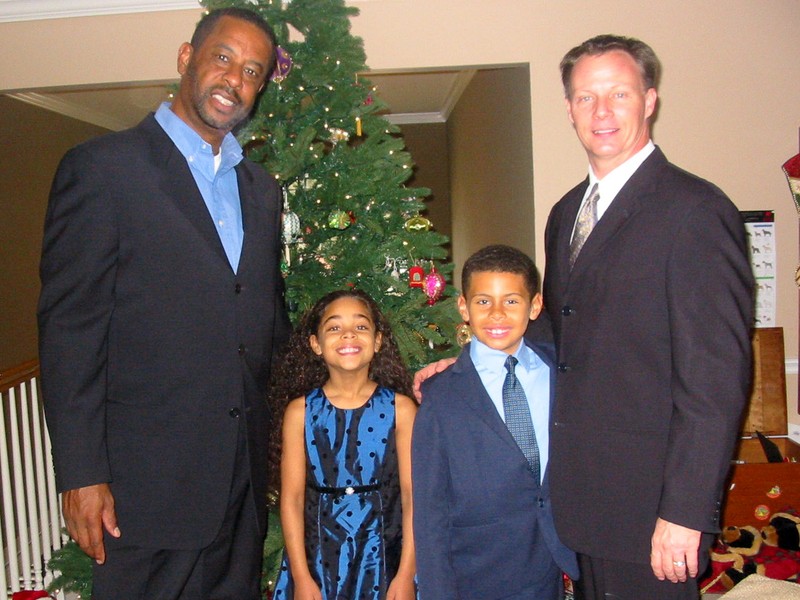
Nearly three years ago, we relocated from the Bay Area in California to my hometown of Houston. We worried if an interracial gay couple with two adopted biracial children would be faced with prejudice and intolerance. After all, the South is not known for being a bastion of acceptance. Well the jury is in, and we have come out the other side of our relocation unscathed. Since coming to Texas we have met dozens of gay and lesbian couples, even more than we knew after several years together in California.
In addition to quickly gaining friendships, we were amazed at how accepting strangers were to our family structure. When we would go to Discovery Green, the Children’s Museum, an Astros game, the Zoo, or even the dog park, we were always casting sideways glances to see if people were staring. The beauty of it was that no one seemed to see us as novel, and if they did, we didn’t see any overt behaviors. In fact, my partner was surprised at the overall friendliness of people who would just strike up conversations for no apparent reason. What’s more is that we are big on family outings, and our experience — or non-experience — has been consistent regardless of the setting.
I am so glad to be home so I can enjoy authentic Tex-Mex cuisine. However, doing such in an inhospitable environment would make staying unbearable. Here, we get to have our enchilada and eat it too.

 mulatto diaries